A Designer with Zero Coding Experience Built a Paid Mini Program in Two Weeks Using AI — Full Story
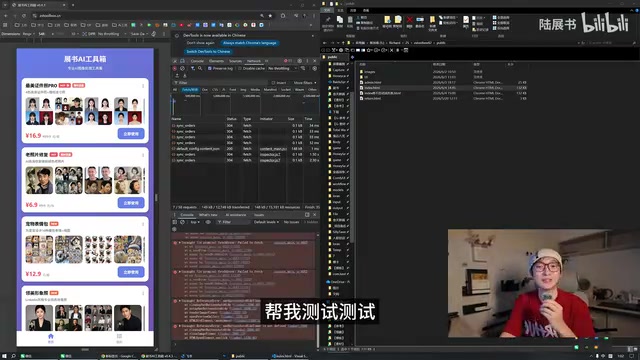
A non-coder designer built a paid WeChat mini program in two weeks using AI tools like Claude and ChatGPT.
Bilibili creator Uncle Zhan, a designer with zero programming experience, used AI tools including Claude, ChatGPT, DeepSeek, and Doubao to independently develop a paid WeChat mini program called "Uncle Zhan's AI Toolbox" in just two weeks. The app features AI-powered pet sticker generation, old photo restoration, and ID photo tools. His multi-model workflow, transparent cost breakdown, and honest reflections offer a practical blueprint for the emerging era of AI-enabled solo developers.
A Designer's AI-Powered Solo Development Experiment
What happens when a designer with absolutely no programming background decides to independently develop a paid mini program using AI tools? Bilibili creator "Uncle Zhan" answered that question in just two weeks — and yes, he actually pulled it off.
Uncle Zhan admits that he'd wanted to build a product ever since AI-assisted coding first emerged, but kept putting it off due to procrastination. It wasn't until this year, as tools like Claude, Cursor, and GPT matured, that he realized an ordinary person truly had the chance to turn an idea into a working product.
2024–2025 has been a pivotal period for the explosive growth of AI coding tools. Claude, developed by Anthropic, is a large language model renowned for its high-quality code generation and strong contextual understanding, particularly excelling at complex programming tasks. Cursor is an AI-native code editor deeply rebuilt on top of VS Code, with built-in support for multiple large models — it can automatically generate and modify code from natural language descriptions. GPT is OpenAI's flagship model series, and ChatGPT's conversational interface enables even non-technical users to collaborate with AI on programming tasks through natural language. What these three types of tools share in common is this: they no longer require users to possess a complete programming knowledge base. Instead, they've made the "describe requirements → generate code → test and debug" loop simple enough that "natural language programming" has moved from concept to practical reality.
So Uncle Zhan set himself a goal: Build a paid mini program entirely on his own, powered by AI.
The final product, called "Uncle Zhan's AI Toolbox," admittedly has a front-end interface with a "strong computer science homework vibe." But it's fully functional, has stable payment processing, and meets the basic requirements for commercial operation.
Product Features: From Pet Sticker Packs to Old Photo Restoration
The mini program currently includes four AI tools, all powered by GPT Image 1 from ByteDance's platform:
- Old Photo Restoration: Launch price of ¥6.9, later returning to ¥9.9
- Premium ID Photo
- LinkedIn Profile Photo
- Pet Sticker Pack (the flagship product)
GPT Image 1 is a native image generation model released by OpenAI in 2025. Unlike the earlier DALL·E series, it's directly integrated into GPT-4o's multimodal architecture, enabling it to generate high-quality images while understanding text semantics. The model achieved breakthroughs in several key dimensions: first, Character Consistency — maintaining a character's visual features across multiple images, which is critical for generating sticker pack series; second, text rendering — accurately embedding Chinese or English text within images, solving the notorious "garbled text" problem that plagued earlier AI image generation models. Platforms like ByteDance's Volcano Engine provide API access to this model, allowing developers to call its capabilities through standardized interfaces, billed per token or per image.
The pet sticker pack was the original inspiration for the entire project. Uncle Zhan has a cat named "Xiao Deng," and he thought: since AI image generation has gotten so powerful, why not turn photos of your own cats and dogs into a set of WeChat sticker packs?
As it happened, by May of this year, image generation models had reached a usable level in both consistency preservation and text rendering. After extensive testing, tweaking, and packaging, users now only need to upload a single pet photo to generate 16 stylistically consistent custom stickers, plus a compiled collage image.
Of course, Uncle Zhan also candidly pointed out GPT Image 1's shortcomings: there's a learning curve, output quality depends heavily on prompt quality, image resolution can degrade, and API subscription fees aren't cheap. These were all issues he had to address one by one during the product packaging process.
AI Coding Workflow: Four Models, Each with Its Own Role
For someone with zero programming experience, the most critical question is: how exactly do you use AI to write code? Uncle Zhan shared his multi-model collaboration workflow — a veritable "AI coding field manual."
Claude: The Coding Workhorse, Building from Scratch
Claude is widely recognized as the top performer in the coding domain. Uncle Zhan used Claude directly in VS Code through plugins and API access. With auto-agent permissions enabled, Claude helped him build the entire codebase from the ground up. His verdict: "Other than being expensive, there's nothing wrong with it."
ChatGPT: Project Management and Code Review
In Uncle Zhan's workflow, ChatGPT plays the role of "project manager" and "code reviewer." He used ChatGPT for overall project planning and code quality control, describing it as "very professional and rigorous."
DeepSeek: Free Code Modification Guidance
DeepSeek is what Uncle Zhan calls a "beast that defies gravity" — free and never cuts corners. DeepSeek is an open-source large language model series from the Chinese AI company DeepSeek, whose DeepSeek-V3 and DeepSeek-R1 models demonstrate excellent code comprehension and generation capabilities. Their reasoning abilities approach or even surpass some closed-source commercial models on multiple benchmarks. DeepSeek's biggest competitive advantage lies in its open-source strategy and extremely low cost — official API pricing is far below OpenAI and Anthropic, with free tiers available in some scenarios. This makes it an ideal choice for independent developers and budget-conscious entrepreneurs. Uncle Zhan used DeepSeek to guide specific code modifications — simply copying and pasting code snippets to get precise modification suggestions.
Doubao: The Emotional Support AI
As for Doubao (ByteDance's AI assistant), Uncle Zhan humorously said he mainly used it to "nurture himself" — providing emotional support during exhausting development sessions.
Uncle Zhan's core methodology boils down to this: You don't need to know how to code. You just need to describe requirements, test behaviors, print logs, then hand everything — including the code — to AI to diagnose problems and generate solutions, then pass those to Claude to execute the changes. Rinse and repeat. Payment interfaces, callback polling, authentication, lifecycle management — technical concepts he previously knew nothing about — were all taught to him step by step by AI during the process.
These technical concepts are core components of mini program development. Payment interfaces refer to the WeChat Pay API — developers need to integrate WeChat's unified order placement and payment notification interfaces to enable in-app payments, involving complex security mechanisms like encrypted signatures and certificate configuration. Callback polling is an asynchronous communication pattern — after a user initiates a payment, the server doesn't immediately know the result and must rely on callback notifications from WeChat's servers or active polling to confirm payment status. Authentication is an identity verification mechanism ensuring that only legitimate users and requests can access server resources, preventing malicious API calls. Lifecycle is a core concept in the mini program framework, referring to the complete process of a page or component from creation, display, hiding, to destruction — developers need to execute corresponding logic at different stages. These concepts are foundational knowledge for professional developers, but each one is a major hurdle for someone with zero experience. The fact that Uncle Zhan could tackle them one by one with AI assistance speaks volumes about the practical utility of today's AI coding tools.
Development Cost Breakdown: Much Lower Than Expected
Uncle Zhan openly shared the full investment for the project:
| Item | Cost |
|---|---|
| Domain name | A few dozen yuan |
| Server (one year) | ~¥1,000 |
| WeChat Mini Program certification | ¥30/year |
| AI development costs (API, subscriptions, tokens) | ~¥600–700 |
| API call usage fees | Pay-as-you-go |
Notably, the WeChat Mini Program certification fee is only ¥30/year, thanks to a major policy shift by WeChat toward individual developers starting in 2024. Previously, enabling payment functionality in a mini program typically required registering a business entity and completing corporate bank account verification — a cumbersome and costly process, with certification fees alone running ¥300/year. The new policy dramatically reduced fees and opened up payment capability applications for individual developers, meaning an ordinary person can own a payment-enabled mini program for just ¥30. This policy change, combined with the proliferation of AI coding tools, created a perfect convergence that has fueled a wave of solo developer entrepreneurship.
The overall monetary investment was much lower than expected. The biggest cost was actually time. Over the two weeks, Uncle Zhan spent nearly every evening building workflows, modifying code, finding API endpoints, testing, and fixing bugs.
The Era of Solo Developers: AI Lowers the Software Development Barrier
Uncle Zhan's experiment reflects a larger trend: AI is lowering the barrier to software development from "team-level" to "individual-level."
A designer can write code. A programmer can do design. One person can accomplish what used to require an entire team. Uncle Zhan even boldly predicts: "2026 might truly be the year ordinary people start building AI applications with their own hands."
Of course, Uncle Zhan maintains a clear-eyed perspective — the project is far from mature, likely still has many issues, and might not even recoup server costs. But he believes the real value lies in this: Ideas that used to be abandoned because the cost was too high can now be pursued, because AI has essentially eliminated the barrier.
For those who have ideas but haven't taken action yet, Uncle Zhan's advice is straightforward: just give it a try. He also promised to continue sharing project data and progress updates, so everyone can see just how far an AI-powered solo development project can go.
Final Thoughts
Uncle Zhan's story isn't a feel-good tale about "AI making it easy for everyone to make money." It's an honest, rough-around-the-edges record of solo development. The front-end isn't polished, features still need refinement, and commercial prospects are uncertain — but that's precisely what real independent development looks like.
What matters isn't how much money this mini program will make. What matters is that it proved something: an ordinary person with no programming background, armed with AI tools, can indeed turn an idea into a working, monetizable product in two weeks. Just two years ago, this would have been completely unimaginable.
As Uncle Zhan put it: "I hope AI coding advances faster than our tendency to procrastinate."
Related articles
Coze Agent in Practice: Building an AI Test Case Generation Workflow from Scratch
Learn how to build an AI test case generation agent on Coze, covering agent vs. LLM differences, workflow orchestration, model selection, and prompt engineering tips.
Anthropic's Latest Research: AI Recursive Self-Improvement Is Rapidly Approaching Human-Level Capability
Anthropic's new research reveals AI recursive self-improvement progress: Claude writes 80%+ of code, achieves 52x training speedup, and outperforms humans at 64% of research decision points.
Complete Guide to Trae's Chat Features: Four Modes for Efficient AI Programming
A detailed breakdown of Trae AI IDE's four chat modes: Sidebar Chat, Inline Chat, Image Input, and Voice Input, with shortcuts, use cases, and practical tips.