Advanced RAG Systems: Building Energy Storage Industry Agents with MCP and Skills
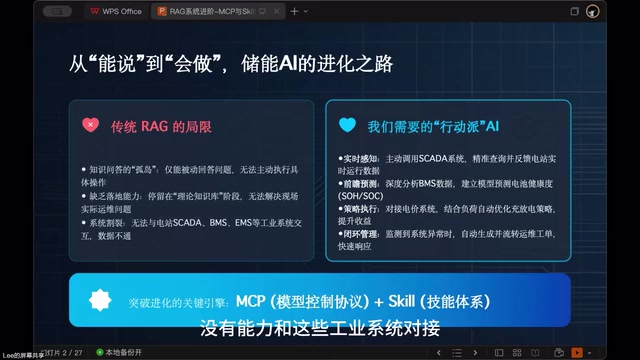
Upgrading RAG to autonomous energy storage agents using MCP protocol and Skills framework.
This article explains how to transform traditional RAG systems into autonomous AI agents for the energy storage industry using MCP (Model Context Protocol) and a Skills framework. It covers the limitations of conventional RAG in industrial settings, details MCP's six-step workflow for connecting AI to SCADA, BMS, and EMS systems, and presents three practical scenarios: intelligent O&M, energy dispatch optimization, and safety compliance with predictive maintenance.
Introduction: The Limitations of Traditional RAG in Industrial Scenarios
In the daily work of the energy storage industry, engineers face multiple independent systems every day — SCADA data acquisition systems, BMS (Battery Management Systems), EMS (Energy Management Systems), and more. In the morning, they check equipment operation data; at noon, they monitor battery SOC/SOH status; in the afternoon, they calculate peak-valley arbitrage profits; and at night, they handle maintenance work orders and write operation reports. While traditional RAG knowledge base systems can answer theoretical questions, they cannot truly connect to these industrial systems to perform actual operations.
This article is based on a livestream course targeting AI product managers in the energy storage industry on Bilibili. It provides an in-depth analysis of how to upgrade RAG systems from "can only talk" to "can take action" — transforming them into autonomous agents through MCP (Model Context Protocol) and a Skills framework.
Three Major Pain Points of Traditional RAG
The Silo Effect of Knowledge Q&A
When you tell an AI, "Help me check the operating power data of PCS inverter #1 from 10 AM to 12 PM yesterday," a traditional RAG system won't call the SCADA system. Instead, it recites the working principles of a PCS. When you say, "A battery cluster has exceeded the cell voltage threshold — generate a maintenance work order and assign it to the repair team," it can't even touch the work order system's API. It just repeats, "Voltage anomalies require inspection."
This is the fundamental limitation of traditional RAG — it can only passively retrieve pre-loaded theoretical knowledge and cannot proactively execute any real-world operations on-site. It's like a student who can only recite textbooks but can't do any actual work once they step into a power station.
Lack of On-Site Execution Capability
The core of the energy storage industry is on-site operations: battery health monitoring, charge/discharge strategy adjustments, and fault warning handling — these are all hard tasks that need to be done every day. Traditional RAG stays entirely at the theoretical level. Engineers climb into energy storage containers, stare at monitoring screens, and manually calculate peak-valley profits, while AI can only stand by and "talk empty words."
Completely Disconnected Systems
The most critical problem is that SCADA, BMS, EMS, and maintenance work order systems are all independent information silos — data doesn't flow between them, and there's no interaction. Traditional RAG has no ability to interface with these industrial systems. It can't see real-time operating status, can't access core data, and certainly can't help resolve issues.
MCP Protocol: The Bridge Between AI and the Physical World of Energy Storage
The Core Value of MCP
The essence of MCP (Model Context Protocol) is to establish a unified, universal communication standard for all systems, devices, and tools in the energy storage industry. It's like equipping all tools with a universal USB interface — regardless of the manufacturer or device type, as long as it connects to MCP, AI can easily invoke it.
If we compare an energy storage AI agent to an all-capable energy storage engineer:
- LLM (Large Language Model) = The engineer's super brain, responsible for thinking, analyzing, and making decisions
- MCP = The engineer's nervous system and limbs, responsible for transmitting brain commands and connecting to all industrial systems like SCADA, BMS, and EMS
- Skills = The professional skills the engineer has mastered — querying data, adjusting equipment, calculating profits, creating work orders
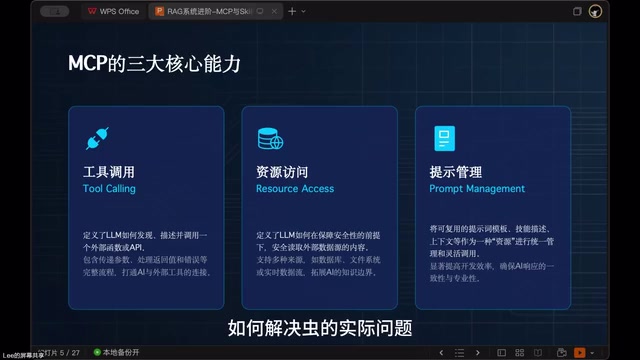
Three Core Capabilities of MCP
Tool Use: Manages how AI invokes industrial system tools such as SCADA, BMS, and EMS, enabling device operations and data queries.
Resource Access: Manages how AI securely and compliantly reads core resources such as power station databases, real-time data streams, and historical data.
Prompt Management: Manages how AI uses unified instruction templates to standardize skill invocations, ensuring responses are professional and aligned with energy storage industry terminology.
These three capabilities — from invoking tools to accessing resources to standardizing instructions — form a complete closed loop for AI-to-energy-storage-system interaction.
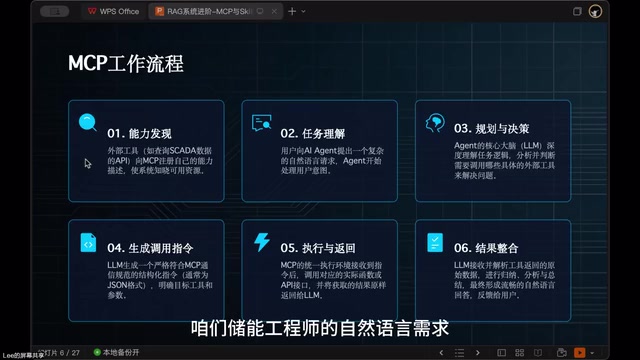
Six-Step MCP Workflow Explained
Step 1: Capability Discovery
All developed Skills (such as querying SCADA data, querying BMS data, querying real-time electricity prices, generating maintenance work orders) must first register their capability information through MCP: what skill it is, what work it can do, what input parameters it needs, and what results it returns. MCP manages these skills uniformly, forming an energy storage skill library that AI can query and invoke at any time.
Step 2: Task Understanding
AI uses the LLM to deeply parse the engineer's natural language request. For example, "Help me check the real-time SOH data of battery cluster #2" — AI identifies core elements such as device ID, data type, and time range, without requiring the engineer to learn any specialized commands.
Step 3: Planning and Decision-Making
After analyzing the request, AI queries the MCP skill library, finds the corresponding Skills, and plans the invocation sequence. For example, "Evaluate the charge/discharge efficiency of Zone B energy storage system from 2 PM to 4 PM" — AI plans: first query SCADA charge/discharge data → then query real-time electricity prices → finally calculate efficiency and revenue.
Step 4: Generating Invocation Instructions
AI generates structured instructions (e.g., in JSON format) that strictly comply with MCP communication specifications, clearly specifying which Skill to invoke, what parameters to pass, and what results are needed. The format is unified and the standards are clear — no room for errors.
Step 5: Execution and Return
Once MCP receives the standardized instructions, it immediately dispatches the corresponding Skill to execute: calling the SCADA API to query data, calling the electricity price API to get real-time prices, calling the BMS system to retrieve battery status. After execution, raw data is returned — the entire process is automated.
Step 6: Result Integration and Output
AI comprehensively analyzes data returned from multiple Skills and generates professional reports or execution recommendations that meet energy storage industry standards, forming a complete task closed loop.
Skills Framework: Encapsulating Energy Storage-Specific Capabilities
Design Principles for Skills
The essence of Skills is to transform the professional expertise that engineers manually possess into standardized functional modules that AI can learn and automatically execute. Designing a good Skill requires following these principles:
- Single Responsibility: Each Skill completes only one clearly defined task
- Standardized Input/Output: Parameter definitions are clear, and return formats are unified
- Composability: Multiple Skills can be flexibly orchestrated by AI to complete complex tasks
- Safety and Compliance: Operations involving industrial systems must have permission verification and safety boundaries
Typical Skills for Energy Storage Scenarios
- Real-Time Electricity Price Query Skill: Interfaces with grid electricity price APIs to obtain peak, valley, and flat rate data
- BMS Data Query Skill: Reads core metrics including battery SOC, SOH, voltage, and temperature
- Maintenance Work Order Generation Skill: Automatically fills in work order templates, assigns maintenance personnel, and pushes notifications
- Charge/Discharge Strategy Optimization Skill: Combines electricity price and load data to calculate optimal charge/discharge time windows
Three Practical Implementation Scenarios
Intelligent O&M Scenario
When AI detects equipment temperature exceeding thresholds, voltage anomalies, or communication interruptions, it automatically generates maintenance work orders, assigns them to maintenance personnel, and responds to faults by severity level — achieving a complete closed loop from fault detection → analysis → dispatching → resolution.
Energy Dispatch Scenario
AI interfaces with the grid electricity price system, combines real-time station load data, and automatically optimizes charge/discharge strategies — charging when it should charge, discharging when it should discharge — maximizing station revenue without engineers staying up late calculating electricity prices and adjusting parameters.
Safety and Compliance Scenario
AI deeply analyzes BMS historical and real-time data, builds battery health models, precisely predicts SOH degradation trends, and provides early warnings for high-risk faults days or even hundreds of hours in advance — transforming the approach from reactive emergency repairs to proactive prevention.
Summary and Outlook
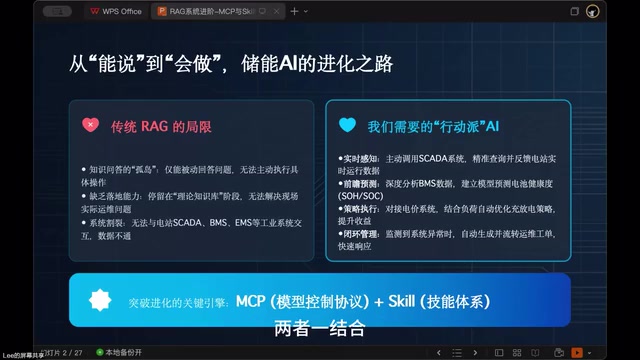
The combination of MCP and Skills fundamentally solves two core problems:
- MCP solves "can it connect": Whether AI can communicate with energy storage systems and interact with devices
- Skills solve "can it do the job": Whether AI can complete specific energy storage tasks
Together, they enable AI to transform from passive knowledge Q&A to proactive operational execution, truly entering the energy storage field. For AI product managers, understanding this architecture is the foundation for designing industrial-grade agent products — it's not simply building a knowledge base, but constructing a complete system that can perceive, decide, and execute.
This also represents the evolutionary direction of RAG systems: from pure retrieval-augmented generation toward autonomous agents deeply integrated with the physical world.
Related articles

Codex VS Claude Code: The Token Economics Behind a 10x Price Gap
Same coding task: Codex costs $15, Claude Code costs $155. Deep dive into the real reasons behind the 10x gap — it's not pricing, it's token volume, output style, and context strategy.
Gemma 4 Open-Source Model Local Deployment Guide: Ollama Installation & Mobile Setup
Step-by-step guide to deploying Google's Gemma 4 open-source model locally with Ollama and running the lightweight version on mobile with tool calling support.
The Decline of Tokenmaxxing: Why Selling Outcomes Matters More Than Selling Tokens
The Tokenmaxxing craze is fading as enterprise AI procurement shifts from chasing Token counts to focusing on actual business outcomes. Learn why outcome-based AI evaluation is the right approach.