Agent Beginner's Guide: Architecture Principles and Practical Efficiency Tips
Agent Beginner's Guide: Architecture P…
A comprehensive guide to AI Agent architecture, principles, and practical efficiency gains for engineers.
This article explains the fundamental differences between large language models and AI Agents, covering core concepts like the ReAct framework, Function Calling, memory systems (RAG), and task orchestration. It explores Agent's transformative impact on software development and testing, and provides a practical roadmap for building Agent Skills—from using existing tools to building custom Agents from scratch.
Introduction: Why Agents Are Becoming the Core Focus of AI
If the previous AI hype was centered on large models themselves, the undeniable keyword of today is Agent. From software development to security testing, from data analysis to daily office work, Agents are penetrating various work scenarios at an unprecedented pace.
Behind this trend lies a profound industry logic: 2023 was called the "Year of Large Models," while 2024-2025 is widely regarded as the "Year of Agent Deployment." Leading AI companies like OpenAI, Google, and Anthropic have all shifted their strategic focus from pure model capability improvement to Agent ecosystem building, signaling that the AI industry is moving from the "technology validation" phase into the "value creation" phase.
This article starts from the underlying principles of Agents to help you understand what an Agent is, how it fundamentally differs from traditional large models, and how to leverage Agent Skills to comprehensively boost your work efficiency.
The Fundamental Difference Between Large Models and Agents
The Capability Boundaries of Generative Large Models
The products we interact with daily—DeepSeek, Doubao, Tongyi Qianwen, etc.—all have a Generative Large Language Model at their core. The "large" refers to neural network pre-trained models obtained through training on massive datasets with hundreds of billions or even trillions of parameters, resulting in enormous model files.
From a technical architecture perspective, virtually all mainstream large language models today are based on the Transformer architecture—a revolutionary neural network structure proposed in Google's 2017 paper Attention Is All You Need. The core innovation of Transformer lies in "Self-Attention," which allows the model to simultaneously attend to information at all positions in the input when processing sequential data, rather than processing step by step like previous Recurrent Neural Networks (RNNs). This architectural breakthrough enables efficient parallel training, supporting parameter scales of hundreds of billions or even trillions. The evolution of parameter scale has been remarkably rapid: from GPT-2's 1.5 billion parameters, to GPT-3's 175 billion parameters, and continuing expansion in subsequent models, model capabilities exhibit astonishing "emergent" properties as parameter counts grow.
The "generative" aspect means the model's core capability lies in generating new content based on input—you give it a paragraph, it writes an article for you; you describe a requirement, it writes code for you. This is the essential characteristic of generative models. From a technical principle standpoint, large language models are essentially "next token predictors"—they calculate the probability distribution of each token in the vocabulary as the next output based on existing context, then select the output through sampling strategies (such as Top-K, Top-P, etc.). It's this seemingly simple mechanism of "predicting the next word" that, empowered by massive parameters and data, gives rise to astonishing language understanding and generation capabilities.
But here's the problem: After generating code, can it execute it? The answer is no. Large models are only responsible for "creating" content—whether that content can be used or executed is another matter entirely. It writes code, but that code won't run automatically; it generates an article, but won't read it aloud automatically. This is the so-called "last mile" problem—there's a gap between the model's output and actual value.
The Qualitative Leap from Large Models to Agents
This is precisely the fundamental reason Agents were born. The core architecture of an Agent can be summarized as:
Agent = Large Model (LLM) + Tools + Memory + Task Scheduling
The large model provides the "brain"—the ability to think and generate; while tools give it "hands and feet"—the ability to execute and perceive. For example:
- A large model generates a novel → A voice tool can read it aloud
- A large model generates code → A code execution tool can run it directly
From a technical implementation perspective, the key mechanism enabling the Agent's "think-act" loop is the ReAct framework (Reasoning + Acting). Proposed by researchers from Princeton and Google in 2022, its core idea is to have the large model alternate between "reasoning" (Thought) and "acting" (Action) steps before generating the final answer. Specifically, the model first thinks about what it should do, then calls the corresponding tool to execute the operation, observes the execution result (Observation), and continues thinking about the next action based on the result, cycling until the task is complete. The technical foundation for tool invocation is the Function Calling mechanism—the model learns during training to recognize when external tools need to be called and outputs tool names and parameters in structured JSON format, which external systems parse and execute.
This means AI is no longer just a "chat companion" but an assistant that can actually do concrete things for you.
Academic Definition and Core Capability Analysis of Agents
Why "Intelligent Agent" Rather Than "Proxy"
The literal translation of the English word "Agent" is "proxy" or "representative," but in the field of artificial intelligence, we translate it as "intelligent agent" (智能体 in Chinese), and this is far from arbitrary. From an academic perspective, the complete definition of an Agent is:
An intelligent entity capable of perceiving the external environment, autonomously planning and executing tasks until completion.
It's worth noting that the concept of "intelligent agents" is not new to AI. As early as the 1990s, distributed artificial intelligence and Multi-Agent Systems (MAS) were already active research areas. Agents at that time relied more on rule engines and finite state machines for decision-making, with relatively limited capabilities. The reason today's AI Agents are generating such enormous attention is fundamentally because large language models provide Agents with unprecedented "general intelligence"—they no longer need hand-crafted rules for each scenario but achieve truly "autonomous planning" through natural language understanding and reasoning capabilities.
This definition contains several key elements:
- Perception: The ability to acquire and understand information from the external environment
- Autonomous Planning: Not mechanically executing instructions, but independently thinking and formulating plans
- Task Execution: Having actual operational capabilities, not just theorizing
- Goal Orientation: Continuously working until the task is complete, with the ability to judge success or failure
The word "proxy" alone is far from capturing its true value and appeal. It's not a simple middleware layer but an intelligent entity full of wisdom, capable of independently completing complex tasks.
The Complete Capability Stack of an Agent
Beyond the two core components of large models and tools, a qualified Agent also needs:
- Memory: The ability to remember context and historical interactions, maintaining conversation coherence and task continuity
The memory mechanism is the key capability that distinguishes Agents from simple "one-question-one-answer" patterns. Technically, Agent memory is typically divided into two levels: Working Memory (Short-term) and Long-term Memory. Short-term memory corresponds to the current conversation's context window, limited by the model's maximum token count (e.g., GPT-4's 128K, Claude's 200K, etc.); while long-term memory requires external storage. The most mainstream long-term memory solution currently is RAG (Retrieval-Augmented Generation) technology based on vector databases (such as Pinecone, Milvus, Chroma, etc.)—converting historical interactions and knowledge documents into high-dimensional vectors for storage, retrieving relevant information through semantic similarity when needed, and injecting it into the current prompt. This enables Agents to "remember" interactions from days or even months ago, achieving true long-term collaboration.
- Task Scheduling and Orchestration: The ability to decompose complex tasks into subtasks and arrange execution order appropriately
The technical implementation of task scheduling involves multiple strategies. The most basic is Chain calling—decomposing tasks into a linear sequence of steps executed in order; advanced approaches include DAG (Directed Acyclic Graph) orchestration—identifying dependencies between subtasks and allowing independent tasks to execute in parallel for improved efficiency; more complex scenarios require dynamic planning—where the Agent adjusts subsequent plans in real-time based on intermediate results during execution. This is also why Multi-Agent architectures are emerging: by having multiple specialized Agents collaborate with division of labor, complex tasks can be completed more efficiently.
- Ethics and Safety Mechanisms: Ensuring AI behavior stays within safe and ethical boundaries
For engineering practitioners, memory and task scheduling are capabilities that deserve focused attention; while the ethics and safety layer is equally important, it's more of a problem to be solved at the platform and framework level.
Agent's Profound Impact on Software Engineering
The Revolution in Development Has Already Happened
If you have colleagues or friends in development, you've certainly already felt this wave. A large number of developers are using Agents to automatically write code and complete feature development. This isn't a future vision—it's reality happening right now.
AI coding Agents represented by Cursor, GitHub Copilot Workspace, Devin, and others have demonstrated astonishing capabilities. They can not only generate code from natural language descriptions but also understand project context, automatically debug errors, write test cases, and even independently complete the entire development workflow from requirements analysis to code submission. According to GitHub's official data, developers using Copilot see an average 55% increase in coding speed, and more advanced Agent tools are pushing this number even higher.
In the security testing field, this transformation is even more "terrifying"—reportedly, within just one week, two top-level P0 vulnerabilities appeared consecutively in the Linux system, and AI's capabilities in security offense and defense are growing exponentially.
The technical principles behind this are worth understanding deeply. Traditional vulnerability discovery primarily relies on Fuzzing and Symbolic Execution techniques, which are effective but limited in efficiency, often requiring massive computational resources and time. The introduction of AI Agents brings a qualitative leap: large models can understand code's semantic logic, identify potentially dangerous patterns (such as buffer overflows, race conditions, privilege escalation, etc.), then automatically construct attack payloads through tools and verify vulnerability exploitability. Even more alarming is that AI Agents can fully automate these steps—from code auditing, vulnerability discovery to PoC (Proof of Concept) writing, forming a complete automated attack chain. This is why the security field is both excited and cautious about Agent technology.
Software Testing Cannot Stand Apart
Software testing and software development are the two pillars of software engineering. When the development side undergoes a qualitative change due to Agent intervention, the entire software engineering paradigm shifts accordingly, and the testing field cannot remain unchanged.
Specifically in API testing scenarios, the traditional approach requires manually writing test cases, configuring request parameters, and verifying return results. Through the Agent approach, we can:
- Have AI understand API documentation and automatically generate test cases
- Automatically send requests and verify results through tools
- Intelligently determine whether tests pass and automatically generate test reports
This isn't limited to API testing—Web testing, APP testing, and even security testing are all experiencing new possibilities empowered by Agents. In Web UI testing, Agents can directly manipulate page elements through browser automation tools (like Playwright, Selenium), combined with visual understanding capabilities to judge whether page rendering is correct; in APP testing, Agents can control mobile devices through tools like ADB, simulate user operation paths, and automatically discover abnormal behavior. The role of test engineers is transforming from "manual executors" to "Agent orchestrators."
How to Start Building Your Agent Skills
Setting Up an AI Testing Environment
To start using Agents for actual work, you first need to set up an AI-based testing environment. The core of this environment consists of two parts:
- Choose an appropriate large model: Serving as the Agent's "brain," responsible for understanding requirements and generating solutions
- Configure a toolset (Tools): Serving as the Agent's "hands and feet," responsible for executing specific operations
It's important to note that we cannot directly use DeepSeek's website or Doubao's APP to perform API testing. While these consumer-grade products run powerful models internally, they lack the tool chains needed to execute specific tasks. What we need is a complete Agent framework that organically combines model capabilities with tool capabilities.
Current mainstream Agent development frameworks each have their own characteristics: LangChain is the earliest and has the richest ecosystem, providing a complete toolchain from model invocation, tool integration to memory management, suitable for rapid prototyping; AutoGPT was the first autonomous Agent project to attract public attention, demonstrating the possibility of Agents autonomously looping through task execution; MetaGPT focuses on multi-Agent collaboration scenarios, simulating a software company's organizational structure (product manager, architect, engineer roles, etc.) to achieve automated development of complex software projects; CrewAI provides a more lightweight multi-Agent orchestration solution; while platforms like Dify and Coze offer low-code/no-code Agent building experiences, lowering the entry barrier. Which framework to choose depends on your specific needs: for personal learning and simple scenarios, Coze or Dify are sufficient; for deep customization and complex orchestration, LangChain or CrewAI are more appropriate.
The Progression Path from "Using" to "Building"
The learning path for mastering Agent Skills can be divided into three stages:
- Using: Understanding basic Agent concepts and being able to use ready-made Agent tools to complete daily tasks
- Tuning: Being able to adjust and optimize Agent configurations and prompts according to your work scenarios
- Building: Being able to design and build Agent Skills suitable for specific business scenarios from scratch
In the "Tuning" stage, Prompt Engineering is the core skill. A good System Prompt can significantly influence Agent behavior quality. Key techniques include: clear role definition, providing clear task boundaries, specifying output format requirements, and setting exception handling strategies. In the "Building" stage, you need to master engineering capabilities such as Tool Schema definition, execution flow orchestration, error retry mechanisms, and result validation logic. This is a transformation process from "AI user" to "AI system builder."
Conclusion: Embrace Agents and Master the Core Competitiveness of the AI Era
Agents represent AI's fundamental leap from "being able to chat" to "being able to do things." They have both a brain (the large model's thinking and generation capabilities) and hands and feet (tools' execution and perception capabilities), plus memory and planning abilities. For every technology practitioner, understanding and mastering Agents is no longer optional—it's mandatory.
From a broader perspective, the maturation of Agent technology is giving rise to an entirely new paradigm of human-machine collaboration. The future work model will likely be: humans define goals, set constraints, and review results, while Agents plan paths, execute operations, and handle details. This isn't a story of "humans being replaced" but a story of "humans being liberated"—freed from repetitive execution work to focus on higher-level creative thinking and decision-making.
Whether you're a development engineer, test engineer, or in any other technical role, now is the best time to embrace Agents and boost your work efficiency. Rather than worrying about being replaced by AI, proactively learn how to harness AI and make it your most powerful work partner.
Related articles
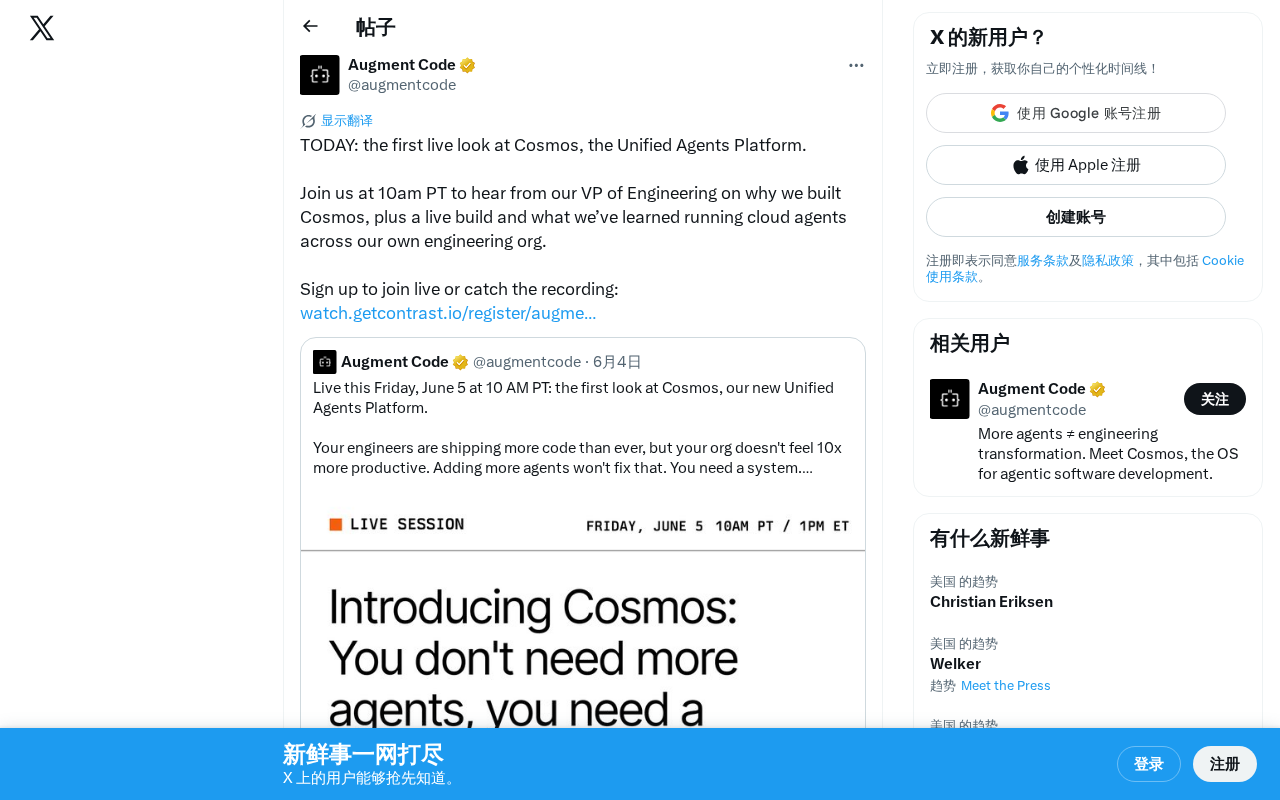
Cosmos Unified Agents Platform First Live Demo: A Platform-Level Solution for Multi-Agent Collaboration
Cosmos Unified Agents Platform gives its first live demo, detailing its design philosophy and cloud agent operations. Learn how it solves AI Agent fragmentation with unified multi-agent building, deployment, and management.
Google CEO Pichai Admits AI Coding Gap…
Google CEO Pichai Admits AI Coding Gap, Details Catch-Up Strategy and AGI Outlook
Google CEO Sundar Pichai admits Google lags in AI coding, details its catch-up strategy involving data flywheels, addresses Gemini controversies, and shares his evolving views on AGI.
Google CEO Admits Gemini Lags in Codin…
Google CEO Admits Gemini Lags in Coding: Lacking an Entry Point Is Just the Surface — What's the Real Problem?
Google CEO Pichai admits Gemini lags behind Cursor and Claude Code in AI coding, blaming lack of product entry points. But the real issues are failed product experience, lost developer trust, and ecosystem advantages that haven't converted to competitiveness.