Cosmos Unified Agents Platform First Live Demo: A Platform-Level Solution for Multi-Agent Collaboration
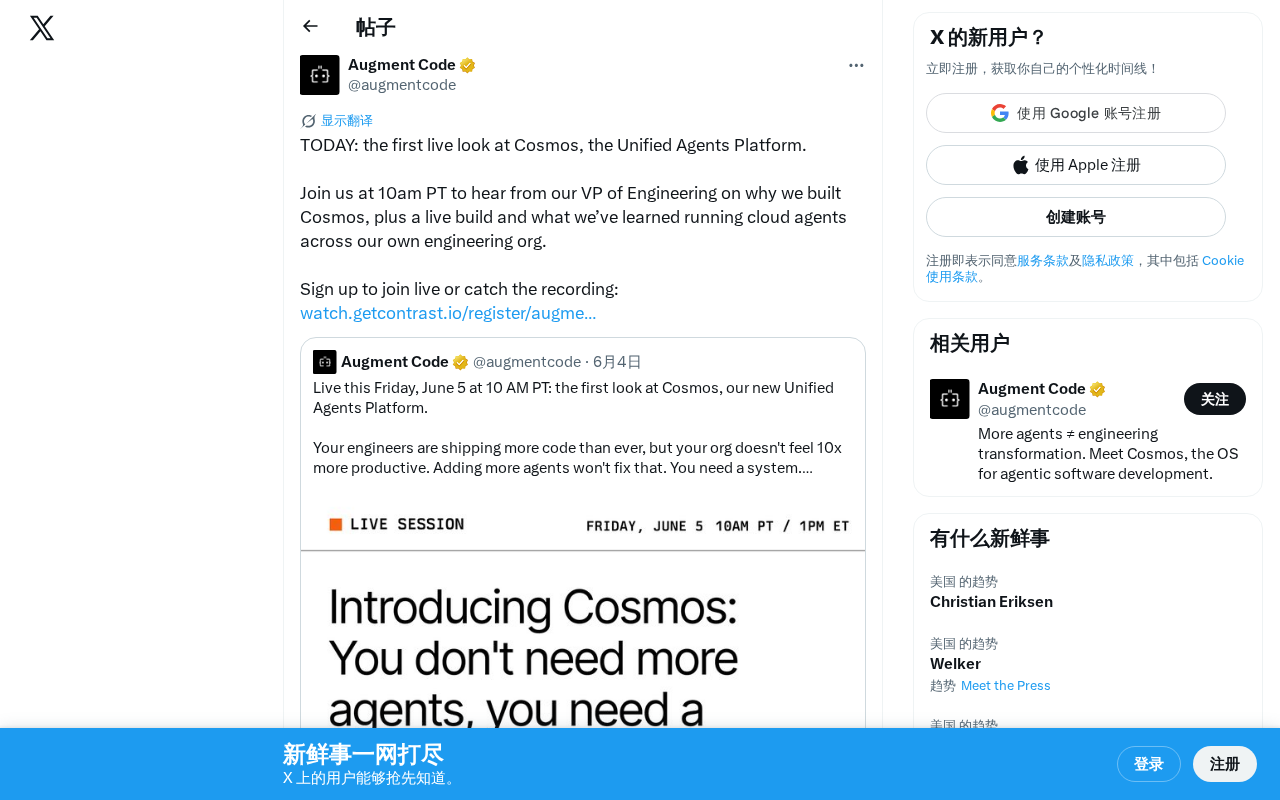
Cosmos debuts as a unified platform for building, deploying, and managing multi-agent AI systems.
Cosmos, a new Unified Agents Platform, gave its first public live demonstration showcasing its approach to solving AI agent fragmentation. The platform enables enterprises to build, deploy, and manage multiple AI agents under a single framework, addressing challenges in reliability, observability, security, and cost management. Validated through internal dogfooding, Cosmos reflects the industry's shift from single-agent experiments to production-grade multi-agent collaboration.
Cosmos Unified Agents Platform First Live Demo
Recently, a platform called Cosmos — billed as a "Unified Agents Platform" — gave its first public live demonstration. The platform's VP of Engineering personally presented Cosmos's design philosophy, development process, and the practical experience the team has accumulated from running Cloud Agents within their own engineering organization.
What Is a Unified Agents Platform?
Judging from its name and positioning, Cosmos aims to solve a core pain point in the current AI agent landscape: fragmentation. As various AI Agents rapidly emerge, enterprises face enormous challenges in managing multiple independent agents, coordinating different workflows, and unifying monitoring and governance.
The fragmentation of today's AI agent ecosystem manifests at multiple levels: different agents use different LLM backends (such as GPT-4, Claude, Gemini, etc.), adopt different orchestration frameworks (such as LangChain, AutoGen, CrewAI, etc.), rely on different tool-calling protocols (such as OpenAI Function Calling, Anthropic Tool Use, etc.), and each handles memory management, state persistence, and error recovery in its own way. This fragmentation means that enterprises deploying multiple agents face high integration costs and exponentially growing operational complexity.
The "Unified Agents Platform" positioning indicates that Cosmos aims to provide a centralized platform where developers and enterprises can build, deploy, and manage multiple AI agents under a unified framework. The core value of a unified platform lies in providing a standardized abstraction layer that shields users from underlying differences, allowing enterprises to focus on business logic rather than infrastructure. This platform-oriented approach aligns closely with the industry's current evolution from "single Agent" to "multi-Agent collaboration."
The evolution from single Agent to multi-Agent collaboration reflects the trend of AI system architecture moving from monolithic applications toward microservices. In multi-Agent architectures, different agents take on specialized roles (such as planning Agent, execution Agent, validation Agent) and collaborate through message passing or shared state. Representative research in this area includes Stanford's Generative Agents, Microsoft's AutoGen framework, and the recently emerging Agent-to-Agent (A2A) protocol. The core challenge of multi-Agent systems lies in coordination mechanism design: how to allocate tasks, how to resolve conflicts, and how to establish trust and permission boundaries between Agents — which is precisely the core problem a unified platform needs to solve.
From Internal Practice to External Product: Cosmos's Validation Path
A noteworthy detail emphasized by the Cosmos team is that they have already been running cloud agents within their own engineering organization, accumulating substantial real-world experience in the process. This "dogfooding" approach is considered an important indicator of product maturity in technology product development.
For AI agent products, dogfooding carries far greater significance than for traditional software. Traditional software behaves deterministically, while AI agents exhibit non-deterministic behavior, emergent properties, and potential security risks. Running agents within an internal engineering organization means the team must directly confront challenges such as hallucination problems in real environments, permission boundary violations, and error accumulation in long-chain reasoning. This first-hand experience is crucial for designing robust platform-level products, as it reveals edge cases and systemic risks that are difficult to reproduce in laboratory settings.
This means Cosmos is not a purely conceptual product but rather a practical tool validated through internal use. The problems encountered and best practices identified in real engineering scenarios are directly reflected in the platform's design decisions.
Industry Trends: Why We Need a Unified Agents Platform
Agent Platformization Is Becoming a New Track
AI agents are rapidly moving from proof-of-concept to production deployment. However, individual agents have limited capabilities, and what enterprises truly need is infrastructure capable of coordinating multiple specialized agents. Cosmos's emergence is a direct response to this demand.
Operational Challenges Facing Cloud Agents
Running AI agents in the cloud presents numerous challenges:
- Reliability: How to ensure agents remain stable during long-running operations
- Observability: How to monitor agent behavior and decision-making processes
- Security: How to control agent permission boundaries
- Cost Management: How to optimize computing resource utilization
AI agent observability is far more complex than traditional cloud services. Beyond conventional logs, metrics, and distributed tracing, agent observability must also cover: complete reasoning chain records (every step of the thinking process), input/output auditing of tool calls, fine-grained monitoring of token consumption and latency, and evaluation metrics for decision quality. Emerging industry practices include using OpenTelemetry extensions to trace LLM calls, building specialized Agent evaluation frameworks (such as LangSmith, Braintrust, etc.), and developing cost attribution systems for AI workloads. These constitute an indispensable infrastructure layer for running production-grade agents.
The experience accumulated by the Cosmos team through internal practice likely encompasses solutions to these core problems.
Summary
The public debut of the Cosmos Unified Agents Platform signals that the AI Agent field is transitioning from an exploratory "let a hundred flowers bloom" phase into a mature stage requiring systematic management and orchestration. For enterprises currently evaluating AI agent deployment strategies, unified platforms like this could become critical infrastructure for reducing complexity and accelerating implementation. Its specific feature set and openness strategy are worth continued attention going forward.
Related articles
Agent Beginner's Guide: Architecture P…
Agent Beginner's Guide: Architecture Principles and Practical Efficiency Tips
A deep dive into AI Agent principles, core architecture, and practical applications. Learn how Agents differ from LLMs and how to leverage Agent Skills to boost productivity.
Google CEO Pichai Admits AI Coding Gap…
Google CEO Pichai Admits AI Coding Gap, Details Catch-Up Strategy and AGI Outlook
Google CEO Sundar Pichai admits Google lags in AI coding, details its catch-up strategy involving data flywheels, addresses Gemini controversies, and shares his evolving views on AGI.
Google CEO Admits Gemini Lags in Codin…
Google CEO Admits Gemini Lags in Coding: Lacking an Entry Point Is Just the Surface — What's the Real Problem?
Google CEO Pichai admits Gemini lags behind Cursor and Claude Code in AI coding, blaming lack of product entry points. But the real issues are failed product experience, lost developer trust, and ecosystem advantages that haven't converted to competitiveness.