Google CEO Admits Gemini Lags in Coding: Lacking an Entry Point Is Just the Surface — What's the Real Problem?
Google CEO Admits Gemini Lags in Codin…
Google CEO admits Gemini's coding lag isn't about missing entry points — it's about broken trust and poor product execution.
Google CEO Sundar Pichai admitted Gemini has fallen behind Cursor and Claude Code in AI coding, attributing it to lacking a direct developer entry point. However, deeper analysis reveals the real problems: Android Studio's disastrous launch drove developers away with opaque quotas and crashes, internal metrics don't reflect real-world usage, and Google's massive ecosystem advantages haven't translated into product experience. The core issue is lost developer trust that no amount of resources can quickly rebuild.
Google CEO's Rare Admission
Google CEO Sundar Pichai recently admitted in an interview that Gemini has indeed fallen behind in agentic coding, instruction following, and long-cycle tasks. This isn't a polite platitude — it's the world's wealthiest AI company officially acknowledging it has fallen behind in the most important AI application track.
Facing the reality of Cursor's 4 million weekly active users and Claude Code capturing 46% of developer votes for most-loved tool, the tech giant's leader offered a seemingly reasonable explanation: Google lacks a product entry point that reaches developers directly, like Cursor or Claude Code.
Does the "Lacking an Entry Point" Explanation Hold Up?
Pichai's logic is this: improving AI coding capabilities doesn't rely on lab benchmarks, but on the data flywheel generated by real developers repeatedly using real codebases. Cursor and Claude Code have massive active user bases, with data continuously feeding back into model iterations. No matter how capable Gemini is, without a high-frequency usage entry point, data can't flow in, and the model can't iterate.
The "Data Flywheel" is a core growth mechanism in AI products: users use the product → generate behavioral data → data is used for model fine-tuning and RLHF (Reinforcement Learning from Human Feedback) → model capabilities improve → attract more users. This cycle is especially critical in AI coding tools because code generation quality is highly dependent on understanding real codebase structures, programming habits, and error patterns. Cursor's 4 million weekly active users means millions of code completions, modifications, and accept/reject signals — these signals directly tell the model what kind of code suggestions are good. This scale of real-time feedback is impossible to simulate in any lab environment.
This explanation is internally consistent, but doesn't hold up under scrutiny.
It's Not That They Didn't Build an Entry Point — They Drove Developers Away
Google pushed its first-generation Android Studio IDE to the public market as early as last November. However, what followed was nothing short of a disaster:
- Locked-down quotas: Users were strictly limited in usage
- Frequent server overloads and crashes: Basic experience couldn't even be guaranteed
- Restricted third-party open-source API access: A closed ecosystem
A string of operational failures exhausted early developers' trust. After the 2.0 version launched in May, the quota confusion actually got worse — users had no idea how much quota a single Agent task would consume.
The quota problem in AI coding tools is a universal pain point across the industry. Because large model inference costs are high (a GPT-4-level model might consume several dollars of compute for a single complex task), vendors must control costs through quota limits. But for developers, coding is continuous work — an Agent task might require dozens of model calls to complete, and if the quota runs out mid-task, the entire workflow breaks. Cursor uses a monthly subscription + transparent request counting model, Claude Code charges by token with real-time consumption display, while Google Android Studio's problem was opaque quota rules and unpredictable consumption, which directly undermined developers' basic expectations of tool reliability.
The real problem isn't lacking an entry point — it's that the entry point was poorly executed, actually driving people away.
The False Prosperity of Internal Data
During the interview, Pichai presented two sets of internal data to prove the technical foundation is solid:
- Internal token consumption doubles every week
- In internal testing, an operating system was built from scratch in 12 hours
But no matter how impressive internal data looks, it doesn't mean external developers are buying in. An Agent that runs smoothly inside Google might not even have enough quota to complete a single full task on an ordinary developer's machine. Internal engineers have unlimited resources and comprehensive infrastructure support — "success cases" in this environment are nearly impossible to replicate in real user scenarios.
This represents a classic "lab vs. reality" gap. Google's internal engineers use low-latency channels directly connected to TPU clusters, have virtually unlimited inference quotas, and their codebases are Google's highly standardized internal monorepo (single code repository). External developers face public network latency, limited quotas, and wildly varying project structures and dependency environments. Using internal metrics to argue product readiness is essentially survivorship bias.
Android Studio 2.0: A Do-or-Die Strategic Pivot
Last week's IDE 2.0 release represents Google's strategic pivot:
- 1.0 era: Traditional IDE with AI assistance — developers enter the code window first, then ask AI for help
- 2.0 era: Project list on the left, conversation area on the right, code editor no longer the visual center — start with a conversation, then let AI take over the task
This design increasingly resembles the philosophy of Claude Code and Codex — Agent First, conversation-driven.
Agent First is the core design paradigm shift in AI coding tools during 2024-2025. Traditional AI-assisted coding (Copilot mode) has humans writing code and AI completing it; in Agent mode, developers describe intent, and AI autonomously plans execution steps, reads/writes files, runs tests, fixes errors, forming a complete task loop. Its technical foundation is large models' long-context understanding capability (supporting codebase indexing of hundreds of thousands of tokens), Tool Use capability, and multi-step reasoning ability. The risk of this mode is: if AI makes an error in intermediate steps that's unobservable, it could contaminate the codebase on a large scale.
But the problem is: jumping to black-box Agent orchestration before establishing user trust is extremely risky. Developers need sufficient confidence in a tool before they dare hand over critical tasks to AI for full autonomous handling. The reason Cursor and Claude Code can take this step is that they've already earned user trust through long-term stable experiences — Cursor gradually upgraded from initial code completion to multi-file editing to full Agent mode, with each step letting users personally verify AI's reliability. This progressive trust-building cannot be skipped.
Why Haven't Ecosystem Advantages Translated into Competitiveness?
Google's resource inventory is enviable: Gemini models, TPU compute, Google Cloud infrastructure, Android ecosystem, YouTube suite. But in the AI coding track, these advantages have barely translated into product experience.
Google's proprietary TPU (Tensor Processing Unit) is one of the world's most powerful AI training and inference chips, with the fifth-generation TPU Trillium delivering 4x performance improvement over the previous generation. Theoretically, this means Google can provide faster model inference services at lower cost. But converting compute advantages into product advantages requires a critical middle layer — product engineering capability. Fast model inference speed doesn't equal good user experience; in between lies a massive amount of engineering detail including context management, code indexing, incremental editing, and error recovery. This is precisely why small teams with extreme product polish can defeat resource-unlimited giants — at the AI application layer, engineering taste matters more than compute scale.
Look at competitors' paths:
- Claude Code: Initially even more bare-bones than Google's product — just a terminal tool with no fancy interface. But it embedded itself in developers' most familiar command line, codebases, and local workflows, crossing the threshold between "demo" and "daily use" earlier. Claude Code's design philosophy is "minimal interface, maximum capability" — no need to learn a new IDE, no need to change work habits, just call it directly in your existing terminal. This respect for developer workflows is itself a form of product competitiveness.
- Cursor: Deeply embedded in the VS Code ecosystem, allowing developers to migrate at nearly zero cost, retaining users with immediate value. VS Code currently holds approximately 70% of the global IDE market share with over 40,000 extension plugins. Cursor is essentially a fork of VS Code, preserving all keyboard shortcuts, extension compatibility, and interface layout — developers migrating from VS Code to Cursor have virtually no learning curve. By contrast, Android Studio is based on JetBrains' IntelliJ platform, primarily serving Android/Kotlin developers, with a naturally limited user base. And once developers have configured their entire work environment in Cursor, the psychological and practical cost of switching to another IDE is very high.
The core difference: Cursor and Claude Code were solving developers' real pain points from day one, while Google was trying to showcase the power of its technology.
How Long Is the Window for Catching Up?
Pichai said that changes happening in the past 30 to 60 days would have taken 5 years in the past. From I/O stuffing AI into virtually every product line, to the CEO personally admitting coding has fallen behind, to the emergency 2.0 pivot — Google is catching up in a somewhat undignified manner.
But the prerequisite for catching up is: developers are still willing to give you a chance.
If the following issues aren't resolved quickly, then "closing the global developer feedback loop" is just a pretty vision:
- Quota system transparency
- Learning cost of interface interactions
- Stability of model responses
- Openness toward third-party ecosystems
Developers won't wait for you to get ready — they'll just use the next tool that works well. In the AI coding track, technical strength can't overcome user habits, and ecosystem scale can't beat product experience. Google's biggest opponent may not be Anthropic or Cursor, but the developer trust that has already been lost.
Historically, cases of tech giants being disrupted by smaller companies in new paradigms are numerous — Microsoft missing mobile internet, IBM missing cloud computing, Nokia missing smartphones. The common pattern in these failures is: the company with the most resources, due to organizational inertia and protection of existing businesses, cannot polish a single product with the speed and focus of a startup. Google faces the same structural challenge in the AI coding track: it needs to simultaneously serve AI demands across Search, Cloud, Android, YouTube, and other business lines, while Cursor and Anthropic can focus all their energy on the single matter of developer experience.
Key Takeaways
Related articles
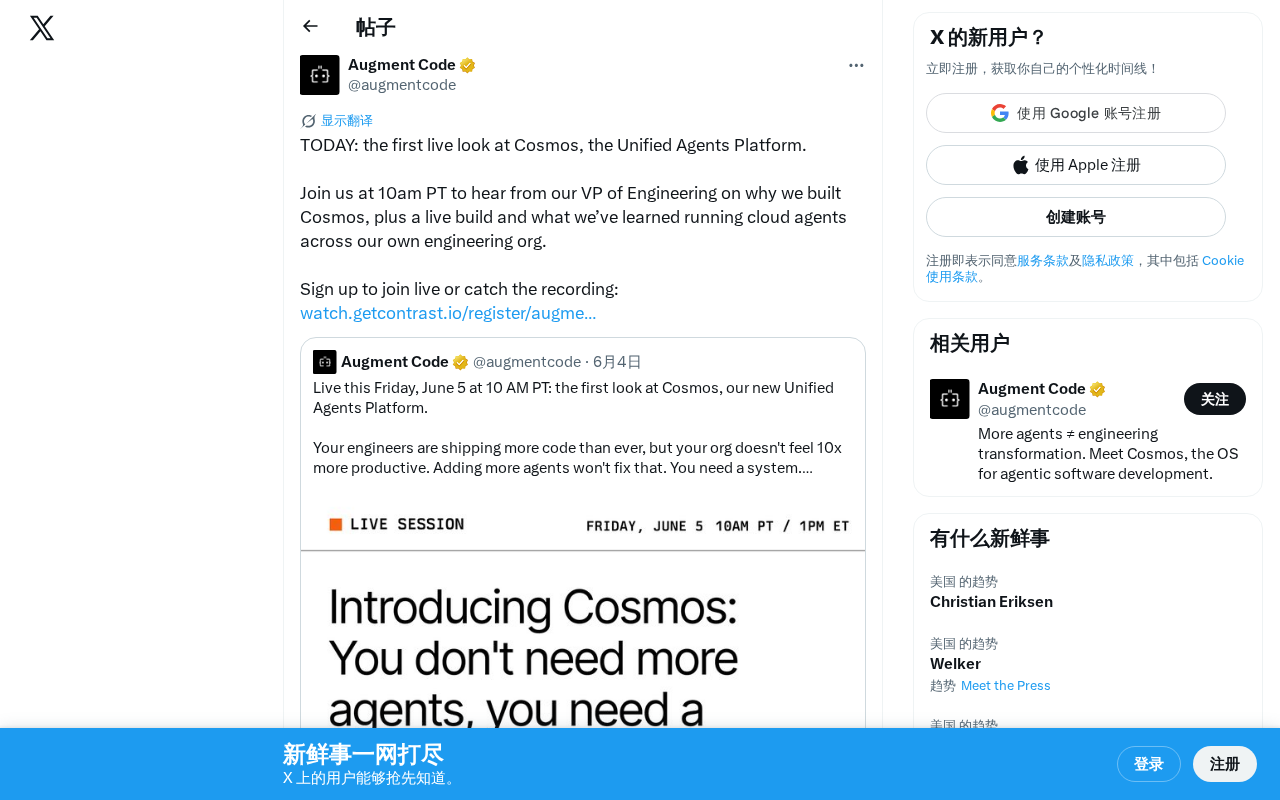
Cosmos Unified Agents Platform First Live Demo: A Platform-Level Solution for Multi-Agent Collaboration
Cosmos Unified Agents Platform gives its first live demo, detailing its design philosophy and cloud agent operations. Learn how it solves AI Agent fragmentation with unified multi-agent building, deployment, and management.
Agent Beginner's Guide: Architecture P…
Agent Beginner's Guide: Architecture Principles and Practical Efficiency Tips
A deep dive into AI Agent principles, core architecture, and practical applications. Learn how Agents differ from LLMs and how to leverage Agent Skills to boost productivity.
Google CEO Pichai Admits AI Coding Gap…
Google CEO Pichai Admits AI Coding Gap, Details Catch-Up Strategy and AGI Outlook
Google CEO Sundar Pichai admits Google lags in AI coding, details its catch-up strategy involving data flywheels, addresses Gemini controversies, and shares his evolving views on AGI.