Google CEO Pichai Admits AI Coding Gap, Details Catch-Up Strategy and AGI Outlook
Google CEO Pichai Admits AI Coding Gap…
Google CEO Pichai admits AI coding gap, details catch-up plans and shares AGI outlook.
In a candid Hard Fork podcast interview, Google CEO Sundar Pichai acknowledged Google trails competitors in agentic coding due to lacking data flywheel advantages like Anthropic's Cursor partnership. He addressed Gemini 2.5 Flash launch controversies, revealed internal AI usage doubles weekly, discussed Google Search's AI transformation, responded thoughtfully to public AI anxiety, and signaled a clearer stance that AGI is approaching—while emphasizing the need for societal coordination to avoid dangerous race conditions.
In the latest episode of the Hard Fork podcast, Google CEO Sundar Pichai made a rare public admission that Google is temporarily behind competitors in AI coding, while sharing his deep thoughts on AGI, AI search transformation, and public anxiety. This candid conversation reveals the tech giant's true position in the AI race.
Admitting the Gap: AI Coding Is Google's Biggest Weakness Right Now
In the interview, Pichai was refreshingly blunt about Google not leading across all AI domains. He drew a clear line dividing Google's AI capabilities: in text generation, multimodality, voice/audio processing, reasoning, and overall intelligence, Google performs very well; but in agentic coding, tool use, instruction following, and long-horizon tasks, Google is "currently a bit behind."
Agentic coding represents the most important paradigm shift in AI programming during 2024-2025. Unlike traditional code completion or single-shot generation, agentic coding refers to AI systems that can work like autonomous software engineers—understanding requirements, making plans, writing code, running tests, finding bugs, and fixing them independently, with the entire process potentially lasting tens of minutes or even hours. This mode requires models to have long-term planning capabilities, tool-calling abilities (such as operating terminals, reading/writing files, running debuggers), and the ability to navigate complex codebases. Products like Cursor, Devin, and Claude Code represent this direction.
He specifically noted that a key reason for falling behind in coding is data flow acquisition. Anthropic has gained substantial real-world coding feedback data through its partnership with Cursor, while Google lacks a similar mature data pipeline. "Getting data flow is crucial in coding, and we probably don't have enough reach in that area," Pichai admitted.
This involves the classic data flywheel effect in AI. When Anthropic's Claude model is used daily by millions of developers through Cursor, every user acceptance, rejection, and modification constitutes valuable human feedback signals. These signals, once processed, can be used for RLHF (Reinforcement Learning from Human Feedback) training, enabling continuous model improvement in real coding scenarios. The improved model attracts more users, generates more data, and creates a positive feedback loop. This is why in AI product competition, "distribution channels" and "user reach" often hold more strategic value than pure model capability—whoever first occupies developers' daily workflows gains the highest-quality training signals.
However, he also emphasized that coding is a "fundamentally important capability" and Google is going all-out to catch up. In scenarios like single-shot web frontend generation, Google's models are already excellent—the gap mainly shows in long-duration development tasks on complex codebases.
Gemini 2.5 Flash Launch Controversy: Pichai's Response
At the time of the interview, Gemini 2.5 Flash had been released just one day earlier, with mixed market reception—users raised concerns about pricing and model quality. Pichai responded quite candidly: "The new model made progress in new areas, but there may be some regressions, which we can quickly fix through post-training."
Model regression is a common and thorny problem in large language model development. When research teams optimize training for certain capabilities (like mathematical reasoning or coding), the model may experience performance degradation in other dimensions (like creative writing, instruction following, or performance in specific languages). This is similar to "catastrophic forgetting" in neuroscience—neural networks overwrite old task weights when learning new tasks. The industry typically uses multi-objective optimization, mixed training data ratios, and large-scale evaluation benchmarks to detect and mitigate regressions. The "quick fix through post-training" Pichai mentioned refers to targeted fine-tuning or RLHF to patch specific capability degradation without requiring costly pre-training from scratch.
He also revealed that because a large number of new features were launched on release day, Google tightened usage limits to avoid outages, which frustrated users. "That frustration is completely understandable—I feel it myself." He promised to relax the limits soon.
A noteworthy data point: Google's internal AI model usage is growing at a rate of doubling every week. Pichai said he shared this figure at Google I/O, adding "internally, I've never seen momentum like this." This massive internal usage is helping models iterate rapidly—Google has over 180,000 employees, many of whom are engineers and researchers whose daily usage itself constitutes a massive internal testing and feedback system.
The AI Search Revolution: Google's Biggest Transformation in 25 Years
Google Search is undergoing the biggest transformation since its founding. Pichai revealed that AI mode integration is progressing deeply, but he has chosen a gradual rather than radical path.
"A year ago we didn't have AI mode, but now many people are already experiencing it." He emphasized that Google won't rashly eliminate traditional "ten blue links" because "we need to bring users along on this journey and make sure the product meets their expectations."
When the host mentioned that he had barely done a traditional search in the past year, Pichai showed no concern, instead pointing out that AI-mode search can create more value for users. He remained optimistic about the business model: "Economic value is always a function of the total value you create for users. Through a combination of subscriptions and advertising, the right model will persist. Adam Smith's laws don't change in the new world."
Behind this optimism lies a real business challenge for Google. Traditional search's business logic is: user enters query → search engine displays results page → user clicks links → advertisers pay per click. But in AI mode, if AI directly provides answers and users no longer need to click external links, this fundamentally threatens the search advertising market worth over $200 billion annually. Google needs to find a balance between user experience upgrades and advertising revenue protection. Current exploration directions include: embedding sponsored content in AI answers, charging subscription fees for premium AI features (like Gemini Advanced's monthly fee model), and creating transactional revenue through new scenarios like AI shopping assistants. Pichai's invocation of Adam Smith essentially expresses a belief: as long as you create enough value for users, monetization methods will always be found.
Addressing Public AI Anxiety: Understanding Without Pessimism
A recent survey showed that only 16% of people believe AI is "mostly good," while 35% think it's "mostly bad." Facing this data, Pichai showed rare thoughtfulness.
"AI has always been seen as the most profound technology humanity will ever research, and it's developing at an extraordinary pace. Human evolution hasn't prepared us to adapt to such rapid change." He believes public anxiety is natural and reasonable, especially concerns about economic prospects—"If you keep hearing that jobs will be disrupted and certain positions will disappear, you'll naturally be anxious. If people weren't anxious, I'd actually be surprised."
But he also holds a positive view of the future. He used the spreadsheet analogy to illustrate the positive effects of technological change: "How did people do financial analysis before spreadsheets existed? AI will change many people's starting point." He also cited the healthcare industry as an example—doctors spend less time with patients due to administrative burdens and have high burnout rates, and AI can help them return to their core work.
The radiologist example is particularly thought-provoking: "For ten years people have been predicting that radiologists would be replaced. But the reality is that the data volume per scan is 10x what it was a decade ago, and it will grow another 10x in the future—you actually need AI to keep up with this demand growth." This example reveals a common blind spot in technological replacement theory: technological progress often doesn't simply replace existing workloads but simultaneously creates new demands far exceeding human processing capacity. As MRI and CT scan resolution continues to improve and scan frequency increases, the medical imaging data requiring analysis grows exponentially, and AI plays the role of a "capability amplifier" rather than a "labor replacer."
AGI Outlook: Pichai Moves from Vague to Clear
In his 2023 interview, Pichai was ambivalent about the term AGI. This time, his stance has clearly shifted forward.
"The pace of progress over the past year or two makes me feel AGI is closer, not further away," he said. But as the leader of one of the world's largest companies, he remains careful with his language: "In my role, the language used around it may be different from others."
Regarding DeepMind head Demis Hassabis's statement at I/O that "we're at the foothills of the singularity," Pichai explained: Demis defines the singularity as the arrival of AGI. "If that's your belief, it's important to say it, because we're all building this technology at the frontier. Hopefully people are listening—as a society, we need to internalize this understanding and prepare."
It's worth noting that AGI (Artificial General Intelligence) still has no unified industry definition. OpenAI defines it as "AI systems that surpass humans in most economically valuable work"; DeepMind tends to measure it by capability levels, dividing it into five tiers from "novice-level" to "superhuman-level." The shift in Google's internal attitude toward AGI discussion—from avoidance to direct engagement—itself reflects a fundamental change in the entire industry's judgment about how close this milestone is.
Recursive Self-Improvement: Google's Pragmatic Safety Stance
When asked about the sensitive topic of recursive self-improvement (RSI), Pichai showed his pragmatic side. He pointed out that Google's AI systems can build a simple operating system from scratch in 12 hours, a task that would require thousands of hours in a manual scenario. But he stated clearly: "I don't think we've reached the level of recursive self-improvement that people describe."
Recursive self-improvement is one of the most central concerns in AI safety and a theoretical path to superintelligence. The basic logic is: if an AI system is intelligent enough to understand and improve its own code and training process, then the improved version will be even more capable of conducting the next round of self-improvement, creating an exponentially accelerating intelligence explosion. This concept was first proposed by mathematician I.J. Good in 1965, known as the "intelligence explosion" hypothesis. The current reality is that AI is indeed already assisting AI research (such as automated hyperparameter search, generating training data, discovering algorithmic improvements), but has not yet achieved fully autonomous closed-loop improvement. The "building an operating system in 12 hours" that Pichai mentioned demonstrates AI's remarkable engineering execution capability, but there remains a fundamental gap from true RSI—where AI autonomously designs better AI architectures and trains stronger versions of itself.
More importantly, he stated his position on safety boundaries: "If we approach such a moment, it shouldn't just be an internal conversation—it must be a broader societal conversation. At these stages of AGI, we all must avoid race conditions."
Pichai's use of the term "race conditions" is quite deliberate. In computer science, a race condition refers to errors caused by timing uncertainty when multiple processes simultaneously access shared resources—it's a metaphor for "losing control." In the AI safety context, it refers to the dangerous situation where multiple companies neglect safety testing and alignment work in their rush to reach AGI first. If every company thinks "if I don't get there first, my competitor will," they may collectively skip necessary safety verification steps. This is precisely why Pichai emphasizes the need for "broader societal conversation"—he's suggesting that at critical junctures approaching AGI, the industry needs some form of coordination mechanism rather than being driven purely by market competition logic.
Final Thoughts
Perhaps the most impressive aspect of this interview is Pichai's rare candor. He didn't dodge Google's gap in AI coding, didn't use PR language to gloss over the Gemini 2.5 Flash controversy, and didn't dismiss public AI anxiety.
When a CEO managing a company worth trillions of dollars says "in this field, 30 to 60 days feels like five years," you can feel the white-hot intensity of the AI race. But as he noted—Google is the only large company truly at the AI frontier, which itself says something.
Gaps are temporary, but cognitive gaps are fatal. At least from this conversation, Google clearly knows where it stands and where it's headed.
Related articles
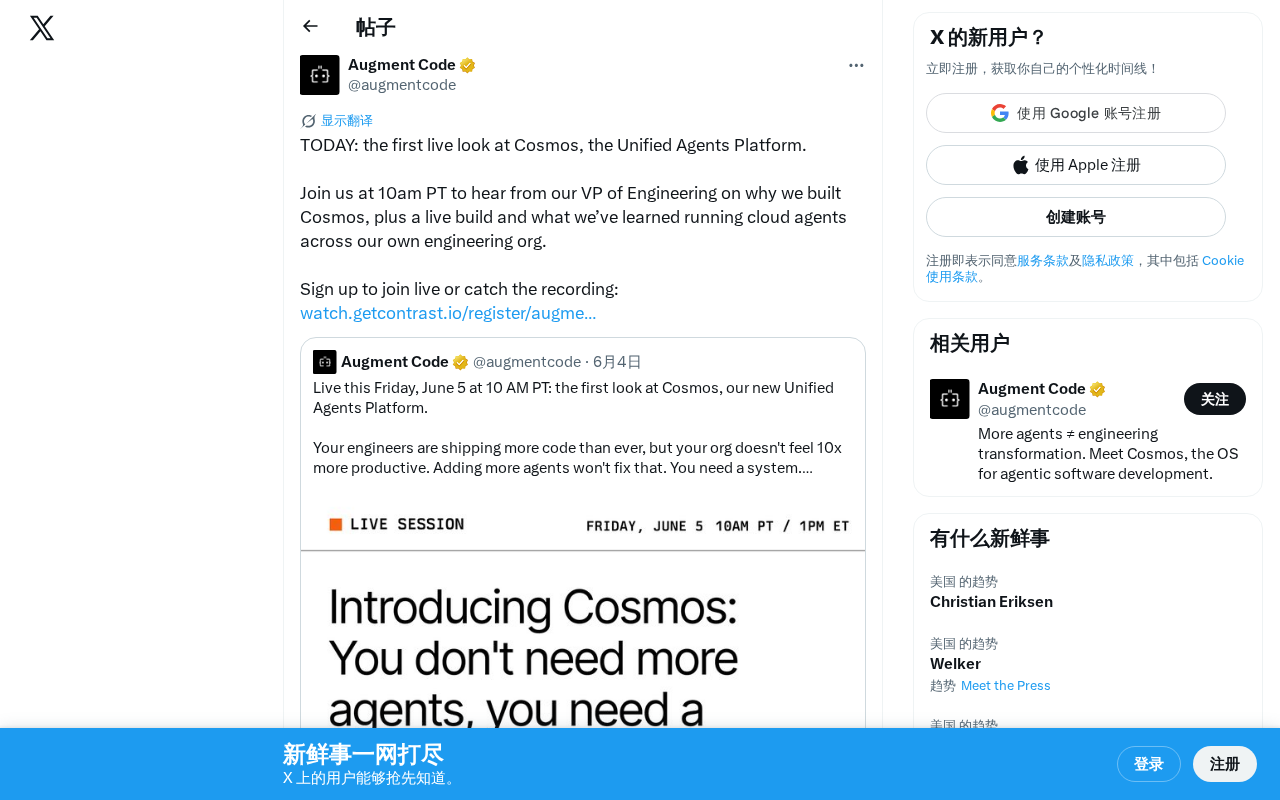
Cosmos Unified Agents Platform First Live Demo: A Platform-Level Solution for Multi-Agent Collaboration
Cosmos Unified Agents Platform gives its first live demo, detailing its design philosophy and cloud agent operations. Learn how it solves AI Agent fragmentation with unified multi-agent building, deployment, and management.
Agent Beginner's Guide: Architecture P…
Agent Beginner's Guide: Architecture Principles and Practical Efficiency Tips
A deep dive into AI Agent principles, core architecture, and practical applications. Learn how Agents differ from LLMs and how to leverage Agent Skills to boost productivity.
Google CEO Admits Gemini Lags in Codin…
Google CEO Admits Gemini Lags in Coding: Lacking an Entry Point Is Just the Surface — What's the Real Problem?
Google CEO Pichai admits Gemini lags behind Cursor and Claude Code in AI coding, blaming lack of product entry points. But the real issues are failed product experience, lost developer trust, and ecosystem advantages that haven't converted to competitiveness.