AI Agent Full-Stack Development: Architecture Principles and Production-Grade Project Implementation Guide

A full-stack guide to building production-grade AI Agents with LangChain, LangGraph, and MCP protocol.
This guide explores AI Agent full-stack development, covering the core perception-decision-action loop, key technologies like LangChain, LangGraph, and MCP protocol, and multiple LLM deployment options. Through a hands-on demo of an agent autonomously creating a Vue3 project, it illustrates how agents observe, reason, and act. The article also outlines a five-layer production architecture and a project-driven learning path for developers.
Why AI Agent Is the Core Track for Developers
Microsoft CEO Satya Nadella introduced the concepts of "agentic web" and "agentic economy" at the Build conference, predicting that by 2030, 95% of code will be generated by agents. This isn't a distant future vision—it's an industry transformation happening right now.
From a capital market perspective, Manus, a general-purpose AI Agent startup, completed a $75 million funding round just two months after launch, with its valuation growing nearly fivefold in a matter of months. According to leading consulting firms, the AI Agent market is valued at approximately $5.1 billion with a compound annual growth rate of 44.8%. Baidu founder Robin Li has also publicly stated: "Agent is the AI application direction I'm most optimistic about."
For developers, AI Agent creates three categories of opportunities: hardware engineers (fewer positions but rigid demand), algorithm engineers (high barrier to entry, requiring at least a master's degree from top universities), and the most universally accessible role—AI agent application development engineers. On recruitment platforms like BOSS Zhipin, AI Agent-related technical positions are rapidly increasing, and due to supply-demand imbalance, this field remains a blue ocean.

What Is an AI Agent: More Than Just a Chatbot
An AI Agent is an intelligent entity with autonomous awareness. At its core, it's a program, but fundamentally different from traditional programs—it can perceive its environment, reason and make decisions, and take actions.
Think of an agent as a person:
- Eyes (Perception): Observes the real-world state through various tools and interfaces
- Brain (Decision-making): Feeds perceived information to a large language model for reasoning
- Hands (Action): Executes specific operations through tools
The entire workflow can be summarized as a loop: Think → Act → Observe → Think again. This is exactly how humans solve problems—do something, observe the result, then decide the next step.
Microsoft's CEO further pointed out that AI Agents will disrupt the SaaS industry. Most SaaS services are essentially "database CRUD + business logic," and AI Agents can fully handle this functionality with significant cost advantages.
Hands-On Demo: An Agent Automatically Creates a Vue3 Project
Let's demonstrate how an AI Agent works through an intuitive example—having an agent autonomously create a Vue3 project on a local machine. This seemingly simple task fully demonstrates the agent's core workflow.
Step 1: Knowledge Retrieval
After starting, the agent first accesses the Alibaba Cloud Bailian knowledge base to query two types of key information: terminal operation standards (MacOS uses Terminal, Windows uses PowerShell) and Vue-related technical knowledge.
Step 2: Environment Preparation and Command Execution
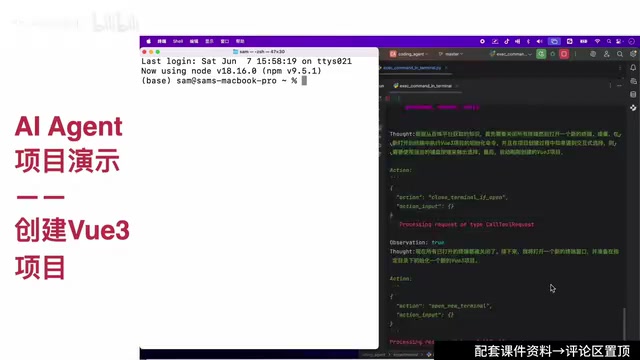
After obtaining the knowledge, the agent follows the standards to close all existing terminals, then opens a new terminal window. Next, it navigates to the specified directory and executes the vue create command.
Step 3: Observe-Decide Loop
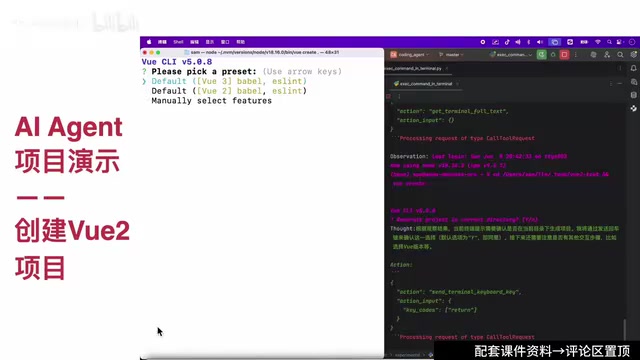
This is where the agent's "intelligence" truly shines. After each command execution, the agent doesn't blindly proceed to the next step. Instead, it reads the terminal's complete output using the get_terminal_full_text tool and makes decisions based on the current state.
A particularly impressive detail: when the command line presents an interactive prompt for Vue version selection, the agent autonomously determines it should select the Vue3 preset and presses Enter to confirm. In a Vue2 project creation scenario, the agent can even decide to "press the down arrow key to move the cursor to the Vue2 option, then press Enter to confirm"—this level of understanding and manipulation of terminal interactions is remarkable.
Finally, the agent automatically executes npm run serve to start the project. Throughout the entire process, the developer only entered one initial instruction.
Extended Capabilities of AI Agents
Although this project is small, it reveals the enormous potential of AI Agents. Based on the same architecture, agents can:
- Fix bugs and perform code reviews within the operating system
- Write Word documents, Excel spreadsheets, and PowerPoint presentations
- Operate web-based collaboration tools like Yuque, DingTalk, and Feishu
- Control browsers to complete automation tasks
- Help with project deployment and release
Essentially, any repetitive work that can be accomplished through an operating system can potentially be taken over by an agent.
Deep Dive into the Core Technology Stack
This production-grade agent's technical architecture is divided into five layers:
Large Model Layer
Three deployment approaches to suit different scenarios:
- Alibaba Cloud Bailian: Domestic cloud-based LLM, suitable for production environments
- Overseas Models: Claude, GPT, etc., suitable for scenarios requiring stronger reasoning capabilities
- Ollama Local Deployment: Completely free, suitable for development testing and privacy-sensitive scenarios
AI Framework Layer: LangChain and LangGraph
- LangChain: Provides foundational capabilities including LLM invocation, tool integration, and chain-based calls
- LangGraph: Handles complex multi-step, stateful agent workflows
These two frameworks are the de facto standards for current AI Agent development. Deep understanding of their underlying architecture is crucial for building production-grade agents.
Tools and MCP Protocol Layer
- MCP Protocol: A standardized model-tool communication protocol enabling plug-and-play tool integration
- Custom Tools: Terminal controllers, browser controllers, etc.
- LangChain Built-in Tools: Database operations, Python code execution (REPL), file system operations
Observability and Debugging
- LangSmith / LangFuse: For monitoring agent runtime status and debugging reasoning chains
Knowledge Base and AI IDE
- Alibaba Cloud Bailian Knowledge Base: Provides domain knowledge for agents
- AI IDE: Including Cursor, Tongyi Lingma, and Trae (open-sourced by ByteDance)
Learning Path for AI Agent Development
An efficient learning approach should follow a project-driven path:
- Don't pursue an exhaustive technology stack: Focus on enterprise-level practical projects, with all technical points revolving around project requirements
- Emphasize technical depth: Go beyond simple API calls to deeply understand LangChain/LangGraph's underlying architecture
- Oriented toward developer career transitions: All code is hand-written from scratch, with a smooth learning curve
Prerequisites are relatively modest: basic experience using LLMs, and foundational knowledge of Python and Node.js. The primary development language is Python, supplemented by some Node.js.
Conclusion: Seize the Window of Opportunity in Agent Development
The rise of AI agents has become an irreversible trend, with virtually all major tech companies investing heavily. For regular developers, this is a rare window of opportunity—the technical barrier is still accessible, market demand continues to grow, and the competitive landscape hasn't yet solidified.
Whether you're looking to achieve breakthroughs in your current role through agent capabilities, transition into an entirely new field, or pursue AI side projects, mastering full-stack AI Agent development will be a high-return technical investment. The key is to start now and build your technical moat in this domain.
Related articles

AI Large Model Learning Roadmap Breakdown: Three Stages from Application Development to Model Fine-Tuning
Deep breakdown of a popular AI large model learning roadmap covering LangChain, RAG, Agent, and LoRA fine-tuning across three stages, with analysis of its strengths and limitations for career changers.

AI Agent Development: A Complete 6-Week Systematic Learning Roadmap
A 6-week systematic learning roadmap for AI Agent development, covering core architecture, ReAct principles, multi-agent collaboration, RAG integration, and deployment.
Four Core Advantages Frontend Developers Have When Transitioning to AI Agent Development
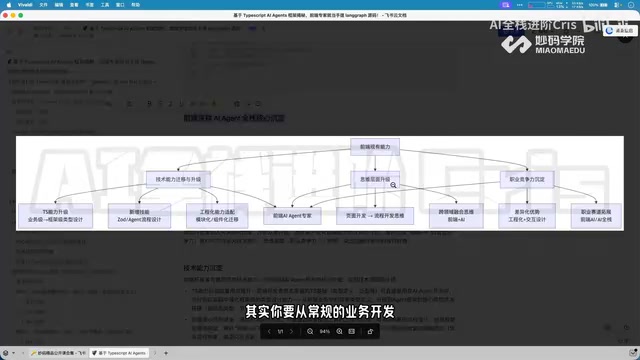
Frontend developers have key advantages for AI Agent development: TypeScript ecosystem fit, low-barrier full-stack bridging, and state management isomorphism. Learn the transition path here.