AI Agent in Practice: Building a Commercial-Grade Programming Agent from Scratch

A practical guide to building commercial-grade AI Agents with LangChain, LangGraph, and MCP.
This article explores AI Agent development from fundamentals to practice. It covers the core perception-decision-action mechanism, demonstrates an agent autonomously creating a Vue3 project, and provides a comprehensive overview of the technology stack including LangChain, LangGraph, MCP, Ollama, and observability tools like LangSmith and LangFuse.
Why AI Agents Are the Next Big Opportunity for Programmers
AI Agents are reshaping the technology landscape at an unprecedented pace. Microsoft CEO Satya Nadella introduced the concepts of "agent networks" and "agent economy" at the Build conference, boldly predicting that by 2030, 95% of code will be generated by agents. Meanwhile, Manus, a general-purpose AI Agent startup, secured $75 million in funding just two months after launch, with its valuation growing nearly fivefold in a matter of months.
According to consulting firm research data, the AI Agent market is valued at approximately $5 billion, with a compound annual growth rate as high as 44.8%. Baidu founder Robin Li has also publicly stated: "Agents are the AI application direction I'm most bullish on." All signs point to AI Agents being on the verge of an explosion.
The rise of AI Agents is no accident — it's an inevitable product of the capability leap in large language models. After ChatGPT launched in 2022, the industry quickly realized that LLMs could do more than generate text — they could serve as reasoning engines powering autonomous decision-making systems. From a technological evolution perspective, AI Agents have undergone three paradigm shifts: from rule-based engines to reinforcement learning (RL-based) to LLM-driven (LLM-based). The reason LLM-based Agents are causing such industry disruption is that large language models now possess Emergent Abilities, enabling zero-shot reasoning and complex task decomposition. This means Agents no longer need to be individually trained for each scenario — they can adapt to multiple tasks through prompt engineering and tool invocation.
What does this mean for the average programmer? On recruitment platforms like BOSS Zhipin, AI Agent-related technical positions are rapidly increasing. Due to supply-demand imbalance, this field remains a blue ocean, with most job requirements being relatively broad. Microsoft's CEO has even predicted that AI Agents will disrupt the SaaS industry — because most SaaS services are built on database CRUD operations plus business logic, and AI Agents are perfectly capable of handling these functions.
The underlying logic of this prediction is as follows: traditional SaaS essentially solidifies business processes into software interfaces, where users perform data CRUD operations through GUIs. AI Agents, however, can directly understand users' natural language intent, bypassing the GUI layer to operate on data and execute business logic directly. This means a significant amount of middle-layer work — form design, page routing, permission validation, and other frontend tasks — could be replaced by an Agent's intent understanding capabilities. Gartner calls this trend "Agentic SaaS" and predicts that by 2028, 33% of enterprise software interactions will be completed through Agents rather than traditional interfaces.
What Is an AI Agent: The Core Mechanism of Perception, Decision-Making, and Action
An AI Agent is essentially a program, but unlike ordinary programs, it can perceive its environment, reason and make decisions, and take actions. Think of an agent as a person: it needs a pair of "eyes" to observe the world, a "brain" (the large language model) for reasoning and decision-making, and a pair of "hands" to execute actions.
The operational flow of an AI Agent can be summarized in three cyclical steps:
- Think: Reason and make decisions based on current information
- Act: Execute specific operations
- Observe: Obtain the results of actions, then enter the next round of thinking
This "Think-Act-Observe" loop is known in academia as the ReAct (Reasoning + Acting) paradigm, jointly proposed by Google Research and Princeton University in 2022. The core innovation of ReAct lies in interleaving Chain-of-Thought reasoning with external tool invocations, rather than completing all reasoning first and then executing uniformly. Experiments have shown that ReAct significantly outperforms pure reasoning or pure action approaches on both knowledge-intensive tasks (such as HotpotQA) and decision-making tasks (such as ALFWorld). Beyond ReAct, the industry has also developed multiple Agent architecture paradigms including Plan-and-Execute (plan first, execute later) and LATS (Monte Carlo Tree Search-based Agent), each suited to different scenarios.
This loop is entirely consistent with how humans handle tasks: do something, observe the result, then do the next thing. Understanding this core mechanism is the first step to mastering AI Agent development.
Hands-On Demo: An Agent Automatically Creates a Vue3 Project
Let's demonstrate the capabilities of an AI Agent through a compelling practical example — having an agent automatically create and launch a Vue3 project on a local computer.
Knowledge Base Query Phase
After starting up, the agent's first action is to query two types of information from the Alibaba Cloud Bailian knowledge base: terminal operation specifications (macOS uses Terminal, Windows uses PowerShell) and Vue-related technical knowledge. This demonstrates the AI Agent's "perception" capability — gathering necessary contextual information before taking action. This process is technically known as RAG (Retrieval-Augmented Generation), where the Agent retrieves relevant document fragments from an external knowledge base before reasoning, injecting them into the prompt context to compensate for the limitations in timeliness and domain expertise of the large model's training data.
Terminal Operation Phase
After retrieving the knowledge, the agent follows the specifications to first close all terminals, then open a new terminal, navigate to the specified directory, and execute the vue create command. The key point is that the agent doesn't blindly execute commands — after each step, it uses the Get Terminal Full Text tool to read the terminal's return value and decides the next action based on the current result.
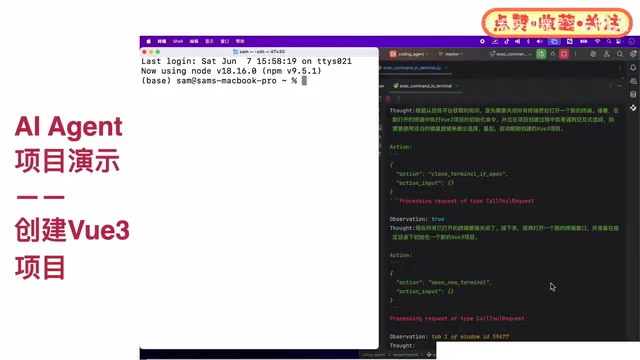
Intelligent Decision-Making Phase
The most impressive part is how the agent handles interactive selections. When the terminal presents Vue version preset options, the agent correctly identifies the currently selected item and confirms the Vue3 selection by pressing Enter. When creating a Vue2 project, the agent can even determine that it needs to press the arrow key to move the cursor, select the Vue2 option, and then confirm.
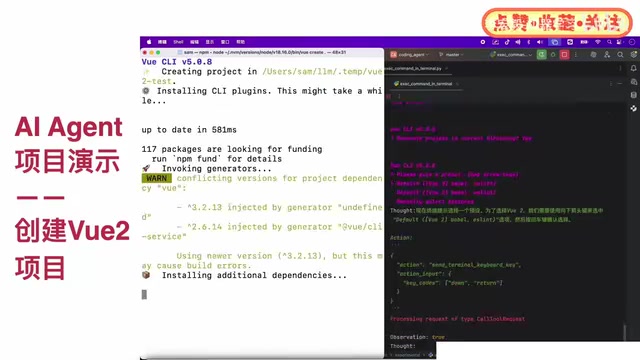
This seemingly simple operation actually demonstrates the most core capability of an AI Agent: autonomous decision-making. It doesn't follow a preset script — it makes judgments based on real-time observations of environmental changes. This is fundamentally different from traditional RPA (Robotic Process Automation) — RPA relies on predefined rules and fixed UI element positioning, breaking down whenever the interface changes; AI Agents make decisions based on semantic understanding, with the ability to adapt to unknown scenarios.
Complete Technology Stack for AI Agent Development
Building a commercial-grade AI Agent requires a comprehensive technology stack. Here's the technical selection at each layer:
Large Model Layer
Three deployment options are available: Alibaba Cloud Bailian models (cloud-based API calls), overseas models like Claude/GPT (high-performance options), and Ollama for local deployment (completely free). Multiple options ensure developers under different conditions can get started.
Ollama is an open-source local large model runtime that supports running open-source models like Llama, Mistral, and Qwen on consumer-grade hardware. Built on llama.cpp, it compresses model parameters from FP16 to INT4/INT8 precision through the GGUF quantization format, enabling models that originally required tens of gigabytes of VRAM to run on ordinary computers with 8-16GB of memory. While quantization introduces some precision loss, for tool invocation and simple reasoning tasks in Agent scenarios, quantized models typically perform well enough. Ollama provides an OpenAI-compatible API interface, allowing developers to switch between cloud and local models with virtually no code changes, offering great flexibility and cost advantages for Agent development.
AI Framework Layer
The core frameworks used are LangChain and LangGraph, combined with MCP (Model Context Protocol) for tool invocation, and LangSmith and LangFuse for agent behavior observation and debugging.
LangChain is currently the most mainstream LLM application development framework, created by Harrison Chase in 2022. Its core design philosophy is to modularize LLM calls, prompt templates, tool binding, memory management, and other capabilities, composing them into complex applications through chain invocations. LangGraph is a state graph orchestration framework released by the LangChain team, specifically designed for building multi-step, stateful Agent workflows. Unlike simple Chains, LangGraph is based on a directed acyclic graph (DAG) model, supporting conditional branching, loops, parallel execution, and human-in-the-loop nodes, enabling precise control over Agent state transitions. This allows developers to build Agents with complex decision trees, not just linear Q&A flows.
MCP (Model Context Protocol) is a standardized protocol open-sourced by Anthropic in late 2024, designed to solve the fragmentation problem of connecting LLMs with external tools and data sources. Before MCP, integrating each tool required developers to write customized adapter code, making it difficult to scale the tool ecosystem. MCP adopts a client-server architecture, defining unified tool description formats, invocation protocols, and context passing specifications — similar to what USB-C does for hardware device standardization. Developers only need to wrap tools according to the MCP specification, and any Agent framework supporting MCP can invoke that tool in a plug-and-play manner, dramatically reducing integration costs in the Agent ecosystem.
Agent observability is a critical challenge for production deployment. Since an Agent's execution path is dynamically generated, traditional logging and monitoring methods struggle to track its reasoning process and decision rationale. LangSmith is the official commercial observability platform from LangChain, supporting complete call chain tracing (Trace), latency analysis, token consumption statistics, and regression testing. LangFuse is an open-source alternative offering similar tracing and evaluation capabilities with self-hosted deployment support, suitable for enterprise scenarios with data privacy requirements. The core value of both is enabling developers to "see" every step of an Agent's thinking process, quickly pinpointing reasoning errors or tool invocation failures.
Tool Layer
This includes custom-built terminal controllers and browser control tools, as well as LangChain's built-in tools for database operations, Python code execution, and file operations. For the knowledge base, Alibaba Cloud Bailian is integrated to provide domain knowledge support for the agent.
IDE Layer
Three AI programming tools are introduced: Cursor, Tongyi Lingma, and Trae (ByteDance's open-source IDE), to help developers efficiently write agent code. The common feature of these AI-native IDEs is deep integration of code completion, context-aware conversation, and code generation capabilities. They can automatically infer developer intent based on project context, significantly reducing the burden of memorizing framework APIs and writing boilerplate code during Agent development.

AI Agent Use Cases: Far Beyond Project Creation
As the demo shows, AI Agents can directly operate the operating system, meaning their capability boundaries far exceed what you might imagine:
- Development Assistance: Automatically creating projects, fixing bugs, code review, and deployment
- Document Processing: Automatically writing Word documents, Excel reports, and PowerPoint presentations
- System Automation: Browser control, operating apps like DingTalk/Feishu/WeChat
- Replacing Repetitive Work: Any repetitive operation that can be done on a computer can be delegated to an agent
Fundamentally, the value of AI Agents lies in converting human operational intent into automated execution workflows, dramatically improving work efficiency. It's worth noting that current AI Agent capabilities are primarily constrained by three factors: the upper limit of the model's reasoning ability determines how complex the tasks an Agent can handle; the richness of the tool ecosystem determines how many systems and services an Agent can reach; context window length limitations determine how long an Agent can maintain task memory. As model capabilities continue to improve, standard protocols like MCP drive tool ecosystem expansion, and long-context technologies break through, the application boundaries of AI Agents will continue to expand.
Learning Path and Target Audience
Mastering AI Agent development requires a project-oriented learning approach — not blindly accumulating knowledge points, but understanding the role of each technical component through actual projects. Prerequisites include experience using large models and a basic understanding of Python and Node.js.
This is suitable for the following groups:
- Programmers looking to transition their careers through AI Agents
- Beginner developers looking to enter the AI field
- Full-stack engineers wanting to enhance their automation capabilities
You may not have noticed, but learning AI Agent development isn't just about mastering the technology itself — it's about cultivating architectural thinking. Understanding the cyclical mechanism of perception, decision-making, and action is what enables you to design truly valuable agent applications in real business scenarios. From a broader perspective, AI Agent development is giving rise to a new engineering role — Agent Engineer — a role that requires comprehensive skills spanning prompt engineering, system architecture, tool integration, and evaluation tuning, with a significantly different skill profile from traditional frontend and backend development.
Key Takeaways
Related articles

AI Now Writes Over 80% of Code: What Doubling Capability Every 4 Months Really Means
Anthropic reveals Claude now writes over 80% of its code, with AI capability doubling every four months. Three real cases show the speed of AI's rise and the shrinking window for human adaptation.
Replit President: Writing Code Will Become Insignificant — Ideas Are Everything
Replit's president shares insights on AI programming's future: how a 40M-user platform uses Claude to eliminate coding barriers, making natural language the new programming language.

Stripe Data Reveals an AI Startup Explosion: A New Business Paradigm Where New Company Creation Has Doubled
Stripe data shows new business creation nearly doubled YoY, surpassing pandemic peaks. A deep analysis of how AI is transforming startup speed, vertical SaaS, and global entrepreneurship.