AI Bots Invade Social Platforms: From Spam Replies to Quote Tweets — A New Threat Emerges
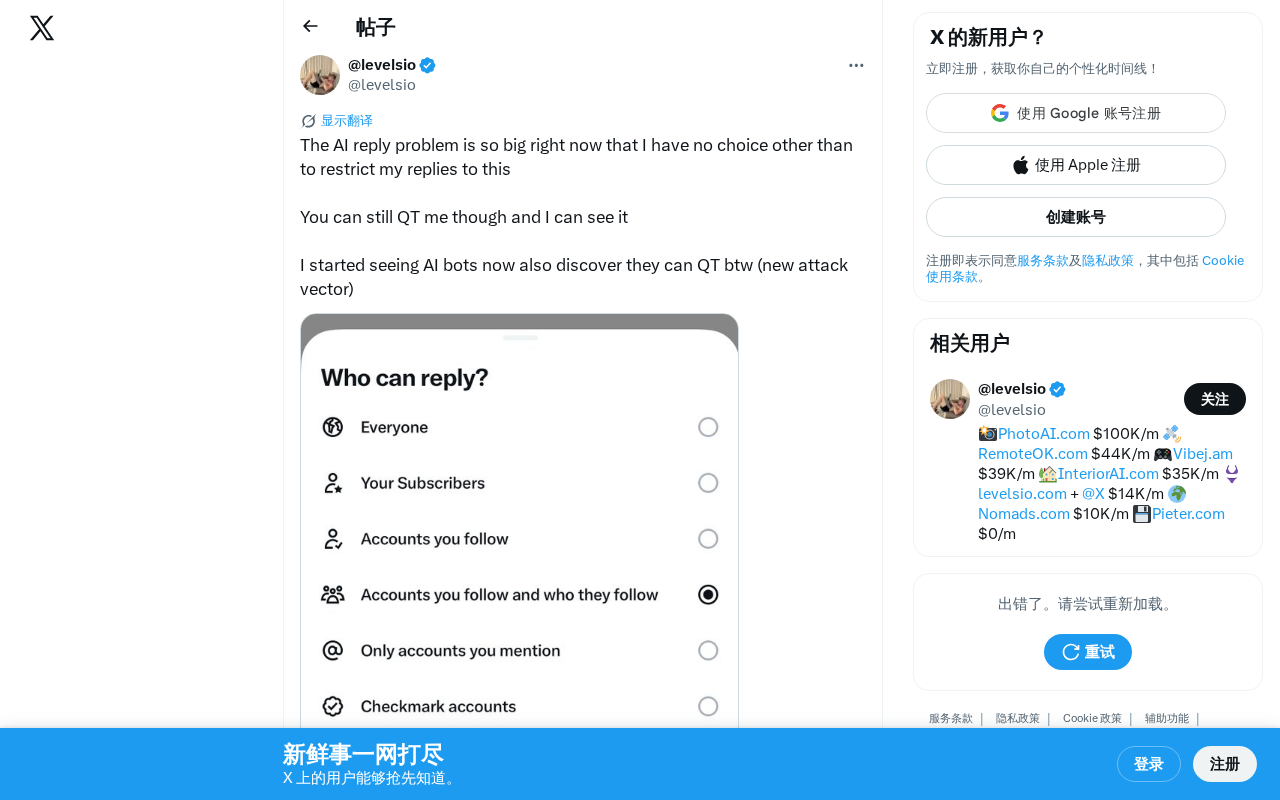
AI bots evolve from spam replies to exploiting Quote Tweets, threatening social media's core value of open dialogue.
AI bots on social platforms have evolved beyond simple spam replies, now leveraging Quote Tweets to bypass user restrictions. Powered by open-source LLMs, these bots generate human-like content at scale while platforms struggle with detection limitations and contradictory AI strategies. The erosion of authentic interaction is pushing users to self-censor, threatening the fundamental purpose of social media as a public discourse space.
Social Media's AI Pollution Problem Has Reached a Tipping Point
Recently, a Twitter (now X) user publicly stated that the AI bot reply problem had become so severe that he had no choice but to restrict reply permissions on his posts. While this may seem like a personal decision, it actually reflects a deep crisis facing the entire social media ecosystem — AI-generated content is eroding authentic human interaction at an unprecedented pace.
The user wrote in his post: "The AI reply problem is so bad now that I have no choice but to restrict my replies. You can still Quote Tweet (QT) my content, and I can see it." Even more alarming, he added a new discovery: AI bots have learned to use the Quote Tweet function, meaning an entirely new attack vector is forming.
The Evolution of AI Bots: From Spam Replies to Strategic Infiltration
Large Language Models Make Bots Harder to Identify
AI bots on social platforms are nothing new, but their rate of evolution is concerning. Early bot accounts primarily sent spam replies triggered by simple keywords, making them easy to identify and filter. Today's AI bots, powered by Large Language Models (LLMs), can generate highly human-like reply content, making it increasingly difficult for ordinary users to distinguish between real people and machines.
Large Language Models are a class of deep learning models based on the Transformer architecture, trained on massive text datasets, with GPT series, LLaMA, and Mistral as notable examples. These models possess powerful natural language understanding and generation capabilities, producing fluent, coherent, and stylistically diverse text based on context. Crucially, many open-source LLMs (such as Meta's LLaMA series) can be freely downloaded and deployed by anyone, meaning bot operators don't need commercial APIs to run thousands of human-like bot accounts at extremely low cost. Even more problematic, through fine-tuning techniques, these models can be trained to mimic the language style of specific communities — whether it's tech jargon, sports fans' passionate expressions, or politically charged rhetoric — allowing them to pass as authentic in various contexts.
When users combat AI spam by restricting reply permissions, bot operators quickly find alternatives — Quote Tweets. This cat-and-mouse game reveals a harsh reality: the iteration speed of defensive measures falls far behind the evolution speed of attack methods. This asymmetry is known in cybersecurity as "attacker-defender asymmetry" — defenders must plug every vulnerability, while attackers only need to find one breach. In the social media context, every protective measure a platform adds can be bypassed by bot operators finding just one uncovered feature entry point.
Why Quote Tweets Have Become a New Attack Vector
Quote Tweet was originally an important interaction method on Twitter/X, allowing users to add their own commentary while sharing others' content. The feature was designed to promote substantive public discussion. However, when AI bots begin exploiting this feature, the situation becomes far more complex:
In information security, an "Attack Vector" refers to the path or method an attacker uses to breach a target system or achieve malicious objectives. In the social media context, every feature that allows users to publish content or interact with others — replies, direct messages, quote tweets, comments, even profile bios — can become a potential attack vector. Quote Tweets are particularly dangerous because they occupy a "governance gray zone" in the platform's architecture: they don't fully fall under the original poster's control, yet they establish a direct content connection with the original post. This design ambiguity makes them an ideal breach point for bot operators.
- Bypassing reply restrictions: Even when the original post restricts reply permissions, Quote Tweets remain open to everyone
- Expanding reach: Quote Tweets appear on the bot's own timeline, reaching more potential victims
- Harder to manage centrally: Unlike replies, Quote Tweets are scattered across various accounts, and the original poster cannot directly delete or manage them
This means that even when users voluntarily sacrifice interaction experience for peace, AI bots can still find ways to infiltrate. From a platform design perspective, this exposes a fundamental architectural problem: social platform features are typically designed with user experience and interaction convenience as priorities, while security and controllability are afterthoughts. When these features are maliciously exploited, the cost and difficulty of patching far exceed those of redesigning.
Platform Governance Dilemmas and Technical Limitations
Multiple Challenges in AI Content Detection
Current mainstream social platforms face multiple challenges in addressing AI-generated content. Traditional anti-spam systems primarily rely on behavioral pattern recognition (such as posting frequency, account age, follower ratios, etc.), but new-generation AI bots can simulate more natural usage patterns and even maintain seemingly authentic profiles and posting histories.
From a technical standpoint, there are currently several approaches to detecting AI-generated text, but each has significant limitations. The first is statistical detection methods, such as OpenAI's AI text classifier, which analyzes statistical features of text (like perplexity and burstiness metrics) to determine whether it was AI-generated. However, these tools generally have low accuracy — OpenAI's own detector was taken offline in 2023 due to insufficient accuracy. The second is digital watermarking technology, which embeds statistical signals imperceptible to humans but detectable by machines during AI text generation. Google DeepMind's SynthID represents this approach, but watermarking faces a fundamental dilemma: it can only mark content generated through cooperating models and is completely ineffective against text from open-source models or content that has been paraphrased. The third is metadata-based detection, which identifies bots by analyzing account behavior, posting time patterns, device fingerprints, and other non-content information, but sophisticated bot operators can easily evade this through residential proxy IPs, simulated device fingerprints, and randomized behavior patterns.
The deeper contradiction lies in this: platforms are simultaneously promoting AI features (such as AI summaries, AI recommendations) while needing to combat AI-generated spam content. This self-contradictory stance makes establishing clear governance rules extremely difficult. Take X as an example — Elon Musk is pushing deep integration of Grok AI into the platform experience while simultaneously needing to address the AI bot flooding problem. When the platform's own AI features are also generating and pushing content, the very definition of "what constitutes harmful AI content" becomes blurred. This structural contradiction exists not only on X — tech giants like Meta and Google face similar dilemmas — they are both the biggest promoters of AI technology and the biggest victims of AI abuse.
Users Forced to Self-Rescue as Core Social Platform Values Erode
When platform-level protections fail, users are forced to take self-protective measures — restricting replies, disabling direct messages, or even reducing posting frequency. But the cost of these measures is obvious: the core value of social media — open public dialogue — is being gradually dismantled.
A social platform that requires users to actively give up interaction features to function normally has fundamentally deviated from its reason for existence. This phenomenon is academically known as the "Digital Tragedy of the Commons" — when shared digital spaces are exploited without restraint, all participants' interests are harmed, ultimately leading to the degradation or even collapse of public spaces. Historically, email went through a similar crisis: before anti-spam technology matured, spam once accounted for over 90% of global email traffic, seriously threatening email's viability as a communication tool. The AI pollution problem currently facing social media is, in some sense, a replay of that history, but with far greater complexity and governance difficulty.
The Broad Impact of AI Pollution and Directions for Response
This phenomenon is not an isolated incident. As AI tools become more widespread and barriers to use decrease, similar "AI pollution" problems are spreading across various online platforms — from fake reviews on e-commerce platforms, to AI astroturfing in forums, to AI phishing content in emails.
This trend inevitably brings to mind the long-circulating "Dead Internet Theory" in internet culture. This theory first emerged around 2021 on online forums, with its core argument being that most content and interactions on the internet are no longer produced by real humans but are automatically generated by bots and AI. While this theory was considered a conspiracy theory when first proposed, with the explosion of generative AI, it is becoming reality in an unsettling way. According to data from cybersecurity firm Imperva, automated bot traffic accounted for nearly 50% of global internet traffic in 2023, with malicious bot traffic comprising 32%. On social media, this proportion may be even higher.
Social platforms need to increase investment in the following directions:
-
Strengthening identity verification mechanisms: Exploring more reliable human verification methods while balancing privacy protection needs. Traditional CAPTCHA verification has been easily cracked by AI, and next-generation verification schemes are moving toward "Proof of Personhood." For example, the Worldcoin project attempts to establish globally unique human identity markers through iris scanning, while some platforms are exploring lightweight verification schemes based on social graph analysis and behavioral biometrics. The core challenge is confirming "this is a real person" without violating users' rights to anonymity and privacy.
-
Establishing AI content labeling systems: Promoting mandatory labeling of AI-generated content to give users the right to know. This direction has already gained regulatory support — the EU's AI Act explicitly requires AI-generated content to be labeled, and China's "Interim Measures for the Management of Generative AI Services" has similar provisions. On the technical side, the C2PA (Coalition for Content Provenance and Authenticity) standard is pushing to establish a cross-platform content provenance framework, with Adobe, Microsoft, Google, and other companies already participating. But the biggest challenge facing mandatory labeling is enforcement — when bot operators run open-source models on overseas servers, any labeling requirement is difficult to reach.
-
Providing granular user control tools: Offering users more flexible interaction management options rather than simple "all-on or all-off" choices. For example, allowing users to set rules like "only allow accounts followed for more than 30 days to reply" or "automatically collapse suspected AI-generated replies." Emerging social platforms like Bluesky have made valuable explorations in this area, with their open architecture based on AT Protocol allowing third-party developers to build custom content filtering and moderation tools.
-
Promoting cross-platform collaborative governance: Bot accounts often operate across platforms, limiting the effectiveness of single-platform governance. Bot operators typically deploy account matrices across multiple platforms simultaneously, forming coordinated networks. A bot network banned on X could be back online on Telegram, Reddit, or other platforms within hours. Therefore, establishing cross-platform threat intelligence sharing mechanisms and coordinated banning systems is crucial.
When AI bots learn to exploit every new interaction feature as an attack vector, what we face is not merely a technical problem but a fundamental challenge about the future form of digital public spaces. If we cannot respond effectively, social media may degenerate into a wasteland where human users continuously retreat and AI content endlessly expands. The outcome of this battle to defend the human-machine boundary will profoundly influence the direction of the internet over the next decade — whether we can still have a digital public space centered on authentic human conversation depends on whether technology, policy, and social consensus can find an effective balance point in this asymmetric competition.
Related articles

Claude Code for Test Development in Practice: An AI Programming Workflow That Doubles Your Efficiency
A practical guide to Claude Code for test development: auto-generating test scripts, Plan Mode workflows, MCP + Playwright integration, and Subagent parallel tasks to build systematic AI-assisted workflows.

Hermes Agent Hands-On Review: An AI Efficiency Revolution for Indie Game Developers
Indie game developer reviews Hermes Agent vs OpenClaude: intelligent context compression, real-time Memory, remote control via Telegram, and practical use cases in game dev, social media, and email.
Vibe Coding Beginner's Guide: Tool Selection Across Three Categories with Practical Examples
A comprehensive guide to Vibe Coding's three tool categories: Agent frameworks, CLI Coding, and IDE tools, with practical examples including Snake game and data analysis workbench.