AI Programming in Practice: A Complete Breakdown of Building a Website from Scratch in 7 Days
AI Programming in Practice: A Complete…
One developer builds and ships a complete website from scratch in 7 days using AI tools.
A developer independently built, populated, and deployed a Chinese anime content website in 7 days using Claude Code and DeepSeek, with 99% of code written by AI. The article distills four core lessons: more complete requirements documents yield more reliable AI output, providing official documentation prevents hallucination, context pollution is the biggest cost black hole, and choosing the right model for task complexity controls costs.
Introduction: Can One Person Really Replace an Entire Team?
No concepts, no news roundups—just building a complete project from scratch. That's the most direct way to validate AI's development capabilities. One developer spent 7 days using AI tools (Claude Code + DeepSeek) to build, populate with data, and deploy a Chinese anime (donghua) content website from zero. 99% of the code was written by AI, all data was AI-generated, and even every illustration was automatically created by calling Doubao C-Dream through MCP.
This hands-on case study not only demonstrates the real capability boundaries of AI programming but also exposes critical pitfalls along the way. Here's the complete 7-step breakdown and lessons learned.
Step 1: Requirements Planning with DeepSeek
The project didn't start with writing code—it started with discussing ideas with AI. The developer had multiple rounds of conversation with DeepSeek to progressively define the website's specific features, page designs, and technology choices.
Technical Background: The Division of Labor Between Claude Code and DeepSeek Claude Code is Anthropic's AI programming assistant designed for developers. Its core strength lies in understanding complex codebases and autonomously planning multi-step tasks. Unlike simple code completion tools, Claude Code can understand a project's overall architecture and autonomously invoke tools, run commands, and verify results during execution. DeepSeek is a large language model series from DeepSeek AI, renowned for its exceptional cost-effectiveness—its V4 Pro version matches top international models in reasoning capability at a fraction of the price. Using both together creates a "plan with DeepSeek, execute with Claude Code" workflow that leverages each tool's strengths.
The entire planning process was divided into four phases:
- Discussing ideas: DeepSeek provided general proposals and suggestions
- Discussing features: Explicitly telling the AI the website's specific functions and having it create detailed plans
- Discussing design: You can propose your own ideas or choose from multiple design options provided by AI. While DeepSeek can't generate images directly, it can provide basic layout wireframes
- Discussing technology: Finalizing the tech stack and architecture design
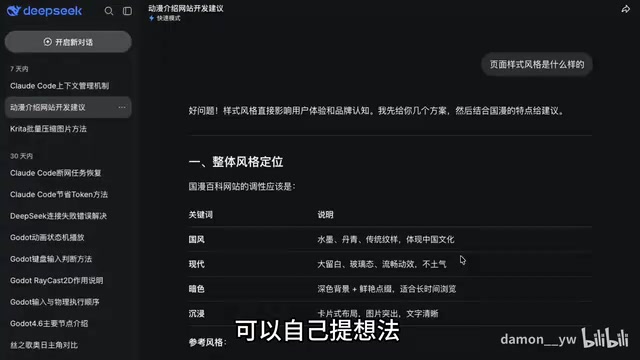
Ultimately, the AI produced a complete requirements design document. The quality of this document directly determined how smoothly subsequent development would go—this is one of the most important lessons from the entire project.
Step 2: Claude Code Takes Over Development
With the requirements document in hand, the development phase became relatively straightforward. The complete requirements design document was pasted into Claude Code, which called the DeepSeek V4 Pro model for reasoning and task planning, then developed step by step.
First Version: Core Features Rapidly Take Shape
The developer only installed a few skills potentially needed for the project, and Claude Code autonomously decided to invoke Nuxt-related frontend skills, completing the first version. The AI-generated code had clear structure, clean frontend and backend code, and ran successfully with minor adjustments—functionality matched expectations.
Technical Background: Why AI Favors Mainstream Frameworks Like Nuxt Nuxt is a full-stack web framework based on Vue.js that supports Server-Side Rendering (SSR), Static Site Generation (SSG), and Single Page Application (SPA) modes. It includes built-in file-based routing, data fetching, state management, and more, making it one of the most popular full-stack solutions in the Vue ecosystem. The AI's autonomous choice of Nuxt for this project reflects its awareness of mainstream technology ecosystems—these frameworks have extensive public documentation and code examples, which happen to be high-quality sources in AI training data. This is why AI tends to perform better with such technologies compared to niche frameworks. This also illustrates an important strategy: choosing mainstream, well-documented tech stacks is a key risk-reduction approach in AI-assisted development projects.
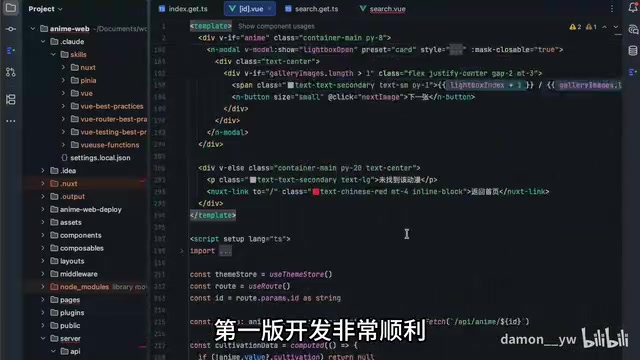
Interestingly, the AI self-tested during development, at minimum ensuring API calls succeeded. This means the AI isn't just "writing code"—it demonstrates a degree of engineering awareness.
Second Version: Feature Expansion and Pitfalls
The second version quickly added comment functionality. However, integrating Alibaba Cloud SMS authentication and CAPTCHA verification consumed enormous amounts of time. The core reason was not providing the AI with official documentation and example code, causing it to "freestyle"—generating large amounts of code that didn't conform to actual API specifications.
Deep Dive: AI "Hallucination" and Engineering Countermeasures The "freestyling" problem encountered during Alibaba Cloud SMS integration is essentially the manifestation of LLM "hallucination" in engineering scenarios. When the model's training data lacks accurate information about a specific API, it infers based on similar patterns, generating code that looks reasonable but doesn't actually meet specifications. This is especially prominent with private APIs, newly released interfaces, or services with incomplete documentation. Industry solutions include: RAG (Retrieval-Augmented Generation)—injecting official documentation into context in real-time; few-shot prompting—providing real, runnable example code; and tool-call verification—having the AI execute generated code immediately and self-correct based on error messages. This project's experience confirms a universal principle: The upper limit of AI's output quality is determined by the quality of context you provide.
This is a highly typical lesson: AI's capability boundary depends on the quality of context you give it.
Step 3: Data Generation—Writing Code Isn't Hard; Data Is
A major highlight of this project: all text and image data was generated by AI, with no externally scraped data used.
- Text data: Generated from AI's own knowledge base and written directly to the database
- Image data: Generated by calling Doubao C-Dream through MCP, stored with pre-agreed naming conventions and paths, with simultaneous database updates
Technical Background: MCP Protocol—A Standardized Bridge for AI-to-AI Calls MCP (Model Context Protocol) is an open protocol released by Anthropic in late 2024, designed to standardize interactions between AI models and external tools/data sources. Through MCP, AI assistants can call external services like function calls, dramatically expanding their capability boundaries. Doubao C-Dream is ByteDance's AI image generation service, supporting batch image generation via API. In this project, Claude Code directly called Doubao C-Dream through the MCP protocol, achieving an automated pipeline of "AI directing AI to generate images"—this represents cutting-edge practice in current AI toolchain integration and is a typical form of so-called "AI Agent" applications in production. As the MCP ecosystem continues to expand, more services are connecting to this protocol, and AI's tool-calling capability boundaries continue to widen.
During bulk generation, the AI automatically orchestrated tasks and retried on failures. When encountering sensitive words, it would substitute alternatives on its own until successful. This automated fault-tolerance mechanism reflects the maturity of current AI toolchains.
Token Consumption and Cost Analysis
The project's token consumption data is highly informative:
| Phase | Duration | Token Consumption | Cost |
|---|---|---|---|
| Environment setup + core development | Days 1-4 | ~120 million | Under ¥7 |
| Data generation | Day 5 | ~50 million | ~¥5 |
| Debugging + deployment | Days 6-7 | ~150 million | Higher |
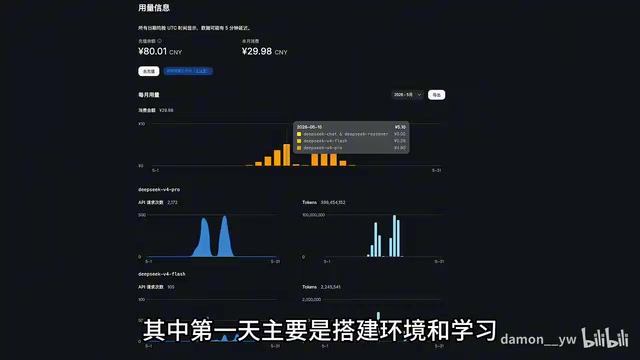
Key findings:
- With DeepSeek V4 Pro at a 75% discount, 120 million tokens of development cost less than ¥7—exceptional value
- On Day 5, forgetting to switch to DeepSeek V4 Flash for data generation wasted money unnecessarily
- The later 150 million token consumption was primarily due to context pollution and repeated debugging—the biggest cost black hole
Deep Dive: Token Economics and the Technical Mechanism of Context Pollution A token is the basic unit of text processing for large language models; Chinese text typically maps 1-2 characters to 1 token. The context window is the maximum number of tokens a model can process in a single call, with current mainstream models typically ranging from 32K to 200K tokens. "Context pollution" refers to the phenomenon where, as conversation turns accumulate, erroneous information, failed attempts, and contradictory instructions from conversation history are continuously included in the model's reference scope, causing output quality to decline and direction to drift. This is the most common efficiency killer in long-conversation development scenarios. From an engineering perspective, solutions include: periodically starting new sessions, manually distilling key context summaries, and using tools that support session management. The 150 million tokens consumed in the later stages of this project were largely the price paid for this "context entropy increase"—understanding this mechanism is key to controlling AI development costs.
Four Core Lessons Learned
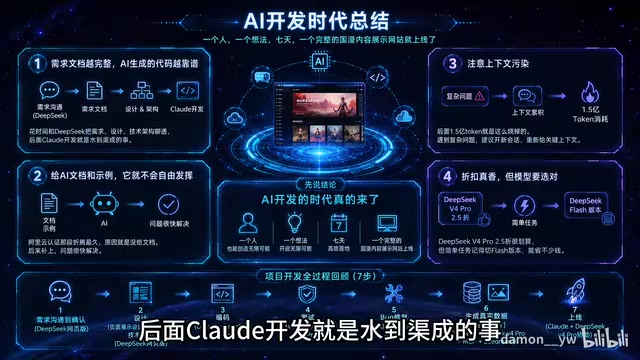
Lesson 1: The More Complete the Requirements Document, the More Reliable the AI
Spend time thoroughly discussing requirements, design, and technical architecture with DeepSeek, and Claude Code development afterward becomes a natural progression. Shortcuts taken early on will exact double the cost later.
Lesson 2: Give AI Documentation and Examples, and It Won't Freestyle
The Alibaba Cloud authentication integration took the longest, precisely because official documentation wasn't provided. Once documentation and example code were supplied, problems were resolved quickly. AI isn't omniscient—it needs correct reference materials.
Lesson 3: Beware of Context Pollution
The later 150 million tokens were burned by context pollution. When conversation turns become too numerous and incorrect information mixes into the context, AI output quality drops dramatically. The recommendation: when facing complex problems, start a new session and re-provide key context.
Lesson 4: Choose the Right Model and Save Where You Can
DeepSeek V4 Pro is suited for complex reasoning tasks, but for simple data generation, format conversion, and similar tasks, switching to the Flash version saves considerable money. Tool selection itself is an engineering competency.
Conclusion: The Real State of AI Programming
This case clearly demonstrates the current real level of AI programming: one person, one idea, seven days—enough to complete a full website with frontend, backend, database, authentication system, and content generation.
But we must also recognize that AI isn't omnipotent. It performs excellently when given clear documentation and context, but once reference materials are lacking or context becomes polluted, it falls into inefficient cycles of trial and error.
AI isn't replacing developers—it's enabling one person to do the work of an entire team. The key is learning to collaborate with AI—giving it clear instructions and correct context. This is perhaps the most essential skill for developers of the future.
Related articles
 Tutorials
Cursor + Codex Dual-IDE Collaboration: A Practical Methodology for Open-Source Project Customization
A complete methodology for open-source project customization based on real-world experience, detailing the Cursor+Codex dual-IDE workflow, seven-stage process, MVP validation, and AI source code reading techniques.
 Tutorials
Cursor Multi-Agent in Practice: Building a Full-Stack Next.js Blog in 50 Minutes
Build a full-stack blog in 50 minutes using Cursor IDE's multi-Agent mode with Next.js, Clerk auth, and Supabase. Learn the 4-phase AI Agent workflow and key integration pitfalls.
 Tutorials
Building an AI Software Factory from Scratch: A Cursor Engineer's Hands-On Experience with Multi-Agent Collaboration
Cursor engineer Eric shares practical insights on building an AI software factory: automation levels, guardrail design, parallel Agent management, and scaling to 1000+ Agents for 24/7 development.