AI Storyboard Freelancing: A Three-Step Pipeline to Earn USD Overseas
A three-step AI pipeline to earn USD freelancing storyboards overseas with zero drawing skills.
This guide breaks down how to earn USD by freelancing AI-generated storyboards for overseas film and advertising clients. The three-step pipeline covers converting scripts to AI prompts, generating images with tools like Midjourney, and delivering polished PDFs via templates. It includes Fiverr setup strategies, tiered pricing, client acquisition channels, and practical tips for overcoming language, consistency, and scalability challenges.
An Underrated AI Side Hustle: Storyboard Creation
The overseas film and advertising industry has a persistent demand — a set of storyboard visuals is needed before any shoot begins. Many directors and producers can't draw or don't have time to, which has created a stable outsourcing market.
The concept of storyboards dates back to the 1930s at Disney Animation Studios, pioneered by animator Webb Smith — he pinned a series of sketches onto a bulletin board to pre-visualize animation sequences. This method was quickly adopted by Hollywood live-action films, with directors like Hitchcock and Spielberg becoming famous for their detailed storyboards. Today, storyboards have become a standard pre-production tool in film, advertising, game cinematics, and even UX design. Their core value lies in validating narrative pacing, composition, and shot logic through low-cost static frames before expensive shooting or production begins, dramatically reducing the risk of costly rework. A 30-second TV commercial can easily cost hundreds of thousands of dollars to produce, while a storyboard set costs only a fraction of a percent — that's why production companies are willing to keep paying for storyboards.
Now, with AI tools, even if you can't draw at all, you can take on these orders and deliver professional-grade results. Today we'll break down a complete AI storyboard freelancing pipeline — from the business logic to specific operations, leaving nothing out.
Business Logic and Real Income
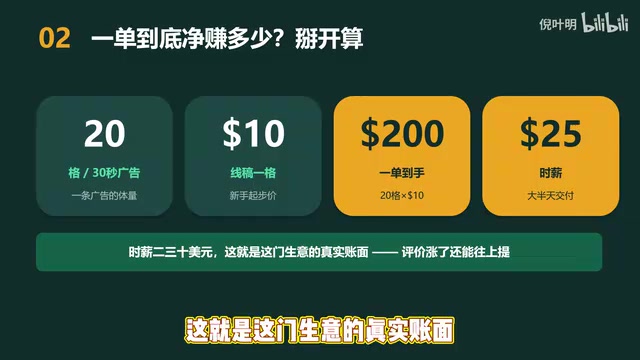
Let's do the math: a 30-second ad requires roughly 20 storyboard frames. At $10 per frame for line art, that's $200 per order. With AI assistance, you can deliver in half a day, translating to an hourly rate of about $20-30.
Storyboard pricing follows a clear tiered structure:
- Black & white line art: $5-15 per frame, the best entry point for beginners
- Detailed line art: $20-30 per frame
- Colored with atmosphere: $50-100 per frame
- Full package: Ranging from $100+ to over $1,000
As positive reviews accumulate, you can climb the tiers one by one. Search "Storyboard" on Fiverr — over 1,800 results, with top sellers having hundreds or thousands of reviews, proving that buyer demand is constant.
The Three-Step AI Pipeline Breakdown
The entire AI storyboard production process can be abstracted as: Input script → AI generates visuals → Human quality control and delivery. The machine does the heavy lifting; you ensure quality.
Step 1: Convert Script to Visual Prompts
Feed the client's script to an AI (like ChatGPT) and have it translate it into frame-by-frame visual instructions. The AI automatically determines whether each shot is a wide shot or close-up, identifies the elements in the frame, and generates English image prompts.
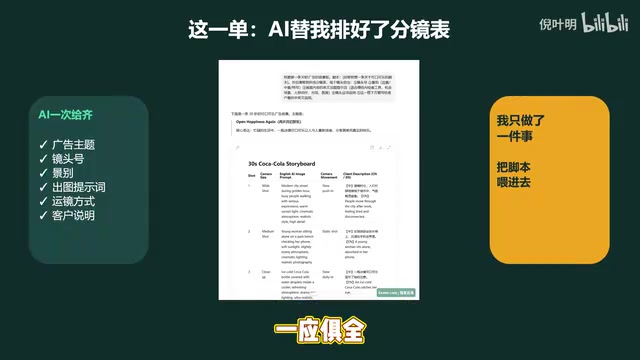
Using a real Coca-Cola ad storyboard as an example: after feeding the script into the AI, it automatically output a complete storyboard breakdown — shot number, shot type, English prompts, camera movement, and scene descriptions for the client, all included. You don't need professional storyboarding knowledge; the AI handles this step for you.
Step 2: AI Image Generation
Take the English prompts from Step 1 and feed them one by one into AI image generation tools (like Canva AI, Midjourney, etc.) to create visuals. Generate multiple images for the same shot and pick the best one. You don't need to draw a single stroke yourself.
These AI image tools are all built on Diffusion Model technology. Simply put, a diffusion model gradually adds noise to an image until it becomes pure noise, then trains a neural network to learn how to progressively restore a clear image from that noise. The user's text prompt is converted into a semantic vector through multimodal models like CLIP, guiding the denoising process to converge toward a specific visual direction. Midjourney excels in artistic stylization, particularly in cinematic composition and lighting atmosphere; while Canva AI wins with its seamless integration with design and layout tools, ideal for quickly completing an end-to-end workflow from image generation to layout. Understanding these principles helps you write more precise prompts — specifying photography terms like "cinematic lighting" or "wide-angle lens" can significantly enhance the professional quality of generated images.
Real test results: after inputting a city street prompt, three cinematic-quality images appeared instantly; a Coca-Cola bottle prompt produced three product-photography-level assets — quality entirely sufficient for client delivery.
Step 3: Template Layout and Final Delivery
This step is the key to getting paid, and it's the part AI can't yet replace:
- Arrange images in shot order within a professional storyboard template
- Add scene description text
- Export as PDF for client delivery
Search "Storyboard Template" on Canva to find plenty of free resources. Your core value lies in organizing scattered assets into a polished, professional deliverable that clients can't find fault with.
Choosing Your Client Acquisition Channels
Based on different personality types, here are three recommended approaches:
| Type | Channel | Characteristics |
|---|---|---|
| Introverted | Fiverr | List your service and wait for clients, passive orders |
| Proactive | Upwork/Discord/Reddit | Directly bid on and compete for projects |
| Experienced | Artstation/Industry job boards | Highest rates, approach creators directly for collaboration |
Getting Started on Fiverr
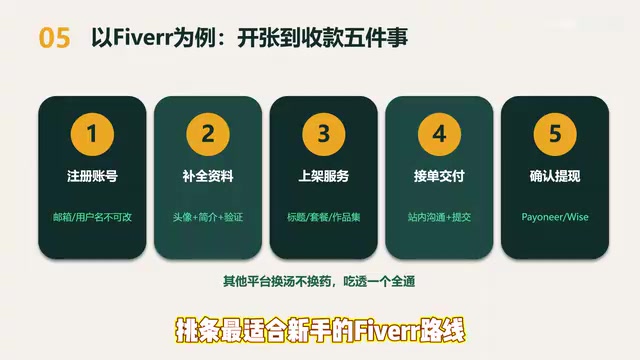
Beginners are most recommended to start on Fiverr. It boils down to five things: register an account, complete your profile, list your service, fulfill orders, and withdraw funds.
Fiverr was founded in 2010, headquartered in Tel Aviv, Israel, and went public on the New York Stock Exchange in 2019. Its core model is "sellers list services (Gigs), buyers order on demand," complementing Upwork's "buyers post requirements, sellers bid" model. As of 2024, Fiverr has over 800,000 active sellers covering 700+ subcategories including design, writing, video, and programming. The platform charges a 20% service fee per transaction (seller side) and uses algorithmic ranking to determine Gig visibility — review rating, response speed, and on-time delivery rate are the three core ranking factors. This explains why the key strategy for beginners is "earn less if needed, but secure five-star reviews": early review data directly determines your position in search results.
Package pricing reference (real seller example):
- Basic: $10/4 frames
- Standard: $15/with color
- Premium: $60/20 frames with details
Each tier clearly states delivery time and revision count. Start with a basic tier to capture your first wave of orders.
Key tip: What determines whether a client places an order is your portfolio. Use the AI pipeline to create sample work first — you don't need to wait for real clients. Build a professional profile page first, then wait for orders to come in.
From One Order to a Stable Business
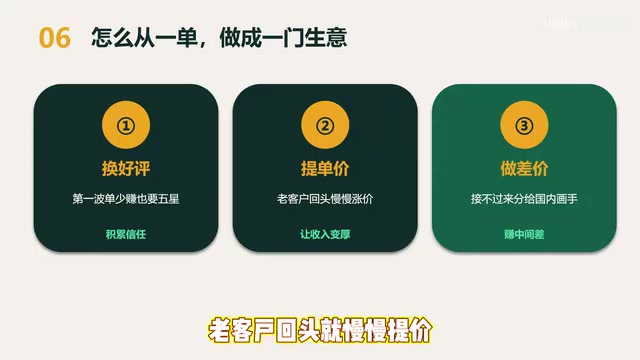
Strategies to stabilize your AI storyboard business:
- For your first batch of orders, earn less if needed to secure five-star reviews — reviews are platform currency
- Gradually raise prices as repeat clients return — once trust is established, there's significant room for premium pricing
- When orders overflow, delegate — pass work to domestic artists who can draw, and earn the margin
Use Payoneer or WorldFirst to withdraw funds to China. It's recommended to register these accounts before you start taking orders. Payoneer was founded in 2005 and has official integrations with Fiverr, Upwork, and other platforms, supporting direct withdrawal from platforms to your Payoneer account, then transfer to a domestic bank card, with withdrawal fees around 1.2% and exchange rate loss of about 0.5%-1%. WorldFirst is a brand under Ant Group, offering certain exchange rate advantages for RMB settlement and supporting direct withdrawal to Alipay. Beginners should prioritize registering Payoneer (since Fiverr natively supports it), while keeping a WorldFirst account as a backup channel to avoid cash flow disruptions if one channel has issues.
Three Challenges You Must Face
Let's be honest — this AI storyboard business has three challenges:
- Language barrier: AI can write English, but you need to keep up with clients during revision communications
- Consistency challenge: AI-generated images tend to produce inconsistent faces for the same character, and commercial use requires attention to copyright issues
- Ceiling challenge: It's fundamentally trading time for money, and one person's capacity is limited
Regarding character consistency, this is one of the biggest technical pain points in current AI image generation. Each generation in a diffusion model is an independent random process — even with identical prompts, the model starts from different random noise seeds, causing deviations in facial features and body proportions. Currently, the industry has several mitigation approaches: first, using fixed random seeds combined with character reference images — Midjourney V6 supports the --cref parameter to lock character appearance; second, using open-source technologies like IP-Adapter and InstantID to constrain generation results by inputting a reference face; third, chaining ControlNet in node-based workflows like ComfyUI to simultaneously control output with skeletal poses and facial features. For commercial storyboards, it's recommended to use the same seed and reference images within the same batch, and fine-tune inconsistent details in Photoshop during post-production.
Copyright compliance is equally important. As of early 2025, the U.S. Copyright Office's position is: purely AI-generated images without substantial human creative contribution are not eligible for copyright protection, but when humans exercise sufficient selection, arrangement, and modification of AI output, the overall work can obtain copyright. Commercial licensing terms vary significantly across AI tools: Midjourney paid users own commercial rights to generated images; DALL·E 3 transfers rights to users through OpenAI's terms; while some open-source models may contain copyrighted material in their training data, posing potential infringement risks. When taking orders, it's recommended to: first, use tools and paid plans with explicit commercial licensing; second, avoid specifying real brand logos or celebrity likenesses in prompts; third, note in client contracts that materials are AI-assisted and clearly define liability boundaries.
Clear Positioning: Your First Step Going Global
Look at going global in three layers: taking orders for service fees is the first layer; content arbitrage for traffic is the second layer; independent websites plus affiliate marketing is the third layer that can compound like a snowball.
Storyboard freelancing is particularly suitable as your first step going global — earn confidence and your first dollars, then move to higher levels. The demand is real, AI has lowered the barrier to the minimum, and there's still little competition from Chinese-language creators — it's genuinely a small blue ocean worth trying. But whether you actually earn depends on whether you're willing to do the quality control work diligently and push through the cold-start period when no one's ordering.
Key Takeaways
Related articles
Xiaomi MIMO vs. Huawei Pangu AI Strategy Comparison: The Android vs. iOS Battle of the Agent Era
Xiaomi releases open-source MIMO Code while Huawei enters the Agent era with Pangu. Compare their AI strategies: Xiaomi's Android-like open ecosystem vs. Huawei's iOS-like vertical integration.
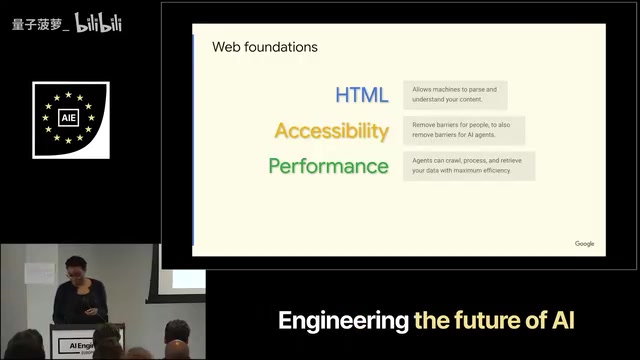
What Is Google WebMCP? A Deep Dive into the New Standard for AI Agents to Directly Invoke Web Functionality
A deep dive into Google WebMCP (Web Model Context Protocol): how it works, its technical implementation, and use cases. Learn how WebMCP lets AI Agents directly invoke web tools.
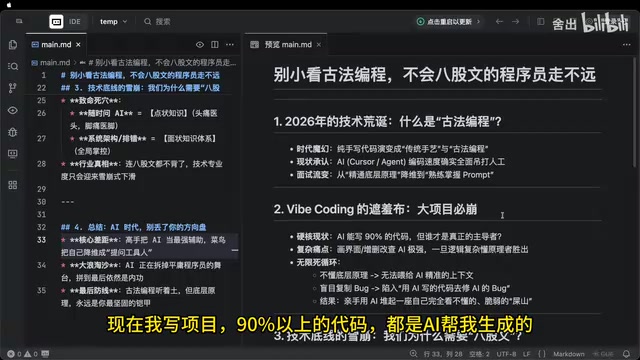
AI Can't Kill Old-School Programming: Why Fundamentals Are Still a Developer's Moat
Vibe Coding is trending, but can it replace solid fundamentals? A deep analysis of why core principles, systems thinking, and knowledge frameworks remain a developer's moat in the AI era.