OpenAI Codex Deep Dive: AI Programming Evolves from Code Completion to Full-Repository Autonomous Development
OpenAI Codex Deep Dive: AI Programming…
AI programming enters a new era of full-repository autonomous understanding as OpenAI, Windsurf, and Anthropic compete
AI programming is undergoing a profound shift from single-file assistance to full-repository autonomous understanding. OpenAI released its O3-fine-tuned Codex agent capable of autonomously reading entire codebases and completing debugging; Windsurf launched its IDE-optimized proprietary model SW1E1; and Anthropic is about to release new reasoning models with automatic debugging capabilities. These advances will dramatically boost development efficiency and product iteration speed, while NVIDIA's Shanghai expansion shows the computing power supply competition continues.
Introduction
The AI programming landscape is undergoing a profound transformation. Just recently, OpenAI released its brand-new AI programming agent Codex, while its acquired company Windsurf simultaneously launched a proprietary model series. Combined with Anthropic's upcoming new reasoning model, AI programming has officially moved from "assisted code writing" into a new era of "autonomously understanding entire code repositories."
This article provides an in-depth analysis of the core capabilities of these new models and the substantive changes they bring to developers' daily workflows.
OpenAI Codex: From Single-File Assistance to Full-Repository Autonomous Understanding
The Technical Prowess of the Underlying Model Codex-1
OpenAI's newly released Codex agent is powered by a specialized model fine-tuned on O3—called Codex-1. O3 is OpenAI's advanced reasoning model series, the third generation of its "o" series (models with chain-of-thought reasoning capabilities). Unlike the traditional GPT series, O-series models perform multi-step internal reasoning before generating responses, similar to how humans "work through scratch paper" when solving problems. "Fine-tuned on O3" means that Codex-1 builds upon O3's powerful general reasoning capabilities, with specialized training (fine-tuning) on large volumes of high-quality code data and programming tasks, achieving more precise performance in code generation, comprehension, and debugging. In programming benchmarks, Codex-1 outperforms both Claude 3.7 and O3 High, demonstrating current state-of-the-art code generation and comprehension capabilities.
Previously, OpenAI had just released Codex-CLI for local execution, while this new Codex supports cloud-based operation with seamless GitHub integration, directly accessing and manipulating code repositories. Each task runs in an independent virtual sandbox equipped with dedicated file systems, CPU, memory, and network policies, balancing efficiency with security. A sandbox is a security isolation technology originating from operating systems and cloud computing—essentially a restricted execution environment where tasks are isolated from each other without interference. This design prevents AI-executed code from accidentally modifying or damaging users' production environments while ensuring each task runs in a clean environment for more stable and reliable results. Similar technology is already widely used in Docker containers and serverless cloud functions. Codex's adoption of this approach for AI programming agents is a textbook example of combining software engineering best practices with AI capabilities.
Core Breakthrough: Truly Understanding Entire Code Repositories

To understand the revolutionary significance of Codex, we first need to recognize the limitations of previous AI programming tools. Traditional models were essentially "single-file processors"—you write code in one file and can ask the model questions, request modifications, or merge changes. But real-world applications are far more complex than a single file can contain, involving multi-level folder structures, complex module dependencies, and system architectures.
Repository-level understanding is a widely recognized technical challenge in AI programming. A medium-to-large project's code repository typically contains hundreds or even thousands of files, involving multiple programming languages, framework configurations, database migration scripts, test cases, and CI/CD pipeline definitions. Complex import dependencies, inheritance relationships, and runtime call chains exist between files—relationships that often cannot be inferred from a single file. Traditional AI programming tools are limited by the context window size—the amount of text a model can "see" at once—typically handling only a single file or small file fragments.
In the past, when using AI-assisted programming, developers had to manually tell the model: where other files are located, what each file does, and which dependencies to watch when making changes. Codex, however, can autonomously read and understand the entire code repository, independently completing debugging, testing, and a series of other tasks without developers providing step-by-step guidance. Codex's breakthrough lies in combining ultra-long context capabilities, code indexing technology, and agent-style proactive exploration strategies, enabling the model to navigate code bases autonomously like an experienced developer—tracing call chains and understanding inter-module collaboration.
In one sentence: Previous models required you to constantly feed them information; now Codex is an intelligent assistant that automatically understands the big picture—and may even know your code better than you do.
Windsurf Launches Proprietary Model SW1E1: Built for the IDE

Windsurf, acquired by OpenAI, has also released its first proprietary model series SW1E1, available in three tiers: full-capability, medium, and small. Based on officially published comparison data, SW1E1's capabilities approach those of Claude 3.7 and Claude 3.5, clearly outperforming DeepSeek V3.
An IDE (Integrated Development Environment) is the core tool developers use daily for writing, debugging, and managing code—common examples include VS Code, the JetBrains suite, and Windsurf's own editor. Deep integration between AI models and IDEs means the model can not only generate code snippets but also perceive the current editor's context—including cursor position, open files, project structure, terminal output, and Git change history. SW1E1 is custom-built for the Windsurf editor, with model training and inference optimization specifically adapted for IDE interaction scenarios, such as faster response times, more precise context awareness, and more natural multi-turn conversational editing experiences. This "model + tool" vertical integration strategy aligns with the approach of AI programming editors like Cursor, representing the trend of AI programming tools evolving from general-purpose plugins to specialized platforms.
However, one caveat: the official comparison report is incomplete—it lacks horizontal comparisons with mainstream reasoning models like DeepSeek R1 and Qwen 3, so SW1E1's true competitive positioning still awaits more comprehensive evaluation.
What AI Programming Capability Improvements Mean for Developers

Work Efficiency: From Quantitative to Qualitative Change
For engineers who write code daily, Codex-class tools address a real pain point: after confidently writing all your code, the debugging process is often extremely painful and time-consuming. Especially in large code repositories, developers frequently forget the logic they wrote just days ago, requiring repeated review and analysis.
If AI can read all the code and understand the entire architecture and module distribution, it becomes an assistant that knows the project's full picture even better than the developer. Work that previously took days of debugging and troubleshooting could potentially be compressed to just a few hours.
Dramatically Accelerated Product Iteration
The time saved doesn't just improve individual efficiency—it drives the entire project's iteration pace. A product's development cycle is long, and adding each small feature can bring enormous workload. When all developers' efficiency improves collectively, the app feature updates users are waiting for may no longer require waiting until "the next version release"—instead, a request made today could go live tomorrow.
Anthropic's New Reasoning Model: Automatic Debugging Capabilities Worth Anticipating
Beyond already-released products, Anthropic's Claude series is also expected to launch two new reasoning models: the Claude Sonnet series and the Claude Opus series. Reportedly, these models can freely switch between "thinking" and "exploring" modes, with support for tool use—including web tools, apps, databases, and other external resources.
The "thinking mode" here is similar to existing reasoning models' chain-of-thought process, where the model performs internal logical reasoning and problem decomposition. The "exploring mode" allows the model to proactively invoke external tools—such as browsing web pages, querying databases, executing code, or calling APIs—to obtain real-time information and validate hypotheses. The ability to freely switch between modes means the model possesses metacognitive capabilities: it can determine whether the current problem requires pure logical reasoning or external information, and automatically fall back to reasoning mode for reflection and correction when tool calls encounter errors. This "reason-act-reflect" loop mechanism (similar to the ReAct framework philosophy) is precisely the technical foundation for achieving automatic debugging.
More critically, when the model encounters problems while using tools, it automatically returns to reasoning mode for thinking and self-correction. This is essentially automatic debugging capability, which holds tremendous practical value for AI programming. Considering that Claude 3.7 already performs excellently in programming, the new models with added reasoning and self-correction capabilities will further raise the ceiling of AI programming.
NVIDIA's Shanghai Expansion: Market Competition in AI Computing Power Supply

While AI programming capabilities advance rapidly, the underlying computing power supply is equally worth monitoring. Reports indicate that NVIDIA plans to establish a research center in Shanghai. Jensen Huang discussed this plan during his visit to China last month, having already leased new office space in Shanghai and posted job listings for engineers and other positions.
NVIDIA states it will not send any GPU designs to China to comply with export controls, but will focus on Chinese customers' needs—for example, after the H20 was banned, preparing the less capable L20 chip as an alternative. To understand the context of this decision, we need to review the evolution of U.S. chip export controls on China. Controls began in 2022 and have undergone multiple rounds of escalation. NVIDIA initially launched the A800 and H800 for the Chinese market (downgraded versions of the A100 and H100, respectively), but these chips were subsequently brought under control as well. The H20 was a chip NVIDIA specifically designed to comply with the latest export control regulations, with computing power significantly reduced compared to the H100, but still retaining large memory capacity (96GB HBM3), suitable for large model inference scenarios. However, the H20 was also restricted by bans in early 2025. The L20 is a data center GPU based on the Ada Lovelace architecture, originally positioned for inference and graphics rendering workloads, with FP8 computing power roughly half that of the H20 and notably inferior memory bandwidth. From H100 to H800, then to H20, and now retreating to L20—each round of substitution comes with significant performance degradation.
This reflects NVIDIA's determination not to abandon the Chinese market, but the performance compromises in these "alternative to the alternative" solutions are evident, imposing substantive computing power constraints on Chinese AI companies training and deploying large-scale models.
Summary and Outlook
AI programming is moving from "code completion" to a new phase of "full-stack autonomous development." OpenAI Codex achieves autonomous understanding of entire code repositories, Windsurf's SW1E1 offers a new option for IDE programming experiences, and Anthropic's upcoming reasoning model brings the possibility of automatic debugging.
As programming capabilities dramatically improve, individual creativity will be fully unleashed, more groundbreaking applications are expected to emerge, and the leap in overall productivity will drive greater demand for foundation models and chips. This transformation has only just begun and deserves close attention from every developer and technology professional.
Key Takeaways
- OpenAI released the Codex agent, powered by the O3-fine-tuned Codex-1 model, capable of autonomously understanding entire code repositories for debugging and testing—compressing days of developer work into hours
- Windsurf launched its first proprietary model series SW1E1 in three versions, with capabilities approaching Claude 3.7 levels, custom-built for its editor
- Anthropic is about to release new reasoning models supporting switching between thinking and exploring modes, with automatic debugging and self-correction capabilities
- AI programming has evolved from single-file assistance to full-repository understanding, marking a qualitative shift in development efficiency and a fundamental acceleration of product iteration speed
- NVIDIA plans to establish a research center in Shanghai, substituting the banned H20 chip with the L20, demonstrating its determination not to abandon the Chinese market
Related articles
 Tech Frontiers
GitHub Agent HQ Launch: AI Coding Tools Enter the Era of Platform Competition
GitHub Universe unveils Agent HQ platform for unified coding agent management, Copilot upgrades with multi-model support. OpenAI completes restructuring, Anthropic tests new model, NVIDIA open-sources AI models.
 Tech Frontiers
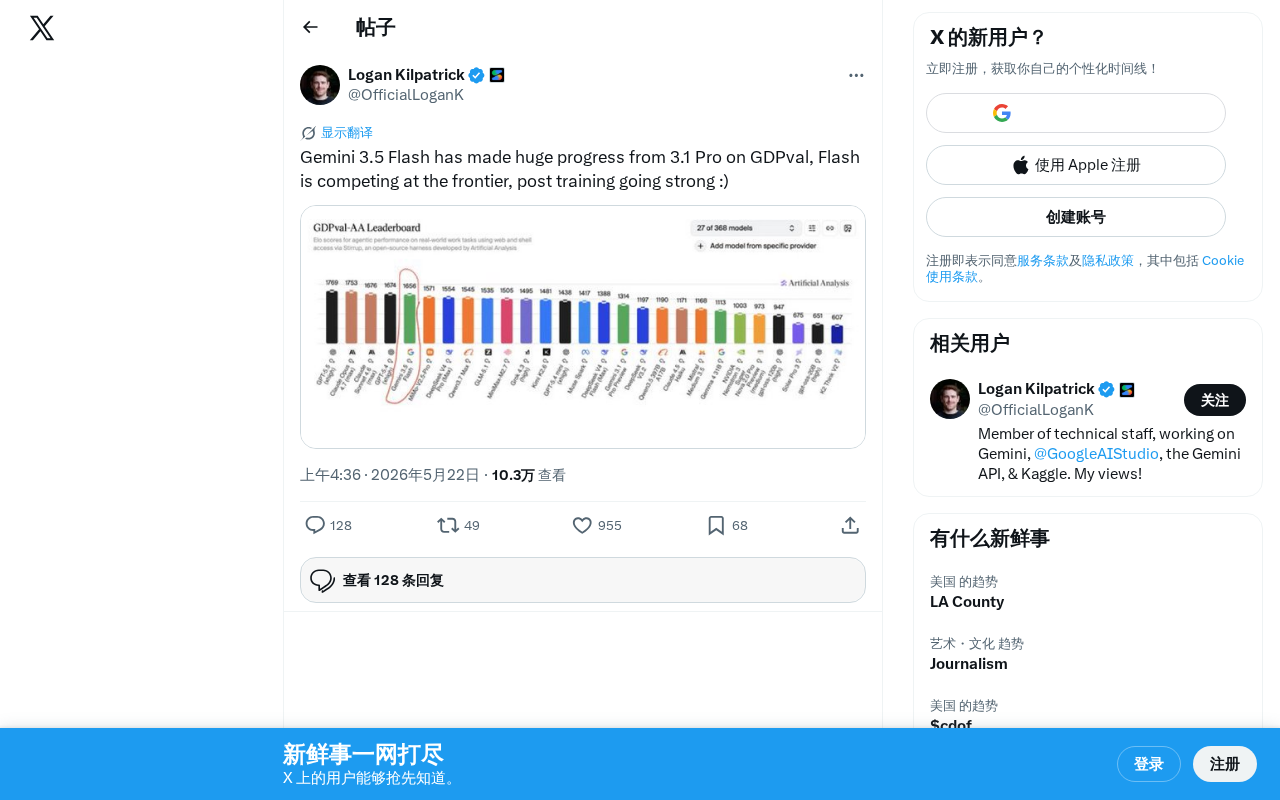
Gemini 3.5 Flash Achieves a Massive Leap on the GDPval Benchmark
Google Gemini 3.5 Flash surpasses Gemini 3.1 Pro on the GDPval benchmark. The lightweight Flash model leverages post-training techniques to approach frontier-level performance, redefining the balance between quality and cost.
 Tech Frontiers
Google Gemini Antigravity Weekly Quota Tripled — AI Coding Without Limits
Google Gemini triples Antigravity weekly quotas following a prior daily quota boost. Analyzing the impact on developers and its strategic significance in AI coding.