AMD Stock Breaks $500: A Deep Dive into the AI Chip Competitive Landscape
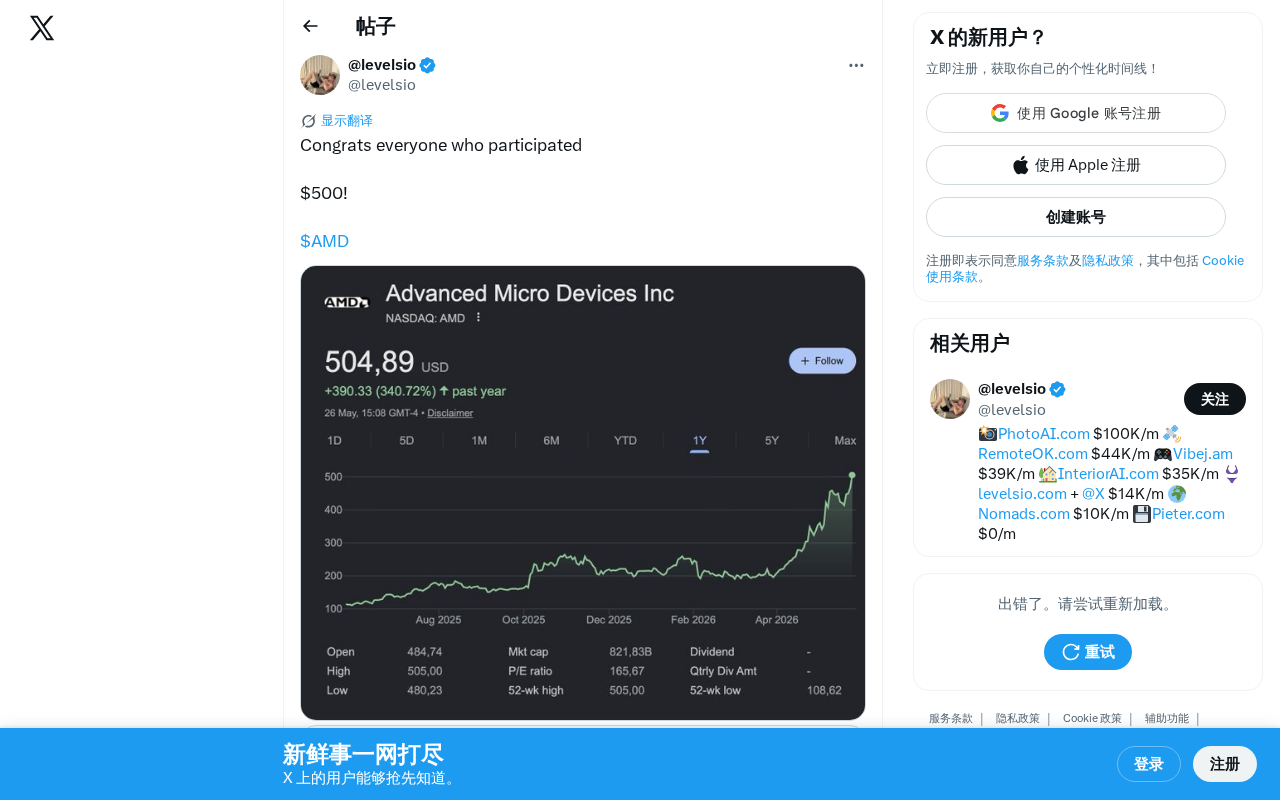
AMD stock breaks $500 as AI chip demand fuels its transformation from near-bankruptcy to industry giant.
AMD's stock breaking $500 marks a remarkable turnaround for a company that traded below $2 a decade ago. Driven by explosive AI chip demand, AMD's Instinct MI300X GPU with 192GB HBM3 memory is challenging NVIDIA's dominance. While AMD's hardware is increasingly competitive, its ROCm software ecosystem still lags behind NVIDIA's CUDA. The stock's rise reflects both strong fundamentals and broader AI industry growth, though high valuations and intensifying competition pose risks.
AMD Stock Milestone: Breaking the $500 Barrier
Recently, AMD (Advanced Micro Devices) stock successfully broke through the $500 mark, a milestone price level that has attracted widespread market attention. On social media, investors celebrated the moment as AMD's market cap once again set a new all-time record.
From a chip company once on the brink of bankruptcy to an AI chip giant now worth hundreds of billions of dollars, AMD's comeback story is one of the most remarkable business narratives in the semiconductor industry. Looking back, AMD's stock price fell below $2 during 2014-2015, with the company facing severe financial crisis and its market share being significantly eroded by Intel and NVIDIA. After Lisa Su took over as CEO in 2014, she implemented a series of strategic transformations: divesting non-core businesses, focusing on high-performance computing, and launching the entirely new Zen architecture for CPUs and RDNA architecture for GPUs. The success of the Zen architecture propelled AMD's server CPU market share from less than 1% to over 20%, and now the AI wave has opened up entirely new growth opportunities for its GPU business. From $2 to $500, AMD's stock price achieved approximately 250x returns over a decade—and behind it all is the massive momentum driven by the AI wave.
AI Chip Market: AMD's Strategic Positioning
The Strong Rise of Data Center GPU Business
AMD's positioning in the AI accelerator space has become increasingly clear in recent years. Its Instinct series GPUs, particularly the MI300X and upcoming next-generation products, are becoming formidable competitors to NVIDIA's H100/B200 series. The MI300X employs an advanced chiplet architecture design, integrating multiple compute dies and I/O dies through advanced packaging technology. Its biggest highlight is the 192GB of HBM3 high-bandwidth memory with memory bandwidth reaching 5.3TB/s, far exceeding NVIDIA H100's 80GB HBM3 configuration. This memory advantage is particularly critical in large language model inference scenarios, as model parameters need to be fully loaded into GPU memory for efficient operation—larger memory means running bigger models on a single card while reducing multi-card communication overhead. Multiple cloud service providers and hyperscale data center operators have begun procuring AMD's AI accelerator cards to diversify their supply chains.
The data center business has become AMD's fastest-growing segment. With the explosive growth in demand for large language model training and inference, enterprise demand for high-performance AI chips far exceeds supply, providing AMD with an excellent window of opportunity to enter the market.
AMD vs. NVIDIA: The Competitive Dynamics
Although NVIDIA still holds absolute dominance in the AI chip market (with over 80% market share), AMD is narrowing the gap through a multi-dimensional strategy:
- Price-performance advantage: The MI300X offers more competitive price-performance in certain inference scenarios
- Open ecosystem: The ROCm software stack continues to improve, reducing developer migration costs. ROCm (Radeon Open Compute) is AMD's open-source GPU computing platform. While it has made significant progress in recent years, it still needs to catch up with NVIDIA's CUDA platform in terms of library completeness, debugging tool maturity, and third-party software compatibility. CUDA has developed over nearly 20 years, forming a massive developer community where virtually all mainstream deep learning frameworks prioritize CUDA support, with millions of developers familiar with its programming model—this software ecosystem "network effect" constitutes NVIDIA's deepest moat
- Memory bandwidth leadership: Using HBM3 technology, demonstrating memory capacity advantages in large model inference. HBM (High Bandwidth Memory) is a high-performance memory standard using 3D stacking technology, with multiple DRAM chip layers vertically stacked and interconnected through Through-Silicon Via (TSV) technology, then closely connected to the GPU die through an interposer. Compared to traditional GDDR memory, HBM provides several times the bandwidth with lower power consumption. In AI training and inference, the read/write speed of model parameters and intermediate activation values directly impacts computational efficiency, making memory bandwidth often the performance bottleneck. Currently, the main HBM suppliers are SK Hynix, Samsung, and Micron, and supply constraints are one of the key factors limiting AI chip production capacity
- Customer diversification needs: Enterprise customers don't want to be locked into a single vendor, making AMD the preferred alternative
Fundamental Support Behind the Stock Price
Continuously Improving Financial Performance
AMD's stock price rise is not mere market hype—it's backed by solid performance. The company's data center revenue has achieved high-speed growth for multiple consecutive quarters, with AI-related chip revenue contribution steadily increasing. Management has raised full-year AI chip revenue guidance multiple times, demonstrating strong confidence in market demand.
Product Roadmap Provides Market Certainty
AMD CEO Lisa Su has established a clear annual iteration plan, committing to launching a new generation of AI accelerators every year. This predictable product cadence gives investors and customers ample confidence and is an important factor in the stock's continued rise.
Risks and Challenges Facing AMD
Software Ecosystem Remains the Biggest Weakness
Despite the narrowing hardware performance gap, AMD still has a significant deficit compared to NVIDIA's CUDA in the AI software ecosystem. CUDA (Compute Unified Device Architecture) is a parallel computing platform and programming model launched by NVIDIA in 2006. After nearly 20 years of accumulation, a vast number of AI frameworks and models are optimized for CUDA by default, and developers migrating to the ROCm platform still face compatibility and performance tuning challenges. The software ecosystem barrier means AMD needs to continuously invest billions of dollars and deeply collaborate with mainstream AI framework communities to gradually close this gap.
High Valuation Brings Correction Pressure
A $500 stock price means AMD's price-to-earnings ratio is already at elevated levels. If AI chip demand growth slows, or if intensifying competition pressures profit margins, the current valuation may face correction risk.
New Competitors Continue to Enter
Beyond NVIDIA, Google's TPU, Amazon's Trainium/Inferentia, and numerous AI chip startups are all competing for market share. Google's TPU (Tensor Processing Unit) is the most successful case of custom AI chips (ASIC), specifically optimized for matrix operations and neural network computation, achieving several times the energy efficiency of general-purpose GPUs for specific workloads. Amazon's Trainium (for training) and Inferentia (for inference) are similarly custom chips optimized for their own cloud services. The advantage of ASICs lies in extreme optimization for specific algorithms and lower cost per unit of compute; the disadvantage is limited flexibility—when AI algorithm architectures undergo major changes, ASICs may need to be redesigned. General-purpose GPUs excel in flexibility and broad software compatibility, able to adapt to rapidly evolving AI model architectures. The efficiency advantages of custom chips in specific scenarios may also erode the market space for general-purpose GPUs.
Deeper Implications for the AI Chip Industry
AMD's stock breaking $500 is not just one company's victory—it reflects the prosperity of the entire AI chip industry. The market's hunger for AI compute is reshaping the competitive landscape of the semiconductor industry:
- Compute demand is far from peaking: Large model parameter scales continue to grow, from GPT-3's 175 billion parameters to GPT-4's estimated trillion-level, with next-generation models potentially expanding by several more orders of magnitude. According to research from OpenAI and other institutions, there exists a "Scaling Law" relationship between model performance and parameter scale, training data volume, and compute—increasing these three elements typically yields predictable performance improvements. Training a frontier large model may require tens of thousands of high-end GPUs running for months at a cost of hundreds of millions of dollars, while the total compute consumed during inference serving hundreds of millions of users may far exceed the training phase. The rise of multimodal AI (models integrating text, images, video, and audio) further drives up computational demand, as processing video and image data requires far more computation than pure text
- Supply chain diversification becomes essential: The risk of single-vendor dependency is driving enterprises to actively seek alternatives
- Hardware-software synergy is key to winning: Hardware performance alone is no longer sufficient to build a moat—ecosystem completeness is equally important
For AI practitioners, AMD's rise means more hardware choices and more competitive pricing, which is undoubtedly a positive signal for the entire industry's development. Competition drives innovation, and ultimately the entire AI ecosystem will benefit.
Related articles

Claude Code for Test Development in Practice: An AI Programming Workflow That Doubles Your Efficiency
A practical guide to Claude Code for test development: auto-generating test scripts, Plan Mode workflows, MCP + Playwright integration, and Subagent parallel tasks to build systematic AI-assisted workflows.

Hermes Agent Hands-On Review: An AI Efficiency Revolution for Indie Game Developers
Indie game developer reviews Hermes Agent vs OpenClaude: intelligent context compression, real-time Memory, remote control via Telegram, and practical use cases in game dev, social media, and email.
Vibe Coding Beginner's Guide: Tool Selection Across Three Categories with Practical Examples
A comprehensive guide to Vibe Coding's three tool categories: Agent frameworks, CLI Coding, and IDE tools, with practical examples including Snake game and data analysis workbench.