Andrew Ng and Anthropic Launch the Definitive Claude Code Tutorial: A Complete Breakdown
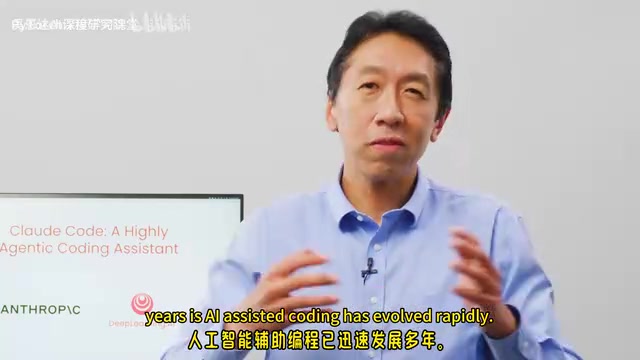
Andrew Ng and Anthropic's definitive Claude Code course covers best practices, multi-instance workflows, and MCP integration.
Andrew Ng and Anthropic engineer Eddie Schopik have launched a comprehensive Claude Code course covering core usage principles, multi-instance parallel development with Git Worktrees, and MCP server ecosystem integration. The course features three hands-on projects — a RAG chatbot, Jupyter Notebook data exploration, and Figma-to-frontend conversion — systematically teaching developers how to maximize productivity with AI-assisted agentic programming.
Course Background and Positioning
Andrew Ng and Anthropic engineer Eddie Schopik have jointly launched a systematic tutorial on Claude Code, positioned as the "definitive course" for the tool. Andrew Ng is a Stanford University professor, founder of DeepLearning.AI, and co-founder of the online education platform Coursera. During his previous roles as chief scientist at Google Brain and Baidu, he drove the large-scale adoption of deep learning in industry. Anthropic, founded in 2021 by former OpenAI Research VP Dario Amodei and Daniela Amodei, is an AI safety company whose core Claude model series is known for its "Constitutional AI" methodology, emphasizing controllability and safety of AI systems. This collaboration represents a deep integration of top-tier AI educational resources with cutting-edge model capabilities.
Andrew Ng states upfront: Claude Code is currently his personal favorite coding assistant, and it has significantly boosted productivity for him and many other developers.
The core objective of this course is to systematically teach Claude Code best practices. Ng points out that even developers already using Claude Code can achieve significant productivity gains through systematic study of these best practices.
The Evolution of AI-Assisted Programming
Four Stages: From Q&A to Autonomous Agents
Eddie Schopik reviews the rapid evolution of AI-assisted programming:
- Early Stage: Developers occasionally asked LLMs programming questions
- Autocomplete Era: The rise of code autocomplete tools, led by GitHub Copilot. Launched in 2021, GitHub Copilot is based on OpenAI's Codex model (a code-fine-tuned version of GPT-3) and generates real-time code completion suggestions by analyzing the developer's current code context. Its working principle involves feeding the code before and after the cursor as a prompt to a large language model, which then predicts the most likely subsequent code snippets. This approach is fundamentally "passive-reactive" — it only provides suggestions while developers are writing code and cannot proactively understand the overall project structure or autonomously execute multi-step tasks.
- Autonomous Tools Stage: Various AI coding tools became increasingly autonomous
- Claude Code Era: A qualitative leap in agency capabilities
In the AI field, "agency" refers to an AI system's ability to autonomously perceive its environment, formulate plans, execute multi-step operations, and adjust strategies based on feedback. Unlike the traditional "question-and-answer" mode, an AI with agency can decompose a complex task into multiple subtasks, execute them sequentially or in parallel, and autonomously decide the next action throughout the process. This involves multiple technical capabilities including tool use, long-term memory management, and error recovery. Claude Code's agency is demonstrated by its ability to autonomously browse file systems, run tests, analyze error logs, and fix code — all without step-by-step guidance from the developer.
A notable characteristic of Claude Code is that it can work independently for several minutes or even longer to complete a task. Going further, developers are now orchestrating multiple Claude instances to work in parallel on different parts of a codebase.
Best Practices for Multi-Instance Coordination
The course emphasizes that coordinating multiple Claude Code instances involves a set of best practices that haven't been widely disseminated. For developers who haven't encountered these methodologies, mastering them will bring a tremendous productivity leap.
Core Principles for Using Claude Code
Provide Clear Context
The key recommendation from the course is: Provide Claude Code with clear context to help it complete tasks efficiently. Specifically:
- Point to relevant files: Explicitly tell Claude Code which files to focus on
- Describe requirements clearly: Detail the functionality and features you want
- Expand capability boundaries: Enhance Claude Code's capabilities through MCP servers and other tools in the ecosystem
The Elegant Simplicity of the Underlying Architecture
Andrew Ng specifically highlights the simplicity of Claude Code's underlying architecture. It doesn't rely on semantic embedding of code or converting it into searchable structures. Instead, it depends on just a few core tools:
- Pattern matching within code files
- Listing directory structures
- Viewing file contents
- Regular expression matching
Semantic embedding is a technique that converts unstructured data like text and code into high-dimensional vector representations. In the code intelligence domain, many tools pre-process entire codebases with embeddings, mapping code units such as functions, classes, and modules into vector space, then using vector similarity search to quickly locate relevant code snippets. The advantage of this approach is fast retrieval, but the downsides are clear: it requires building and maintaining an index beforehand, the indexing process may require uploading code to the cloud, and embedding quality is limited by model capabilities. Claude Code's choice to not rely on this method — instead using real-time file browsing and pattern matching to understand code — means code never needs to leave the local environment, providing a natural advantage in data security and privacy protection.
Claude Code's effectiveness comes from its ability to agentically read code, take notes in .md files, autonomously understand the codebase structure, and then make decisions to advance the code based on that understanding. Since it doesn't need to index the codebase, code can remain entirely local, which also brings security advantages.
Three Hands-On Projects in Detail
Project 1: RAG Chatbot
Build a complete RAG chatbot from frontend to backend, covering these core aspects:
- Code refactoring and optimization
- Writing automated tests
- Using GitHub integration to handle Pull Requests and fix Issues
RAG (Retrieval-Augmented Generation) is an AI architecture pattern that combines information retrieval with text generation. Its core idea is: before a large language model generates an answer, it first retrieves the most relevant document fragments from an external knowledge base, then injects these fragments as context into the model's prompt, enabling the model to generate answers based on the most current and accurate information. A typical RAG system contains three core components: document processing and chunking, vectorized storage and retrieval (typically using vector databases like FAISS or Pinecone), and generation based on retrieval results. RAG effectively addresses the knowledge cutoff date limitation and "hallucination" problems of large language models, making it one of the most common architecture patterns in enterprise AI applications.
The course will dive deep into Claude Code's core features including planning mode, thinking mode, creating parallel sessions, and managing Claude's memory.
Project 2: Jupyter Notebook Data Exploration
Using Claude Code to work with e-commerce data, completing the following tasks:
- Refactoring Notebook code structure
- Removing redundant code to improve code quality
- Creating powerful data dashboards and web applications
Project 3: Figma Design to Frontend Application
This is the most agent-characteristic hands-on project:
- Using Figma visual design mockups as input
- Using the Figma MCP server to import design elements
- Combining other MCP servers for iteration, testing, and building
- Autonomously completing frontend application development in an agentic manner
Figma is currently the most mainstream collaborative design tool in the design industry. UI mockups created by designers in Figma contain rich structured information: component hierarchies, style properties (colors, fonts, spacing), layout constraints, interaction states, and more. The Figma MCP server obtains this structured design data through Figma's open API and converts it into a format that Claude Code can understand. This means Claude Code isn't simply "looking" at a design screenshot — it can precisely access the property values of each design element, thereby generating pixel-perfect frontend code. This "Design-to-Code" automation workflow traditionally requires frontend developers to spend significant time implementing manually, but through MCP integration, Claude Code can compress this process to just a few minutes.
Key Technical Highlights
Git Worktrees and Parallel Development
The course teaches how to leverage Git Worktrees with multiple Claude Code instances for parallel development. Git Worktrees is a feature introduced in Git 2.5 that allows developers to simultaneously check out multiple working directories from the same Git repository, with each working directory corresponding to a different branch. In traditional Git workflows, developers need to stash current modifications or commit before switching branches, whereas Worktrees allow multiple branches to exist simultaneously as independent directories in the file system.
This is particularly important for Claude Code's multi-instance parallel development scenario: each Claude instance can work in an independent Worktree, modifying code on different branches without interfering with each other, and finally integrating the results through Git's merge mechanism. This approach avoids conflict issues caused by multiple AI instances modifying the same file simultaneously, and is an important technique for advanced users to boost efficiency.
MCP Server Ecosystem Integration
The course demonstrates how to extend Claude Code's capability boundaries through MCP (Model Context Protocol) servers, showing how to integrate external services like GitHub and Figma to achieve more complex automated workflows.
MCP is a standardized protocol open-sourced by Anthropic in late 2024, designed to establish a unified communication interface between AI models and external tools and data sources. Think of MCP as the "USB-C port" of the AI world — it defines a standardized way for AI assistants to connect to various external services. MCP uses a client-server architecture: AI applications (like Claude Code) serve as MCP clients, while various tools and services (such as GitHub API, Figma API, databases, etc.) expose their functionality through MCP servers. Developers can write custom MCP servers to connect to any internal system. This design allows Claude Code's capabilities to continuously expand through community-contributed MCP servers, forming an open tool ecosystem. There are currently hundreds of community-developed MCP servers covering scenarios ranging from code hosting and design tools to database management.
Summary and Outlook
The value of this course lies in systematically organizing Claude Code best practices that were previously scattered across the community. Whether you're a newcomer to AI coding tools or a developer with existing experience, you can gain substantial capability improvements from it.
Claude Code represents the trend of AI-assisted programming shifting from "tool" to "collaborator" — it can not only execute instructions but also autonomously understand codebases, formulate plans, and advance development tasks. For developers who want to stay competitive, mastering best practices for these highly agentic programming tools is no longer optional — it's required learning.
Related articles
Codex VS Claude Code: The Token Economics Behind a 10x Price Gap
Same coding task: Codex costs $15, Claude Code costs $155. Deep dive into the real reasons behind the 10x gap — it's not pricing, it's token volume, output style, and context strategy.
Gemma 4 Open-Source Model Local Deployment Guide: Ollama Installation & Mobile Setup
Step-by-step guide to deploying Google's Gemma 4 open-source model locally with Ollama and running the lightweight version on mobile with tool calling support.
The Decline of Tokenmaxxing: Why Selling Outcomes Matters More Than Selling Tokens
The Tokenmaxxing craze is fading as enterprise AI procurement shifts from chasing Token counts to focusing on actual business outcomes. Learn why outcome-based AI evaluation is the right approach.