Andrew Ng Partners with Anthropic to Launch Agent Skills Course: Build Once, Deploy Anywhere
Andrew Ng and Anthropic launch a course on building reusable, cross-platform Agent Skills.
Andrew Ng and Anthropic have launched the Agent Skills course, explaining how to encapsulate repetitive domain expertise into reusable Skill modules that follow an open standard for cross-platform deployment. The course covers Skills' technical architecture, progressive context loading, integration with MCP and Subagents, and includes four hands-on modules spanning marketing, content creation, code review, and research agents.
Course Overview: What Are Agent Skills?
Andrew Ng has partnered with Anthropic to launch a brand-new course — Agent Skills, taught by instructor Ellie Sherwick. The course centers on one core concept: Skills are instruction folders that give Claude Code and other AI Agents new capabilities, significantly expanding the range of tasks an Agent can perform.
Put simply, if you have a workflow you repeatedly ask an Agent to execute, instead of explaining it from scratch every time, you can package it as a Skill so the Agent automatically knows what to do. This is the core value of Skills — encapsulating repetitive domain expertise into reusable capability modules.
Technical Architecture of Skills
Standardized File Structure
Each Skill is essentially a folder containing instructions. At its core is a skill.md Markdown file with three key elements:
- Name: Identifies the skill's purpose
- Description: Explains the scenarios where the skill applies
- Main Instructions: Detailed execution steps
The main instructions can also reference other files, including scripts, additional Markdown files, and asset files such as templates and images. This modular design keeps Skills both concise and flexible.
Progressive Context Loading Mechanism
The course introduces a critically important design principle — Progressive Disclosure. Here's how it works:
- A skill's name and description are always present in the Agent's context window
- Only when a user request matches a skill's description does the Agent load the skill's full instructions into the context
- If needed, the Agent further loads referenced files and asset files
This mechanism effectively prevents wasting the context window, allowing the Agent to remain highly responsive even when equipped with a large number of skills. It's an elegant engineering design that directly addresses the real-world constraint of limited context length in large language models.
Basic Tool Requirements
To enable an Agent to use a Skill, two fundamental tools are required:
- File system access: For reading and writing files
- Batch Tool: For executing code
These two tools allow the Agent to execute the various commands and operations defined within a Skill.
Open Standard: Build Once, Deploy Anywhere
One of the most noteworthy takeaways from the course is that Skills have become an Open Standard. This means Skills have a standardized format and can work with any Skills-compatible Agent product.
The strategic significance of this cannot be overstated. Developers only need to build a Skill once and can then deploy it across multiple Agent products, dramatically reducing the cost of redundant development. This aligns perfectly with the philosophy of MCP (Model Context Protocol) — breaking down barriers between different AI systems through standardized protocols.
How Skills Work with MCP and Subagents
The course specifically emphasizes that Skills don't exist in isolation. They can be combined with MCP and Subagents to build powerful agentic workflows:
- Skills + MCP: MCP handles fetching data from external data sources, while Skills tell the Agent how to process that data or retrieve it efficiently
- Skills + Subagents: An Agent can delegate tasks to Subagents with isolated contexts, and those Subagents can themselves use Skills to access specialized knowledge
This combination creates a well-structured hierarchy of Agent capabilities: MCP solves the "where does the data come from" problem, Skills solve the "how to use the data" problem, and Subagents solve the "how to divide the tasks" problem.
Hands-On Course Content
The course features four progressively advanced hands-on modules:
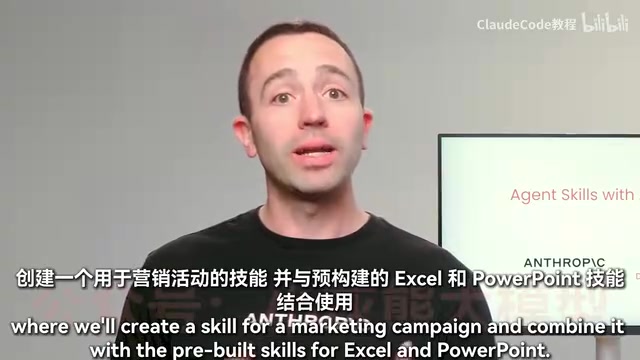
- Marketing Campaign Skill: Create a marketing campaign skill in Cloud AI and combine it with pre-built Excel and PowerPoint skills
- Content Creation & Data Analysis: Build two independent Skills for content creation and data analysis workflows, invoked via the Claude API
- Code Review & Testing: Use Skills in Claude Code for code review and testing
- Research Agent: Build a research Agent using the Claude Agent SDK, leveraging a Skill to synthesize research results
These four modules cover the most common enterprise scenarios — from office automation to software development to research analysis — demonstrating the broad applicability of Skills.
Summary and Outlook
This Agent Skills course reveals an important trend in AI Agent development: the shift from general-purpose capabilities to specialized, modular capability expansion. The establishment of Skills as an open standard signals that the Agent ecosystem is moving from fragmentation toward interoperability.
For developers, mastering Skill construction means being able to systematically inject domain expertise into Agents, rather than relying on lengthy prompt engineering. For enterprises, the reusability and cross-platform compatibility of Skills will significantly reduce the marginal cost of Agent deployment.
As standardized components like MCP, Skills, and Subagents mature, we are witnessing the dawn of an "Agent-as-Platform" era — where every Agent can rapidly adapt to different business scenarios through plug-and-play capability modules.
Related articles
Freely Switch Between Claude/DeepSeek and Other AI Models in Codex: CPA Deployment Guide
Learn how to use CLI Proxy API (CPA) to aggregate Claude, DeepSeek, Grok, and Gemini models into OpenAI Codex via VPS deployment, Docker setup, and Codex++ integration.
Codex vs Claude Code: An In-Depth Comparison of AI Coding Agents
In-depth comparison of Codex, Claude Code, and Cursor across pricing, features, GitHub integration, and team collaboration to help developers pick the best AI coding agent.

Use Claude Code for Just ¥7.9: A Complete Guide to Affordable Alternatives with Chinese AI Models
Learn how to set up Claude Code with affordable Chinese AI model alternatives. Use providers like SiliconFlow and DeepSeek starting from just ¥7.9, with full environment variable configuration guide.