Codex vs Claude Code: An In-Depth Comparison of AI Coding Agents
A deep dive comparing Codex, Claude Code, and Cursor on cost, features, GitHub integration, and team workflows.
This article provides a comprehensive comparison of three leading AI coding agents — Codex, Claude Code, and Cursor — covering pricing, underlying model costs, feature sets, GitHub integration, and team collaboration capabilities. It highlights Codex's significant cost advantage with GPT-5, its superior GitHub integration for automated code review and bug fixing, and its streamlined approach to features, while acknowledging Claude Code's strengths in MCP integration and advanced configuration options.
From Cursor to Claude Code to Codex — one senior developer's migration journey across AI coding tools reveals the core competitive dynamics shaping today's AI coding agent market.
The Three Major AI Coding Agents Are Converging
An interesting phenomenon is unfolding: the features of Cursor, Claude Code, and Codex — three leading AI coding agents — are rapidly converging. AI coding agents are intelligent tools that understand natural language instructions and autonomously write and modify code. Unlike earlier code completion tools, coding agents possess contextual understanding, multi-step reasoning, and autonomous execution capabilities — they don't just complete a line of code, they can understand entire project structures, make cross-file modifications, run tests, and iterate based on results.
Cursor historically laid much of the groundwork, Claude Code built on it with numerous improvements (such as to-do lists and better diff formatting), and Cursor subsequently began emulating those improvements, with Codex following close behind. This convergence isn't uncommon in the tech industry — economists call it "Feature Convergence." When competitors in a market see a feature gain widespread user approval, they quickly follow suit, ultimately leading to highly similar products at the feature level, with competition shifting toward experience details and ecosystem integration.
That said, differences remain in the finer details. The Codex agent tends toward longer reasoning times but faster tokens-per-second output, while Claude Code spends less time reasoning but outputs relatively slower. This involves two key performance dimensions of large language models: reasoning depth and output speed. Reasoning depth refers to the number of "thinking" steps a model takes before generating its final answer — OpenAI's o-series models introduced a "Chain-of-Thought" mechanism where the model generates extensive intermediate reasoning steps internally before producing a result. Higher reasoning intensity improves accuracy on complex problems but increases latency. A token is the basic unit of text processing for LLMs — in English, roughly 1–1.5 tokens per word; in Chinese, about 1–2 tokens per character. Tokens per second (TPS) directly determines the response speed users perceive. This difference is quite noticeable in actual coding — for simple tasks, excessive reasoning can feel frustrating.
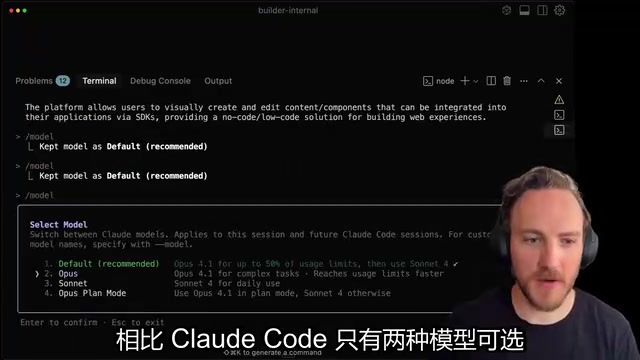
Codex offers a commendable design for model selection: users can freely switch between low, medium, and high reasoning intensity, or even choose a "Minimal" mode for maximum speed. This essentially gives users flexible control over the accuracy-speed tradeoff. By comparison, Claude Code offers only two model choices, while Cursor has so many options it can feel overwhelming. More importantly, the company behind Codex is the model developer itself (OpenAI), meaning they can best optimize their own models and offer the best pricing — no middleman markup.
Pricing Comparison: GPT-5's Cost Advantage Is Staggering
Codex comes with the standard ChatGPT subscription, and Claude Code comes with the standard Claude subscription. On the surface, pricing seems similar: both offer free tiers, plans around $20/month, and premium tiers at $100–$200. But a deeper analysis reveals massive cost differences.
GPT-5 as the underlying model is significantly more efficient. LLM usage costs are primarily driven by inference compute resources, typically measured in price per million input/output tokens. Model efficiency depends on multiple factors: how well the model architecture is optimized, the engineering implementation of the inference framework, and whether sparse computation architectures like Mixture of Experts (MoE) are employed. The core idea behind MoE is splitting the model into multiple "expert" sub-networks, activating only a subset during each inference pass, thereby dramatically reducing actual computation while maintaining the model's total parameter count and capabilities. As the model developer directly offering a coding tool, OpenAI eliminates the intermediary cost of third-party API calls while enabling deep optimization for its own infrastructure (such as custom inference chips and optimized batching strategies) — this is the structural source of its cost advantage.
According to real-world integration data from Builder.io:
- GPT-5/GPT-5 Codex costs only one-third of Claude Sonic
- Roughly one-tenth of Claude Opus
- In most benchmarks and real-world usage, these models actually perform quite comparably
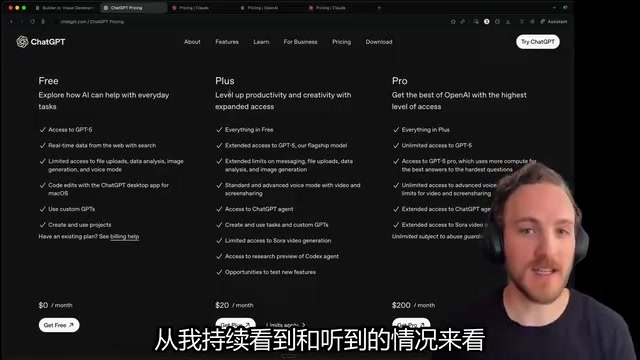
In terms of usage limits, Codex's advantage is even more pronounced. Based on actual user feedback, more people find the $20/month Codex plan perfectly sufficient, while Claude's $17 plan quickly hits usage caps. Even on Claude's $100 and $200 plans, heavy users still encounter limits, whereas virtually no one has reported quota issues with the Codex Pro plan.
Interestingly, these aren't just coding plans. The ChatGPT subscription also includes image generation, video generation, and other features, with a more polished overall product. That said, Claude's MCP integration is genuinely better, with many connectors available for one-click installation.
Feature Comparison: Less Is More?
Claude Code wins on feature richness: it supports creating custom sub-agents, hooks, and extensive configuration options. Codex, by contrast, is quite minimal — you'll barely find these kinds of advanced options.
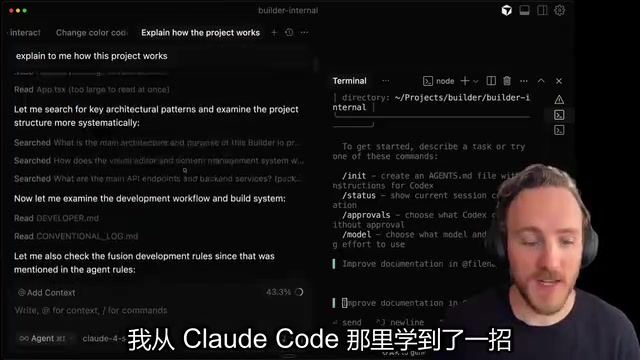
But here's a counterintuitive take: more features aren't necessarily better. As this developer responded when the Cursor team asked "what features would we need to add to bring you back" — "I really don't care about features themselves. I just want the best agent that can reliably get my work done." Those features that look cool? You genuinely don't miss them when they're gone. The core need is simple: an excellent agent plus a good instruction file.
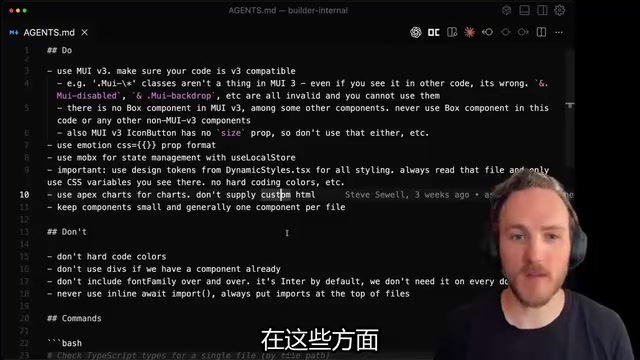
That said, one thing about Claude Code is genuinely frustrating: it doesn't support the agents.md standard and only recognizes claude.md. These two concepts deserve explanation. agents.md is an emerging project-level AI instruction file specification where developers can define code style preferences, architectural constraints, testing requirements, and other guidance to ensure AI agents follow team conventions when working with a codebase. Cursor, Codex, Builder.io, and other tools all support this universal standard. Claude Code insists on using its own claude.md format — a "walled garden" strategy that may increase user stickiness but also adds maintenance overhead when collaborating across multiple tools, forcing users to maintain a separate instruction file just for Claude.
As for Claude's MCP integration advantage — MCP (Model Context Protocol) is an open standard introduced by Anthropic in late 2024, designed to provide AI models with a unified way to connect to external tools and data sources. Through MCP, AI agents can connect to databases, APIs, file systems, and other external resources without writing custom adapter code for each integration — similar to how the USB protocol standardized peripheral connections. Claude Code genuinely leads in MCP ecosystem richness, with a large number of connectors available for one-click installation.
GitHub Integration: Codex's Killer Advantage
This is Codex's most prominent differentiator compared to other AI coding agents. To appreciate the weight of this advantage, you need to understand that modern software development relies heavily on CI/CD (Continuous Integration/Continuous Deployment) pipelines — every code commit automatically triggers a series of processes including builds, tests, and code quality checks. When an AI coding agent can deeply embed itself into this workflow, it upgrades from an "assisted coding tool" to an "automated development team member."
Claude Code's GitHub app experience was rated by the team as "terrible": code review comments lacked real value, were verbose and meaningless, couldn't catch obvious bugs, and couldn't be used within Claude to fix anything.
Codex's GitHub integration is a completely different story:
- After installing the GitHub app, you can enable automatic code review on any build
- It catches real, hard-to-spot bugs and comments inline
- You can have Codex automatically fix issues in the background and notify you when done
- Directly review the fixes, update the PR, and merge once confirmed
A Pull Request (PR) is GitHub's code review mechanism — after a developer submits code changes, team members review code quality, logical correctness, and potential risks. Codex's GitHub app can automatically find bugs and provide fixes at this stage, essentially embedding AI code review seamlessly into existing development workflows rather than requiring developers to change their habits to accommodate a new tool.
The most critical aspect is consistency — prompts debugged in the terminal and optimized agents.md instructions behave identically when used through the GitHub app. This means CI runs the same configuration, the same behavior, delivering a highly unified experience.
It's worth mentioning that Cursor's BugBot is also a solid alternative, capable of finding hidden bugs and offering convenient one-click fix buttons for the web version or Cursor.
Team Collaboration: Bridging the Last Mile from Design to Development
At the team level, Codex's advantages are further amplified. Through integration with Builder.io, designers can directly use Codex to update websites and apps via prompts, iterate using a Figma-like visual editor, and then submit PRs for the development team to review and merge.
The "handoff gap" between designers and developers has long been an efficiency bottleneck in the software industry. In traditional workflows, designers complete mockups in tools like Figma, then pass them to developers through annotation documents and design specs, who then "translate" the visual design into code. Information loss during this process is severe — pixel-perfect fidelity, interaction details, and responsive adaptation often require multiple rounds of communication to resolve. Visual development platforms like Builder.io attempt to bridge this gap through a WYSIWYG approach, and combining them with AI coding agents takes it a step further: designers can describe their intended changes in natural language, the AI agent executes changes directly on the real codebase, and the generated PR is reviewed by developers — ensuring code quality while dramatically shortening the cycle from design to deployment.
This means the entire team — designers, product managers, developers — all work on the same codebase, using the same model, following the same agents.md instructions. This workflow that eliminates handoff friction is becoming the new standard.
Conclusion: How to Choose the Right AI Coding Agent for You
All three AI coding agents have their strengths, and you can't go wrong with any of them. But if you need to prioritize, Codex's core advantages are:
- Lower underlying model costs, meaning more usage for the same price
- More generous usage limits, so heavy users no longer stress about quotas
- Outstanding GitHub integration, a complete loop from code review to automatic fixes
- Model provider is the tool developer, ensuring optimal pricing and performance
Of course, Claude Code still has advantages in MCP integration and advanced features, and Cursor has its own strengths in ecosystem richness. The final choice depends on your specific needs and workflow — but from a cost-effectiveness and daily experience standpoint, Codex is becoming the top choice for an increasing number of developers.
Related articles
Trae + WPS: Building a Zero-Code JSA Login Authorization System — A Practical Tutorial
Learn how to use Trae AI programming tool with WPS Bitable to build a JSA login authorization system with zero handwritten code, covering online tables, Web API auth scripts, and remote user management.

Superpowers: Installing Work Standards for Your AI Coding Assistant
How the Superpowers methodology constrains AI coding assistants through requirement clarification, task decomposition, TDD, and verification loops — with setup tips for Trae.

Scientific Achievements Deserve Public Applause: Why We Should Give Standing Ovations for Scientific Breakthroughs
Scientific achievements receive far less public attention than entertainment and sports. This article explores why we should applaud scientific breakthroughs and how AI is leading a new celebration culture.