Anjney Midha: The Rise from Singapore to Helm of a16z's AI Investment Empire
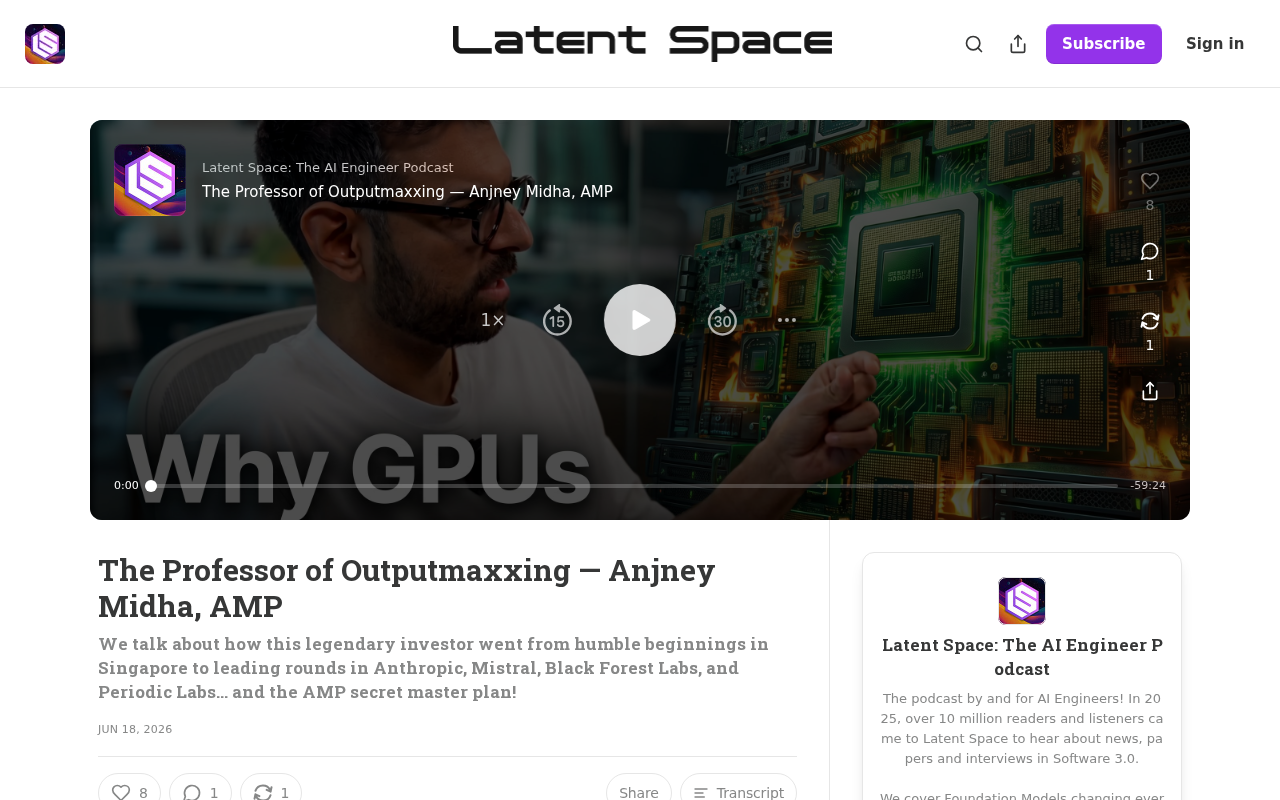
How Anjney Midha rose from Singapore to lead a16z's most pivotal AI investments.
This article traces Anjney Midha's journey from Singapore to becoming a central figure at a16z's AMP fund, where he has led investments in Anthropic, Mistral, Black Forest Labs, and Periodic Labs. It explores his Outputmaxxing investment philosophy — prioritizing real-world output over benchmark scores — and examines AMP's full-stack AI investment strategy spanning foundation models, applications, and tooling layers.
Introduction: One of the Most Influential Investors in AI
In today's AI investment landscape, one name keeps appearing in the most important deals — Anjney Midha. As a core figure at a16z's (Andreessen Horowitz) AMP fund, he has led investments in standout companies including Anthropic, Mistral, Black Forest Labs, and Periodic Labs. How did this investor, who started his journey in Singapore, make his way to the forefront of AI investing?
a16z is one of Silicon Valley's most influential venture capital firms, founded in 2009 by Netscape co-founder Marc Andreessen and Ben Horowitz. The firm is renowned for its distinctive "platform model" — providing not just capital, but comprehensive services including recruiting, marketing, and technical support for portfolio companies. As of 2024, a16z manages over $42 billion in assets, with a portfolio spanning iconic tech companies like Facebook, GitHub, Airbnb, and Coinbase. Amid the AI wave, a16z established a dedicated AI fund (the AMP fund), elevating AI investment to a strategic priority — reflecting the firm's evolution from its signature "software is eating the world" thesis to "AI is eating software."
From Singapore to Silicon Valley: An Unconventional Starting Point
Unlike many Silicon Valley investors, Anjney Midha's story begins in Singapore. This humble origin gave him a unique global perspective. In a venture capital industry dominated by American elites, this international background became a differentiating advantage.
The leap from Asia to Silicon Valley was more than a geographic relocation — it was a transformation in mindset. Singapore, as a nexus of Asian technology and finance, cultivated Midha's keen instinct for technology commercialization — a capability that would prove crucial in his later AI investment decisions. The Singaporean government's long-standing strategic investment in the tech industry — from Temasek Holdings' large-scale global tech portfolio to the National Research Foundation's sustained funding of AI R&D — created a cultural environment where technology is viewed as a core element of national competitiveness. Growing up in this environment, Midha naturally developed the mental habit of rapidly connecting technology trends with commercial value.
Anjney Midha's AI Investment Portfolio
Anthropic: A Core Bet on the Foundation Model Race
One of Anjney Midha's most notable investments is Anthropic. As OpenAI's strongest competitor, Anthropic has established a unique position in the safe AI space with its Claude model series. Leading this investment at an early stage demonstrates Midha's deep understanding of the balance between AI safety and commercialization.
Anthropic was co-founded in 2021 by former OpenAI VP of Research Dario Amodei and his sister Daniela Amodei. The company's core technical philosophy is "Constitutional AI" (CAI). The central idea behind this methodology is that rather than relying on extensive human annotation to align AI behavior, the AI critiques and corrects itself based on a predefined set of principles (the "constitution"). Specifically, the model first generates a response, then evaluates whether its own response contains harmful, dishonest, or irresponsible content according to the constitutional principles, and revises accordingly. This approach dramatically reduces the cost of human feedback while improving the scalability of alignment. Anthropic's Claude model series has excelled in enterprise applications, establishing differentiated advantages in long-context processing, code generation, and safety, with its valuation surpassing $60 billion in 2024.
Mistral AI: The Standard-Bearer of European Artificial Intelligence
The investment in Mistral showcases Midha's global vision. This French AI company is renowned for its open-source models and plays a pivotal role in the European AI ecosystem. At a time when most American investors were focused domestically, Midha chose a transatlantic strategy — a decision that now appears remarkably prescient.
Mistral AI was founded in Paris in 2023 by former Meta and Google DeepMind researchers Arthur Mensch, Timothée Lacroix, and Guillaume Lample. The company completed a record-breaking seed round just weeks after its founding, becoming a benchmark enterprise in European AI. Mistral's core strategy runs open-source and commercialization in parallel: its open-source models (such as Mistral 7B and Mixtral 8x7B) employ a Mixture of Experts (MoE) architecture, achieving performance close to much larger models at a fraction of the computational cost. The MoE architecture works by dividing the model into multiple "expert" sub-networks, activating only a subset during each inference pass, thereby dramatically reducing inference costs while maintaining model capacity. Mistral's rise also carries geopolitical significance — in a landscape dominated by the US and China in the global AI race, Europe urgently needs its own AI infrastructure, and Mistral fills precisely this gap, garnering strong support from European governments and sovereign wealth funds.
Black Forest Labs and Periodic Labs: Multimodal and Vertical Applications
The investments in Black Forest Labs (creators of the FLUX image generation model) and Periodic Labs reveal Midha's deeper investment logic — he's not simply betting on large language models, but seeking critical nodes across the entire AI technology stack. From text to image, from foundation models to vertical applications, this comprehensive approach forms a complete AI investment matrix.
Black Forest Labs was founded by core Stable Diffusion team members who left Stability AI. Its flagship FLUX series of image generation models quickly became an industry benchmark upon release. Diffusion models are the dominant technical architecture in current image generation, and their working principle can be likened to "reverse denoising": during training, the model learns to progressively add Gaussian noise to images until they become pure noise; during generation, the model starts from pure noise and progressively removes it, ultimately producing a clear image. The FLUX model builds on this foundation by incorporating advanced techniques such as Flow Matching, achieving significant breakthroughs in image quality, text comprehension, and generation speed. Black Forest Labs' business model encompasses API services, enterprise customization, and open-source community ecosystems, representing a critical turning point as AI creative tools transition from the lab to large-scale commercialization.
Periodic Labs represents an important emerging direction in AI investment — applying AI technology to specific scientific and industrial domains. While the company maintains a relatively low profile, its sector (AI for Science) is becoming a hot area for venture capital. Traditionally, R&D cycles in drug discovery, materials science, and chemical synthesis span years or even decades, but AI technology — particularly large-scale pretrained models and reinforcement learning — has the potential to dramatically shorten these timelines. DeepMind's AlphaFold breakthrough in protein structure prediction has already demonstrated AI's enormous potential in scientific research. The investment in Periodic Labs reflects Midha's conviction in the long-term trend of AI technology permeating from the "digital world" into the "physical world."
The Outputmaxxing Philosophy: An Output-Oriented Investment Methodology
"Outputmaxxing" is a portmanteau of "Output" and "Maxxing" (maximizing), encapsulating Midha's core investment philosophy: focus on the actual output capabilities of AI systems, rather than merely chasing technical metrics.
In an AI industry currently awash with benchmark competitions, this output-oriented mindset is especially valuable. The current AI industry suffers from a phenomenon known as "benchmark gaming" — major model companies fiercely compete on standardized tests like MMLU, HumanEval, and GSM8K, with each new model release accompanied by a parade of record-breaking scores. However, these benchmarks have significant limitations: first, training data may contain test questions, leading to "data contamination"; second, benchmarks often measure narrow capability dimensions that fail to reflect a model's comprehensive performance in real-world scenarios; finally, over-optimizing for benchmark scores can lead to poor real-world performance — a phenomenon known as "Goodhart's Law," which states that when a measure becomes a target, it ceases to be a good measure.
Truly valuable AI companies aren't those posting the highest scores in papers, but those consistently creating real value for users. Midha's portfolio validates this point precisely — whether it's Anthropic's enterprise AI assistant or Black Forest Labs' creative tools, solving real problems is at the core.
The Strategic Master Plan of the a16z AMP Fund
As a16z's AI-focused investment platform, AMP's strategic positioning can be summarized across three layers:
- Foundation Layer: Investing in foundation model companies (Anthropic, Mistral) to secure influence at the AI infrastructure level
- Application Layer: Positioning in vertical AI applications to capture the commercial value of technology deployment
- Tooling Layer: Supporting multimodal tool developers like Black Forest Labs to build out the AI creative ecosystem
This Full-Stack Investment Strategy is the core methodology that top-tier VC firms have adopted during platform-scale technology waves in recent years. Its logic is rooted in the network effects of technology ecosystems — when an investor simultaneously positions across the infrastructure layer, middleware layer, and application layer, portfolio companies can generate synergies that reduce each other's market risk. Historically, this strategy was validated during the mobile internet era: institutions that simultaneously invested in chips (the ARM ecosystem), operating systems (the Android/iOS ecosystem), and applications (Uber, Instagram, etc.) reaped the richest returns. In the AI era, the same logic applies — foundation model companies provide compute and intelligence platforms, tooling-layer companies lower development barriers, and application-layer companies create end-user value. The three are interdependent and mutually reinforcing.
This full-stack investment strategy means AMP isn't merely betting on any single company's success — it's betting on the arrival of the entire AI era.
Implications for the AI Investment Industry
Anjney Midha's investment trajectory offers several important lessons for the industry:
A diverse background is an advantage, not a liability. In a globalized technology wave, cross-cultural perspective helps investors discover opportunities overlooked by local thinking. Midha's decision to invest in Mistral is the perfect example — while most American VCs had their eyes locked on the San Francisco Bay Area, he saw the AI force emerging in Paris.
AI investing demands technical depth. The ability to simultaneously understand Anthropic's Constitutional AI methodology and Black Forest Labs' diffusion model architecture — this kind of technical judgment is the foundation for making sound investment decisions. In the AI space, the depth of technical understanding directly determines whether an investor can distinguish genuine technological breakthroughs from marketing packaging, and whether they can identify companies with durable technical moats among a sea of competitors.
Long-termism remains the best strategy. Amid the bubbles and noise in the AI space, the truly successful investors are those who can see through short-term hype to identify long-term value. Midha's portfolio shows that he's not betting on next quarter's hot trend, but on the technological infrastructure of the next decade. From the dot-com bubble to the mobile internet wave, history has repeatedly proven that in the early stages of a technological revolution, the biggest winners are not speculators chasing trends, but long-term thinkers who deeply understand the direction of technological evolution and resolutely invest in infrastructure.
Conclusion
From Singapore to Silicon Valley, from obscurity to leading the most important investments in AI, Anjney Midha's story is itself the best case study in Outputmaxxing — proving one's value through consistently high-quality output. In an era where AI technology evolves at breakneck speed, this kind of investor and the strategic thinking behind him deserve close attention from anyone following the AI industry.
Related articles

Andrew Ng's Advanced AI Prompting Guide: Core Methods for Going from Beginner to Expert
Based on Andrew Ng's latest AI prompting tutorial, learn the core gaps between beginners and experts: providing context, overcoming sycophancy, iterative workflows, and four key principles.

AI Batch Rename Tool: One-Click File Name Standardization with LLM Semantic Understanding
Explore the AI Batch Rename Tool Pro v5.0: use LLM semantic understanding to intelligently standardize file names, with multi-engine API support and dual-model collaboration.

AI Engineering in Practice: The Progression Path from Vibe Coding to Enterprise-Level Development
Deep dive into AI engineering methodology, comparing Vibe Coding vs enterprise development, covering Claude Code, Codex tool selection, SuperPower plugin practices, and the path from prototype to production.