Anthropic Releases AI Safety Policy Proposal to Advance U.S. Leadership in Frontier Safety
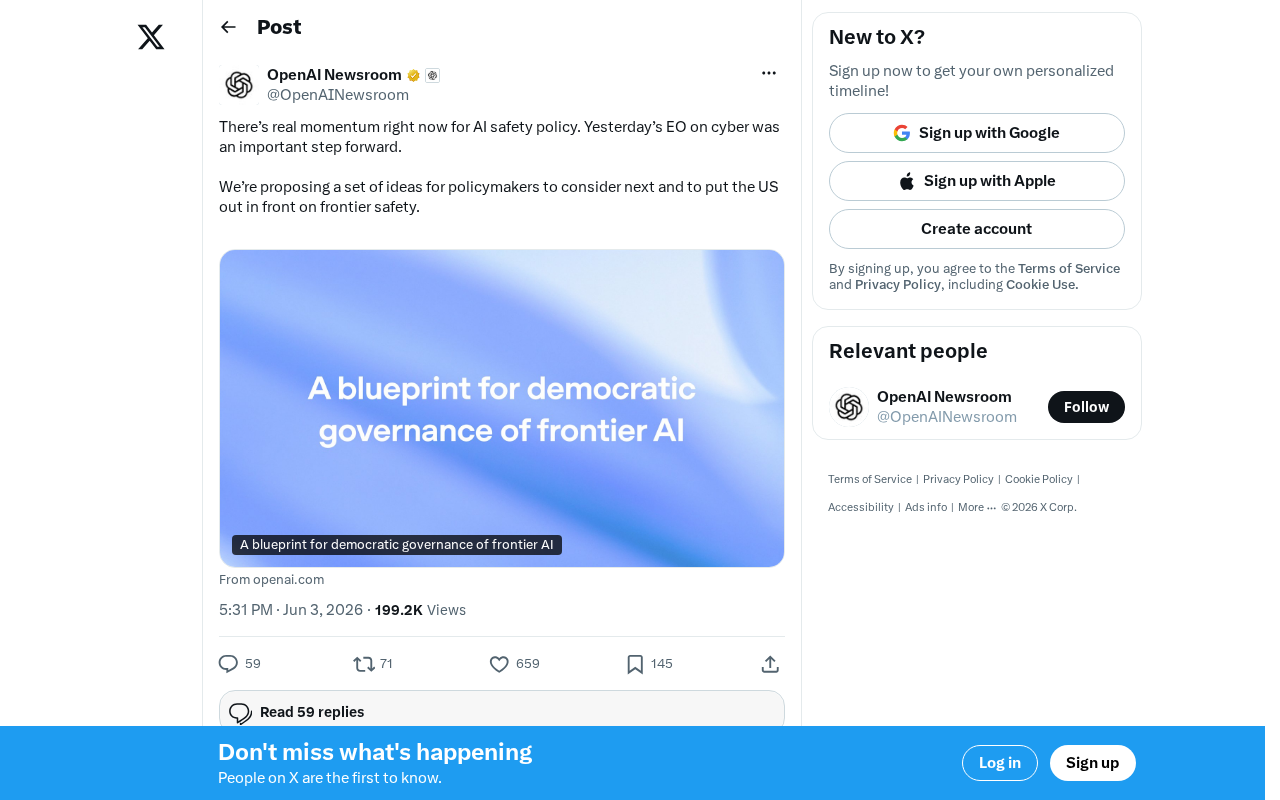
Anthropic proposes AI safety policies to position the U.S. as a leader in frontier AI safety governance.
Anthropic CEO Dario Amodei has publicly released AI safety policy proposals aimed at putting the U.S. at the forefront of frontier safety. Building on the recent cybersecurity Executive Order, the proposals address capability evaluation, pre-deployment testing, and international coordination. The move marks Anthropic's expansion from technical safety research into active policy advocacy, with significant implications for global AI governance.
Background: A Critical Window for AI Safety Policy
Anthropic CEO Dario Amodei recently posted on social media, noting that AI safety policy is gaining real momentum. He referenced the recently issued Executive Order on Cyber as an important step forward, and announced that Anthropic is building on this foundation by presenting a series of new recommendations to policymakers.
This development comes against the backdrop of the U.S. government's ongoing efforts to strengthen its AI regulatory framework, with the cybersecurity executive order seen as a substantive step in technology governance. Notably, an Executive Order is a legally binding directive issued by the U.S. President directly to federal agencies without going through the congressional legislative process—an important tool for rapid policy implementation. In the AI governance space, the most influential prior example was the Biden administration's October 2023 "Executive Order on Safe, Secure, and Trustworthy Artificial Intelligence" (EO 14110), which for the first time required companies developing the most powerful AI systems to report safety test results to the federal government. However, after the Trump administration took office in early 2025, it revoked that executive order in favor of a more innovation-focused regulatory approach. The new cybersecurity executive order focuses on the intersection of AI and cybersecurity, reflecting the fact that regardless of political stance, cybersecurity remains a strong bipartisan consensus issue—and provides a new entry point for advancing AI safety policy.
Anthropic's Policy Position: Putting the U.S. at the Forefront of Frontier Safety
From Corporate Self-Regulation to Policy Advocacy
Anthropic has long positioned itself as an "AI safety company," founded with the explicit mission of researching and developing safer AI systems. This positioning is no accident—Anthropic was co-founded in 2021 by siblings Dario Amodei and Daniela Amodei, both former OpenAI executives. Dario served as OpenAI's VP of Research before departing due to disagreements over OpenAI's prioritization of safety issues and its commercialization direction. The company's core technical philosophy centers on "Constitutional AI," a training method that enables AI systems to self-supervise and self-correct based on a set of explicit principles, aiming to reduce harmful outputs without over-relying on human annotation. The company's Claude series of large language models is its primary product. As of 2024-2025, Anthropic has secured massive investments from giants like Google, Salesforce, and Amazon, with a valuation exceeding $60 billion, making it the second-largest frontier AI lab after OpenAI.
This public outreach to policymakers marks the company's expansion from technical safety research into active policy advocacy.
Dario Amodei explicitly stated in his post that these proposals aim to "put the US out in front on frontier safety." This framing reflects both national competitiveness considerations and a strategic intent to seize discourse power in the global AI governance landscape. Currently, global AI governance is taking on a multipolar structure: the EU officially passed the AI Act in 2024—the world's first comprehensive AI regulatory legislation—adopting a risk-based tiered regulatory approach with strict compliance requirements for high-risk AI systems and specific transparency and safety obligations for general-purpose AI models; the UK has charted a path emphasizing technical assessment over legislative constraints through the 2023 Bletchley Declaration and the AI Safety Institute; China has also issued a series of regulations including measures for managing generative AI. With multilateral mechanisms like the UN, OECD, and G7 all pushing for international coordination on AI governance, Anthropic's emphasis on "putting the US out in front" essentially advocates that the U.S. should seize rule-making authority by setting high-level safety standards, rather than passively accepting regulatory frameworks from other jurisdictions.
Core Issues in Frontier Safety
"Frontier safety" primarily focuses on managing risks posed by the most advanced AI models. The emphasis on "frontier" is deliberate—when AI models reach certain thresholds in parameter scale and training data volume, they may exhibit emergent capabilities that trainers never anticipated, such as autonomously writing malicious code, assisting in synthesizing bioweapon formulas, or conducting highly realistic social engineering attacks. Anthropic itself developed the "Responsible Scaling Policy" (RSP), the industry's first systematic safety framework for frontier models, classifying AI systems into levels from ASL-1 to ASL-4 based on dangerous capability levels, with each level corresponding to different safety measure requirements. Similarly, OpenAI introduced its "Preparedness Framework," and Google DeepMind published its "Frontier Safety Framework." These corporate self-regulatory frameworks are precisely what policymakers hope to transform into industry standards or even legal requirements.
Core issues in frontier safety include but are not limited to:
- Capability Evaluation and Red Lines: How to systematically assess dangerous capabilities of frontier models and set clear safety thresholds. Capability evaluation is typically conducted through "red teaming"—a concept borrowed from military and cybersecurity domains—where specialized teams simulate malicious users or adversarial scenarios to systematically probe the boundaries of an AI model's dangerous capabilities. Evaluation teams test whether models can assist in cyberattacks, provide critical information for manufacturing weapons of mass destruction, carry out large-scale deception or manipulation, or demonstrate tendencies toward autonomously acquiring resources and evading human control. "Red lines" refer to explicit thresholds that, once a model demonstrates a dangerous capability to a certain degree, must trigger additional safety measures or deployment suspension. The core challenge facing the industry is that these evaluation methods have not yet been standardized, with significant differences in assessment criteria and rigor across companies—a key reason policymakers are seeking to intervene with unified standards.
- Pre-deployment Safety Testing: Establishing standardized safety evaluation processes to ensure models undergo thorough examination before release
- Cross-governance of Cybersecurity and AI: AI systems can serve both as tools for cyberattacks and as defensive assets, requiring comprehensive policy frameworks
- International Coordination Mechanisms: Establishing common AI safety standards and cooperation mechanisms on a global scale
Industry Trends: The Balancing Act Between Safety and Innovation
The AI Safety Race Among Tech Giants
Interestingly, Anthropic is not the only tech company speaking up on AI safety policy. OpenAI, Google DeepMind, and other major players are also participating in policy discussions to varying degrees. What sets Anthropic apart is that it positions safety as a core competitive advantage rather than merely a compliance cost.
This strategy carries profound commercial implications—as AI regulatory frameworks take shape, companies that have invested more heavily and built deeper expertise in safety may gain first-mover advantages in compliance. This logic follows a strategy known as "regulatory arbitrage"—when industry regulatory frameworks are still forming, companies that invest early in compliance infrastructure can gain significant first-mover advantages once policies are implemented. This strategy has mature precedents in heavily regulated industries like finance and pharmaceuticals. Specifically in the AI industry, as governments gradually establish safety evaluation and approval mechanisms for frontier models, companies with mature safety testing processes, robust internal governance structures, and extensive policy communication experience will hold advantages in securing government contracts, passing regulatory reviews, and winning enterprise customer trust. Anthropic's Claude model has already received adoption approval from multiple U.S. government agencies, validating to some extent the commercial logic of "safety as competitiveness." Additionally, this strategy helps attract top research talent who prioritize AI ethics, creating differentiated advantages in talent competition.
The Urgency of the Policy Window
Dario Amodei's use of "real momentum" to describe the current policy environment suggests this is a rare policy window. Against the backdrop of rapid AI technology iteration, policy-making often lags behind technological development. The current U.S. government's heightened focus on cybersecurity and AI governance provides industry participants with a valuable opportunity to influence policy direction.
The urgency of this "policy window" is also reflected in the pace of technological evolution. Frontier AI model capabilities are improving at speeds exceeding most expectations—from GPT-4 to Claude 3.5 to each company's latest models, every generation achieves significant leaps in reasoning, programming, scientific research, and other domains. If policy frameworks cannot be established before model capabilities reach critical thresholds, the difficulty and cost of remediation after the fact will increase dramatically. This also explains why Anthropic is choosing to actively push the policy agenda now—by the time risks truly materialize, it may be too late to act.
Outlook: Multiple Challenges Remain from Proposal to Implementation
Although Anthropic's policy advocacy direction is clear, numerous challenges remain between proposal and actual policy implementation: finding the balance between promoting innovation and preventing risks, avoiding over-regulation that stifles technological development, and ensuring policy enforceability and international coordination are all critical issues requiring deep exploration.
One core tension is that the development of AI safety standards itself faces the "who regulates the regulators" dilemma. The technical complexity of frontier AI models is extremely high, and government regulatory agencies often lack sufficient technical expertise to independently assess model safety, relying heavily on safety evaluation results provided by the companies themselves. This information asymmetry can lead to regulatory capture—where regulated entities end up dominating the formulation of regulatory rules, making them favorable to themselves rather than the public interest. While Anthropic and similar companies proactively participating in policy-making can provide valuable technical insights, independent third-party evaluation mechanisms must also be established to ensure policy fairness and effectiveness.
It is foreseeable that as AI capabilities continue to advance, policy discussions around frontier safety will become increasingly intensive. Anthropic's proactive move is not merely a corporate-level strategic play—it may have profound implications for AI governance in the United States and globally.
Key Takeaways
Related articles

DeepSeek + Codex Tutorial: Achieve Low-Cost AI Coding with Codex++
Learn how to connect DeepSeek to Codex using the open-source tool Codex++. Covers provider setup, connection testing, and launch verification for low-cost AI coding.

AI Alleviating Sierra Leone's Teacher Shortage: Technology Empowering Rather Than Replacing Educators
Sierra Leone faces severe teacher shortages. AI as a teacher partner can provide personalized tutoring, content preparation, and basic Q&A. This article analyzes AI education prospects, infrastructure challenges, and localization strategies in developing countries.

Hands-On Tutorial: Integrating Google Maps Grounding with Firebase AI Logic
Learn how to integrate Google Maps Grounding with Firebase AI Logic in three steps. Combine Gemini with map data to build smart location-aware AI apps.