Antigravity Ecosystem Expansion: Freeing Up Debugging Time to Refocus on Architecture and Design
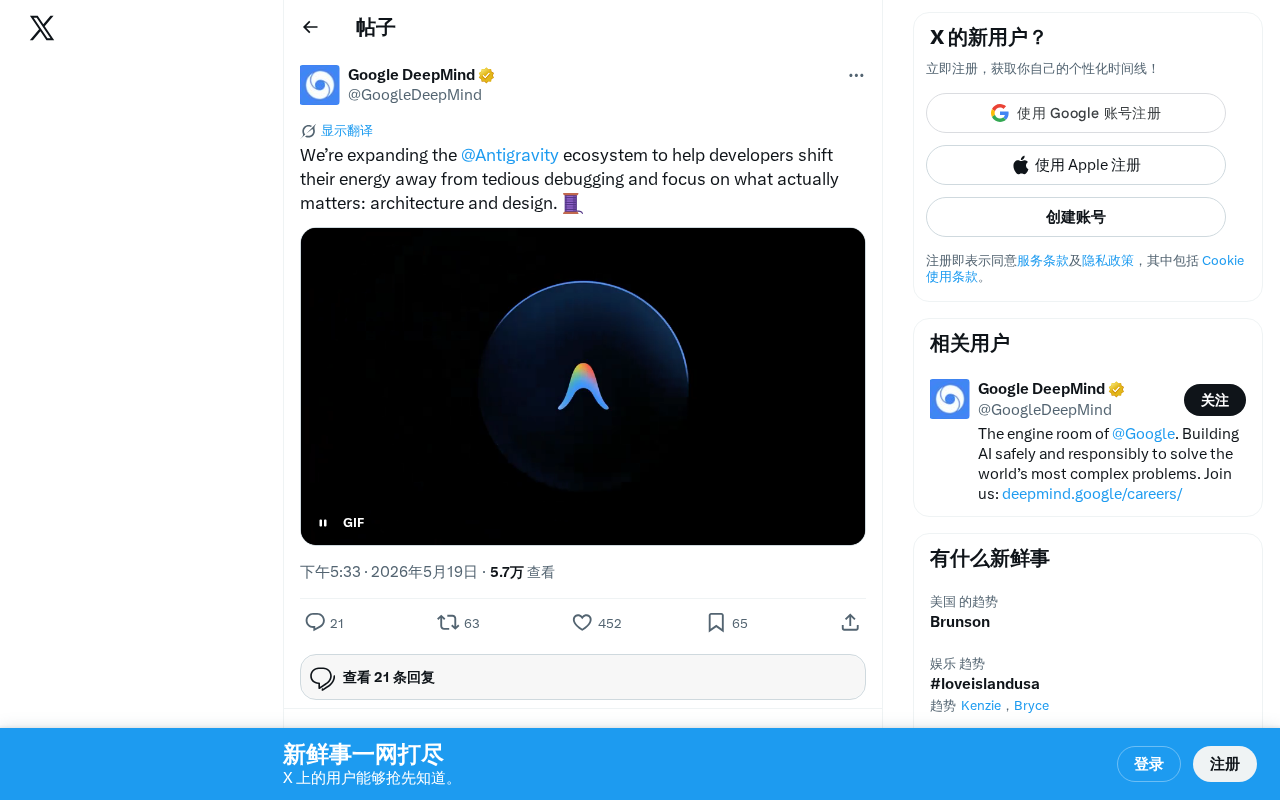
Antigravity expands its ecosystem to shift developer focus from debugging to architecture and design.
Antigravity has announced plans to expand its ecosystem with the goal of freeing developers from time-consuming debugging work so they can focus on architecture and design. This article analyzes the structural costs of debugging, the evolution from point AI tools to integrated ecosystems, and how the developer role is shifting from writing code to making high-level architectural decisions in the AI era.
Antigravity's New Ecosystem Vision
Recently, the Antigravity team announced its ecosystem expansion plans on social media, with a clear and ambitious core objective: help developers break free from tedious debugging work and refocus on what truly matters — architecture and design.
While brief, this statement strikes at a core pain point in today's software development landscape. As AI-assisted programming tools become increasingly prevalent, the role of developers is undergoing a profound transformation.
The Pain of Debugging: The Hidden Cost for Developers
According to industry research, developers spend an average of 30%-50% of their working time debugging and fixing bugs. This isn't just a waste of time — it's a drain on creativity. When engineers are trapped in stack traces and log analysis, they can't invest their intellectual resources in higher-value work like system architecture design, technology selection, and product innovation.
The high cost of debugging doesn't stem solely from the complexity of bugs themselves — it's also closely tied to the architectural characteristics of modern software systems. In microservices architectures, distributed systems, and cloud-native environments, the root cause of a single bug may span multiple service boundaries, involve asynchronous message queues, and traverse multi-layer caching mechanisms, making traditional breakpoint debugging and log tracing extremely difficult. A classic study from the University of Cambridge estimated that the global economic cost of software debugging reaches $312 billion annually. This figure reveals that debugging is not merely an efficiency problem for individual developers — it's a structural burden on the entire software industry.
Antigravity's positioning targets precisely this structural problem. Rather than having developers struggle repeatedly with code-level details, the approach leverages tools and ecosystem capabilities to automate or dramatically simplify this mechanical labor.
From Tools to Ecosystem: The Evolution of AI Development Assistance
Interestingly, Antigravity uses the term "ecosystem" rather than simply "tool" or "product." This reflects an important trend in the AI development assistance space.
The Limitations of Point Solutions
Early AI programming assistants (such as code completion and automated test case generation) improved efficiency at specific stages, but they were often isolated. Developers still needed to switch between different tools and manually stitch together their workflows.
The development of AI-assisted programming tools has gone through several key phases. The earliest tools relied primarily on static code analysis and rule matching, such as Lint-type tools. The launch of GitHub Copilot in 2021 marked the entry of LLM-based code generation into the mainstream, with its underlying Codex model capable of generating code snippets from natural language descriptions and context. Since then, products like Cursor, Windsurf, and Devin have further extended AI capabilities from code completion to code review, automated fixes, and end-to-end task execution. However, most of these tools focus on the code generation phase and still have notable shortcomings in debugging diagnostics, architecture recommendations, and full-pipeline engineering collaboration — precisely the direction Antigravity is trying to break through.
The Ecosystem Integration Approach
Truly valuable solutions need to cover the entire development pipeline — from code writing, debugging diagnostics, and test validation to deployment and operations. By choosing to build an "ecosystem," Antigravity is likely creating a coordinated toolchain spanning multiple development stages, allowing AI to shoulder the heavy lifting across a broader range of scenarios.
In the development tools space, building an "ecosystem" typically means establishing a plugin system, API interfaces, third-party integrations, and a developer community around core capabilities. Notable success stories include JetBrains' plugin marketplace built around its IDE, Vercel's full-stack development ecosystem built around frontend deployment, and HashiCorp's tool matrix built around Infrastructure as Code (IaC). The core advantage of an ecosystem strategy lies in network effects — the more tools in the ecosystem and the deeper the integrations, the higher the user switching costs and the wider the platform's moat. Antigravity's choice of an ecosystem approach over a single-product approach signals strategic ambitions that go beyond solving any single pain point — it's an attempt to redefine the development workflow for the AI era.
Architecture and Design: Returning to the Developer's Core Value
The phrase "focus on architecture and design" carries an implicit redefinition of the developer's role. In the AI era, a developer's core competitive advantage is shifting from "writing code" to "making decisions":
- System architecture decisions: How to design scalable, highly available systems
- Technology selection judgment: Choosing the most suitable tech stack for the business scenario from numerous options
- Abstraction ability: Translating complex business requirements into clear technical models
- Trade-off analysis: Finding the optimal balance between performance, cost, and development efficiency
These high-level thinking and judgment capabilities are precisely what current AI finds hardest to replace. The fundamental reason architecture design is difficult for AI to replicate is that it's essentially a multi-objective optimization decision-making process under incomplete information. Architects must holistically consider business growth projections, team technical capabilities, operational costs, compliance requirements, and other multidimensional constraints — conditions that are often ambiguous, dynamically changing, and even contradictory. For example, the well-known CAP theorem in distributed systems tells us that a system cannot simultaneously guarantee Consistency, Availability, and Partition Tolerance — architects must make trade-offs based on specific business scenarios. An e-commerce transaction system might prioritize consistency, while a social media feed would lean toward availability. This kind of comprehensive judgment requiring deep domain knowledge, business intuition, and engineering experience is precisely the weakest link in current AI models.
Antigravity's philosophy essentially promotes a division of labor: let AI handle deterministic, rule-based debugging work, while humans focus on design work that requires creativity and judgment.
Industry Implications
Although Antigravity has not yet disclosed specific product details or technical roadmaps, its ecosystem expansion direction is worth watching. As more AI development tools evolve from "coding assistance" to "engineering assistance," the productivity landscape of the entire software development industry may be poised for another round of reshaping.
For developers, this represents both an opportunity and a challenge — engineers who can focus their energy on architectural thinking and system design will gain a greater competitive edge in the AI era.
Key Takeaways
Related articles

Claude Code for Test Development in Practice: An AI Programming Workflow That Doubles Your Efficiency
A practical guide to Claude Code for test development: auto-generating test scripts, Plan Mode workflows, MCP + Playwright integration, and Subagent parallel tasks to build systematic AI-assisted workflows.

Hermes Agent Hands-On Review: An AI Efficiency Revolution for Indie Game Developers
Indie game developer reviews Hermes Agent vs OpenClaude: intelligent context compression, real-time Memory, remote control via Telegram, and practical use cases in game dev, social media, and email.
Vibe Coding Beginner's Guide: Tool Selection Across Three Categories with Practical Examples
A comprehensive guide to Vibe Coding's three tool categories: Agent frameworks, CLI Coding, and IDE tools, with practical examples including Snake game and data analysis workbench.