Apple AR Glasses Delayed to 2030, Vision Air Canceled, New Vision Pro Coming 2028 at Earliest
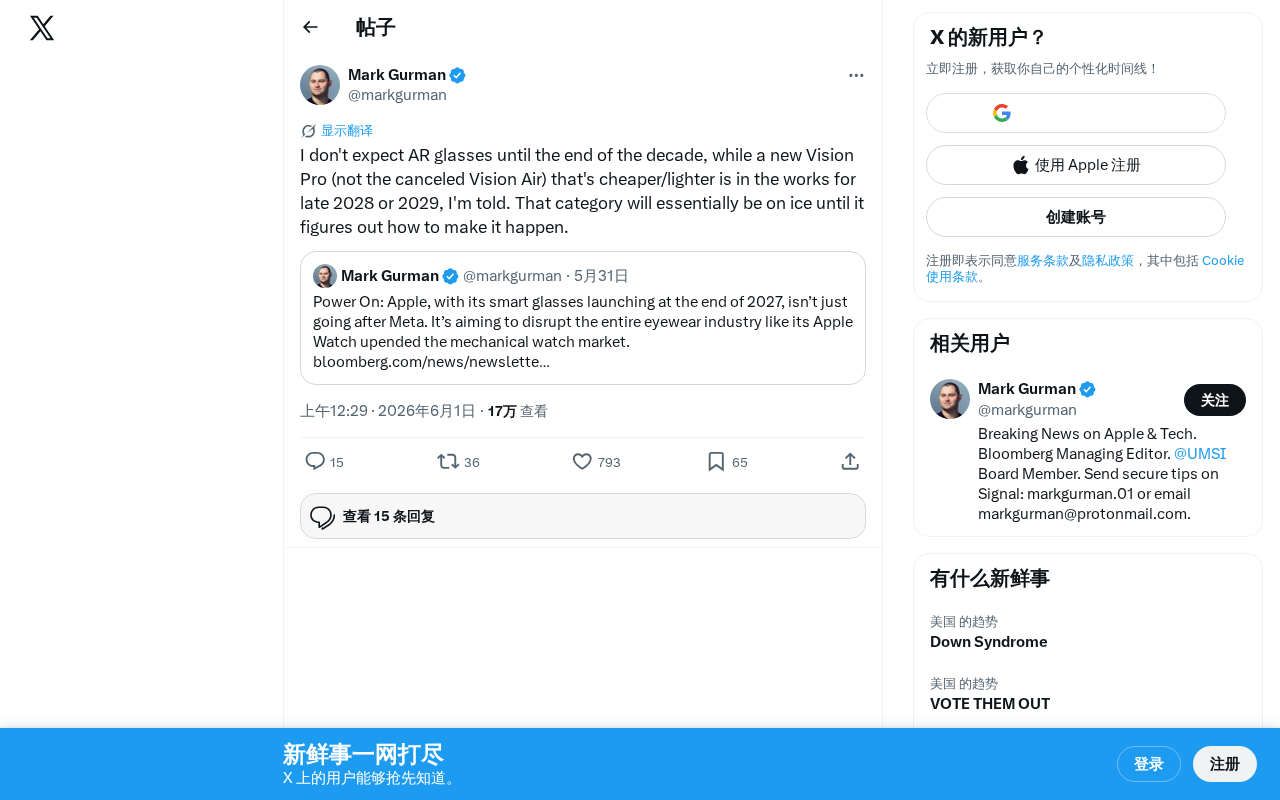
Apple's AR glasses pushed to 2030; Vision Air canceled in favor of a next-gen Vision Pro by 2028-2029.
A new leak reveals Apple's AR glasses won't arrive until 2029-2030, while the rumored Vision Air has been canceled entirely. Instead, Apple is developing a next-generation Vision Pro that's lighter and cheaper, targeting a late 2028 or 2029 launch. The shift reflects Apple's refusal to compromise on spatial computing experience amid unresolved challenges in optics, thermals, and battery technology.
Key Leak: Apple AR Product Timeline Pushed Back Significantly
According to a well-known tech leaker on Twitter, Apple's AR glasses aren't expected to arrive until the end of this decade (2029–2030), and the long-rumored lightweight headset lineup has undergone a major shakeup.
The leaker explicitly stated that the previously rumored "Vision Air" — positioned as a lighter, more affordable alternative to Vision Pro — has been canceled. In its place, Apple is working on a next-generation Vision Pro that aims to be lighter and cheaper, with the earliest possible launch in late 2028 or 2029.
Vision Air Killed: Apple's Spatial Computing Strategy Shifts
From Dual Product Lines to Focused Iteration
Apple's original spatial computing roadmap appeared to follow a "Pro + Air" dual-product strategy — similar to the MacBook Pro and MacBook Air relationship. Vision Pro would target the high-end professional market, while Vision Air would appeal to a broader consumer audience. That strategy has clearly been abandoned.
"Spatial computing" is the conceptual framework Apple formally introduced at WWDC 2023, referring to the seamless integration of digital content into the user's physical space through natural interaction methods like eye tracking, hand gestures, and voice. Apple didn't invent the concept — Microsoft used similar language during the HoloLens era — but Apple was the first to attempt building a complete consumer-facing ecosystem around it through visionOS and the Vision Pro hardware. Understanding this strategic context explains why Apple would rather delay products than compromise on experience: the core value proposition of spatial computing is "seamless" and "natural," and any obvious technical shortcoming would fundamentally undermine that promise.
Canceling Vision Air suggests Apple realized that simply cutting specs to lower costs wouldn't deliver a satisfactory user experience with current technology. Rather than releasing a heavily compromised "budget version," Apple chose to concentrate resources on building a genuinely better next-generation Vision Pro.
The New Vision Pro's Positioning
The leak mentions the new Vision Pro will achieve both "cheaper" and "lighter" simultaneously, hinting that Apple may have made breakthrough progress in display technology, chip fabrication, or optical systems — enabling cost and weight reductions without sacrificing the core experience.
To appreciate how difficult this challenge is, consider the current Vision Pro's technical makeup: it features two Sony custom Micro-OLED displays (each exceeding 4K resolution per eye), a total of 12 cameras and 5 sensors for spatial awareness, an M2 main chip paired with a dedicated R1 co-processor for spatial computing tasks, and an overall weight of roughly 600–650 grams. These high-end components are exactly why it costs $3,499 and feels heavy to wear. To cut the price while reducing weight, Apple needs simultaneous advances across multiple dimensions: chip process nodes (evolving from the current 5nm/3nm to 2nm or beyond), display panels (potentially adopting more efficient Micro-LED technology), and miniaturization of Pancake optical lenses. The 2028–2029 timeline aligns roughly with industry expectations for TSMC's 2nm mass production and Micro-LED technology maturity.
Apple AR Glasses: A Vision That Won't Materialize Until the End of the Decade
Massive Technical Hurdles Remain
The leaker stated bluntly that the entire AR glasses category will be "basically on ice" until Apple figures out how to make it work. This reveals several key takeaways:
- The optics problem is unsolved: Compressing an AR display system into a regular eyeglass form factor while maintaining adequate field of view and brightness remains an industry-wide challenge
- The compute-vs-thermal tradeoff: Glasses impose extremely strict constraints on power consumption and heat dissipation that current chip technology struggles to meet
- Battery technology limitations: The all-day wearability requirement demands far more battery life than current technology can deliver
For AR glasses optics, the industry is primarily exploring waveguide technology and diffractive optical elements (DOE). Waveguide technology guides light through a thin glass substrate and couples it out at specific points, theoretically allowing display modules to be as thin as an eyeglass lens. In practice, however, the technology faces severe tradeoffs: field of view (how much of the virtual image the user can see), display brightness, color accuracy, and lens transparency are in fundamental physical conflict with one another. Today's most advanced consumer AR glasses (such as the Xreal Air series) offer a field of view of roughly 46–52 degrees, while the human eye's natural field of view exceeds 200 degrees. On top of that, issues like outdoor visibility in bright sunlight and uniformity of full-color high-resolution displays remain unsolved by any manufacturer. For Apple to meet its own experience standards, the technological leap required is genuinely enormous.
Apple AR Glasses vs. Meta: The Competitive Landscape
Meta has already established an early foothold in lightweight wearables with its Ray-Ban smart glasses, but those products are essentially "smart glasses with a camera" rather than true AR devices. Apple clearly isn't willing to ship a feature-compromised transitional product and is instead waiting for the technology to mature before going all-in.
Meta's Ray-Ban Meta smart glasses (second generation, released September 2023) retail for $299, weigh only about 50 grams, and integrate a 12-megapixel camera, open-ear speakers, and Meta AI voice assistant — but they have no visual display whatsoever. They're essentially sunglasses that can take photos, play music, and use AI. Meta's strategy is "claim the space first, evolve later": build the habit of wearing smart glasses through a practical, affordable product, then gradually add display capabilities. Reportedly, Meta is developing a true AR glasses prototype codenamed "Orion" that has demonstrated holographic display effects in internal demos, but a consumer version isn't expected until after 2027. This means Apple and Meta are actually facing similar technical timelines for true AR glasses — they've just chosen dramatically different approaches for the transitional period.
Impact on Consumers and Developers
This timeline means:
- Short-term (2025–2027): The current Vision Pro will be Apple's only spatial computing hardware
- Mid-term (2028–2029): The next-gen Vision Pro could bring price and weight down to more acceptable levels
- Long-term (2029 and beyond): True Apple AR glasses may finally emerge
For visionOS developers, this means at least a 3–4 year window to refine the app ecosystem — but it also means the user base won't see explosive growth in the near term. Apple's spatial computing vision is a marathon, not a sprint.
Related articles

CodeGraph: Give Your Coding Agent a Code Map, Save 47% Tokens
CodeGraph is an open-source project with ~40K GitHub stars that uses Tree-sitter to build a local queryable code map, helping Claude Code and Cursor reduce 47% token usage and 58% tool calls.
AI Finishes Writing Code, Automatically Strikes a Gong to Alert You: Open-Source Physical Feedback Tool DAgent
A developer built a physical feedback device with chopsticks and a small gong that auto-strikes when AI finishes coding. Now open-sourced as DAgent, it also simulates IPO bell-ringing when creating new files.

Level Up Claude Code: Building an Enhanced Plan Mode with Grill Me
Learn how to install and use the Grill Me Skill for Claude Code, replacing AI guesswork with structured questioning to clarify requirements before generating execution plans.