Apple Deprecates ImageCreator Class: Complete Migration Guide and Impact Analysis
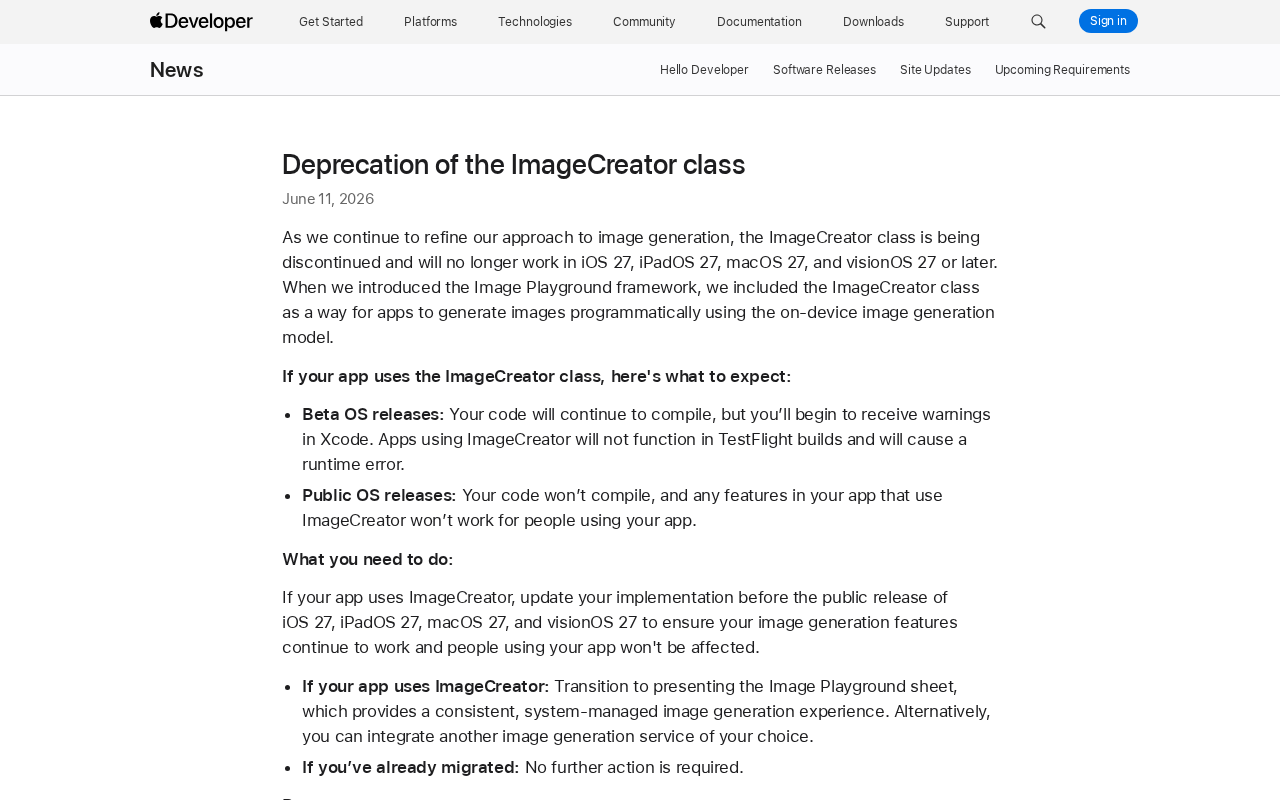
Apple deprecates ImageCreator in iOS 27, forcing developers to migrate to system-managed UI or third-party APIs.
Apple has announced the deprecation of the ImageCreator class across iOS 27, iPadOS 27, macOS 27, and visionOS 27. Developers must migrate to Image Playground Sheet or integrate third-party image generation services. The move reflects Apple's strategy to tighten AI capability exposure, prioritizing safety and consistency over developer flexibility.
Event Overview
Apple recently issued a developer announcement formally deprecating the ImageCreator class in iOS 27, iPadOS 27, macOS 27, and visionOS 27. This means applications relying on this API for programmatic image generation must complete migration before the public release, or face compilation failures and broken functionality.
This change reflects Apple's strategic shift in AI image generation—moving from an open programmatic interface toward a more unified, system-controlled interaction experience.
The History of ImageCreator
What It Was
ImageCreator was a programming interface Apple provided as part of the Image Playground framework, allowing developers to directly invoke the on-device image generation model through code. For scenarios requiring automated in-app image generation, this class offered tremendous flexibility—developers had full control over generation timing, parameter configuration, and result handling.
Image Playground is the image generation framework Apple introduced alongside Apple Intelligence at WWDC 2024, first appearing in iOS 18.2. The framework is built on Apple's proprietary on-device diffusion model, capable of completing image generation locally without internet connectivity. Diffusion models are the dominant architecture in current image generation technology—their core concept involves learning to "progressively restore images from noise" to generate new pictures. Stable Diffusion, DALL·E 3, Midjourney, and other products all follow this technical approach. Apple's distinction lies in compressing the diffusion model to a scale that can run locally on the Apple Neural Engine in iPhones and iPads, which demands extremely sophisticated model quantization, distillation, and hardware co-optimization. The advantage of on-device inference is privacy protection and offline availability, but the tradeoff is constrained model parameter size, making generation quality and diversity difficult to match against cloud-based large models.
The framework internally contains two invocation methods: the user-facing Image Playground Sheet (system-managed UI) and the developer-facing ImageCreator class (programmatic interface). The latter is what's being deprecated.
Why Apple Is Deprecating ImageCreator
Apple's announcement states this move is intended to "continuously optimize the image generation solution." While the official wording is concise, the underlying logic is straightforward:
- Safety and compliance considerations: A programmatic interface means developers can bind arbitrary prompts to batch-generate images. Apple is concerned this could be misused to generate inappropriate content, while the system-level Image Playground Sheet has stricter built-in content moderation mechanisms.
- Experience consistency: By unifying around Image Playground Sheet, Apple ensures all apps maintain a consistent image generation experience, including UI style, interaction flow, and safety guardrails.
- Model iteration convenience: By encapsulating image generation at the system level, Apple gains more freedom to upgrade underlying models without affecting third-party app compatibility.
It's worth understanding the fundamental difference between a programmatic interface and system-managed UI. In Apple's framework design philosophy, programmatic interfaces allow developers to fully control feature invocation at the code level—when to trigger, what parameters to pass, and how to handle results—the entire process invisible to users. System-managed UI, on the other hand, lets the operating system control the presentation and interaction flow, with developers only able to configure within limited bounds. This pattern is not uncommon in the iOS ecosystem: for example, SFSafariViewController replaced the earlier practice of developers embedding their own WebViews, and HealthKit's sensitive data access must go through system authorization Sheets. This design fundamentally represents Apple's tradeoff between developer flexibility and platform security.
Specific Impact on Developers
Behavior During Beta
In the current Beta OS versions, code using ImageCreator still compiles, but Xcode throws deprecation warnings. More critically, the feature will directly fail in TestFlight builds, triggering runtime errors. This means even during testing, functionality relying on this class can no longer be properly validated.
TestFlight is Apple's official beta distribution platform, allowing developers to distribute pre-release app versions to up to 10,000 testers. In Apple's software release cycle, Beta OS versions typically begin rolling out after WWDC in June each year, iterating for approximately 3 months before officially launching alongside new hardware in September. For API deprecations, the Beta phase is the critical warning period for developers—deprecation warnings appear in Xcode compile logs, but code can usually still run. However, ImageCreator's situation is more aggressive: functionality has already failed in TestFlight builds, meaning Apple has cut runtime support for this interface during Beta rather than waiting for the official release.
Impact After Official Release
When iOS 27 and other systems officially launch, the situation will be even more severe:
- Code containing
ImageCreatorwill fail to compile - Functionality relying on this class in published apps will be completely unavailable to users
This leaves developers a relatively tight migration window, especially for applications with deep programmatic image generation integration.
ImageCreator Migration Options and Recommendations
Option 1: Migrate to Image Playground Sheet
Apple's recommended primary solution is to switch to Image Playground Sheet. This is a system-managed image generation interface presented to users as a Sheet. Advantages include:
- No need to maintain image generation UI logic
- Automatic access to Apple's future model upgrades
- Built-in content safety mechanisms
However, the drawbacks are also clear—developers lose fine-grained control over the image generation process. For scenarios requiring background automated image generation or custom generation parameters, this solution may not meet requirements.
Option 2: Integrate Third-Party Image Generation Services
Apple's announcement also explicitly mentions that developers can "integrate other image generation services." This opens the door to third-party services like OpenAI DALL·E, Stability AI, and Midjourney API. For applications that need to retain programmatic generation capabilities, this may be the more pragmatic choice.
Current mainstream third-party image generation APIs include OpenAI's DALL·E 3 (invoked through the ChatGPT API, supporting text-to-image and image editing), Stability AI's Stable Diffusion API (offering multiple model versions with fine-grained parameter control), and Google's Imagen series. These services typically use per-request pricing, with costs ranging from $0.02 to $0.12 per generation. Compared to Apple's on-device solution, cloud services are more powerful in model capability (parameters typically in the billions), but introduce additional complexity including network latency, API key management, and usage cost control.
Developers choosing this route should focus on:
- Additional API call costs
- Network dependency (no longer pure on-device inference)
- Need to handle content safety moderation independently—App Store Review Guidelines require apps to bear compliance responsibility for AI-generated content
Deeper Signals from Apple's AI Strategy
This deprecation event conveys a noteworthy signal: Apple is tightening its approach to AI capability exposure. From initially providing flexible programmatic interfaces to now forcing migration to system-controlled interaction interfaces, Apple clearly prefers positioning AI image generation as a "system-level service" rather than a "developer tool."
This aligns with Apple's longstanding platform strategy—when it comes to user experience consistency and platform security, Apple has historically been willing to sacrifice developer flexibility. But for applications that built core features around ImageCreator, this is undoubtedly a forced architectural adjustment.
Developers should assess the scope of impact early, formulate migration plans, and avoid being caught off guard when the official release arrives. Apple has provided the Image Playground framework documentation and related WWDC Sessions as migration reference resources.
Key Takeaways
Related articles

Xiaomi MIMO vs. Huawei Pangu AI Strategy Comparison: The Android vs. iOS Battle of the Agent Era
Xiaomi releases open-source MIMO Code while Huawei enters the Agent era with Pangu. Compare their AI strategies: Xiaomi's Android-like open ecosystem vs. Huawei's iOS-like vertical integration.
What Is Google WebMCP? A Deep Dive into the New Standard for AI Agents to Directly Invoke Web Functionality
A deep dive into Google WebMCP (Web Model Context Protocol): how it works, its technical implementation, and use cases. Learn how WebMCP lets AI Agents directly invoke web tools.
AI Can't Kill Old-School Programming: Why Fundamentals Are Still a Developer's Moat
Vibe Coding is trending, but can it replace solid fundamentals? A deep analysis of why core principles, systems thinking, and knowledge frameworks remain a developer's moat in the AI era.