Apple Opens Its First European Developer Center in Berlin, Expanding Global Footprint to Five Cities

Apple opens its first European Developer Center in Berlin, expanding its global network to five cities.
Apple will open its fifth global Developer Center in Berlin later this year, marking its first in Europe. The center will offer multilingual expert consultations, technical labs, and workshops for developers of all sizes. The choice of Berlin reflects the city's status as a European tech hub, while also positioning Apple to help developers navigate the EU's Digital Markets Act requirements.
Apple Expands Its Global Developer Center Network
Apple has announced that it will open its fifth global Apple Developer Center later this year in Berlin, Germany — marking the company's first developer center in Europe. Apple previously established four developer centers in Cupertino, Shanghai, Bangalore, and Singapore. The addition of Berlin signals Apple's accelerating investment in its global developer ecosystem.
Apple Developer Centers are physical spaces where Apple provides in-person technical support to third-party developers worldwide, complementing the online Apple Developer Program. The Apple Developer Program is Apple's membership system for developers, costing $99 per year and offering development tools, testing environments, App Store distribution, and more. Developer Centers extend this support offline, providing face-to-face, in-depth technical exchanges. This model is partly inspired by the Labs sessions at WWDC (Worldwide Developers Conference) — where developers can have one-on-one conversations with Apple engineers to solve technical challenges. However, since WWDC is held only once a year with limited capacity, Developer Centers make these high-value interactions available year-round.
Berlin Developer Center: Positioning and Features
Serving Teams of All Sizes
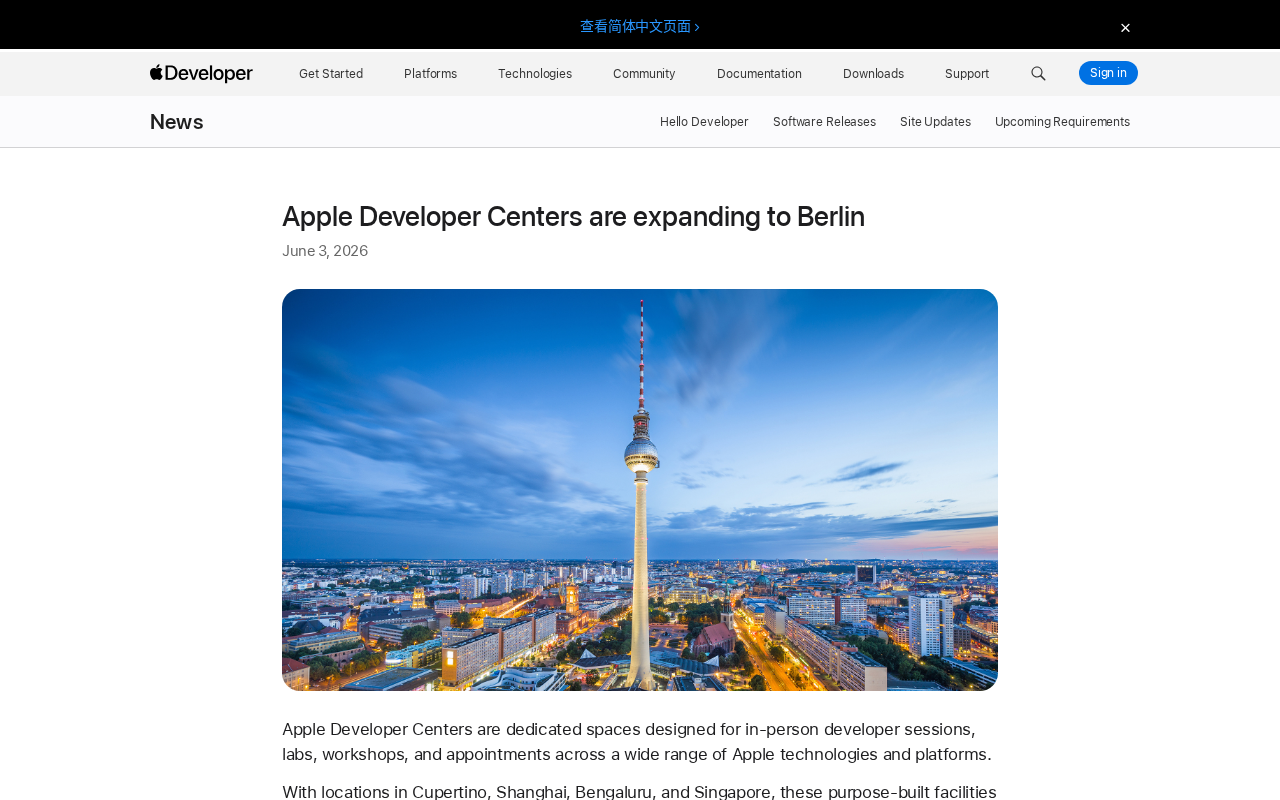
Apple Developer Centers are dedicated spaces designed for in-person developer activities, encompassing developer meetings, Labs, Workshops, and one-on-one appointment consultations. The Berlin center will serve teams of all sizes — from independent developers to large enterprise teams — and support every stage of app development, from initial concept to post-launch optimization.
Multilingual Expert Support
A key highlight of the Berlin Developer Center is its multilingual expert consultation services. The center features dedicated consultation areas and labs where developers can receive face-to-face technical guidance from Apple experts. This is particularly important for the developer community in Europe's multilingual environment, reducing communication barriers caused by language differences. Europe has 24 official languages, with developers spread across a vast geography from Northern to Southern Europe and from Western to Central and Eastern Europe. Multilingual support means developers from France, Poland, Italy, Spain, and other countries can access technical guidance in a more comfortable manner.
Strategic Significance: Why Berlin?
Berlin's Status as a European Tech Hub
Berlin is one of Europe's most important tech startup hubs, with an active developer community and abundant technical talent. Over the past decade-plus, Berlin has grown into one of Europe's most dynamic tech startup centers, earning its place as a strong contender for the title of "Europe's Silicon Valley." The city has given rise to well-known tech companies like SoundCloud, N26, and Delivery Hero, and is home to over 3,000 active startups. Berlin's advantages include relatively low living costs (compared to London and Paris), a rich pool of international talent (approximately 20% of residents are foreign nationals), and a vibrant creative culture. Additionally, Germany itself is Europe's largest economy, with a strong engineering education tradition and deep software development talent reserves. Choosing Berlin as the location for the first European Developer Center reflects Apple's commitment to the European market and Berlin's increasingly important position in the global tech landscape.
Closing the Gap with European Developers
Previously, European developers seeking face-to-face guidance from Apple experts typically had to wait for the annual WWDC or travel to developer centers in the Asia-Pacific region. WWDC (Worldwide Developers Conference) is Apple's flagship developer event held each June, typically used to announce new operating system versions, development frameworks, and hardware products. Since the COVID-19 pandemic in 2020, WWDC's main programming has shifted online. Although small-scale in-person events resumed in 2022 (Apple Park special experience days), the number of developers who can attend in person remains extremely limited. The Berlin center will provide developers across Europe with more convenient access to Apple's technical experts — essentially a decentralized extension of WWDC's in-person interaction capabilities, allowing European developers to receive expert guidance similar to what's available in Cupertino without flying to California. This is significant for advancing Apple's ecosystem development in Europe.
Responding to Europe's New Regulatory Landscape
Apple's increased developer investment in Europe cannot be viewed in isolation from the profound impact of the EU's Digital Markets Act (DMA) on Apple's ecosystem. The DMA took effect in March 2024, requiring Apple to allow third-party app stores in the EU, support sideloading, open NFC interfaces, and more. This means European iOS developers face a distribution environment and technical requirements that are fundamentally different from the rest of the world. Establishing a developer center in Berlin also helps Apple directly explain and guide European developers on how to develop and distribute apps under the new regulatory framework, helping them adapt to alternative payment systems, alternative browser engines, and other new rules. This move serves both as developer support and as a strategic consideration for Apple to maintain ecosystem cohesion under regulatory pressure.
The Logic Behind Apple's Global Developer Center Layout
Looking at the geographic distribution of Apple's five developer centers, the strategic logic is clear:
- Cupertino: Headquarters location, serving North American developers
- Shanghai: Covering China, one of the largest app markets
- Bangalore: Serving India's massive and rapidly growing developer community
- Singapore: Reaching the Southeast Asian market
- Berlin: Filling the European gap
This layout essentially covers all major global developer hubs, forming a relatively complete worldwide support network. Notably, these locations are all in cities with high concentrations of tech talent rather than purely commercial centers, reflecting Apple's site selection strategy centered on developer community density.
Practical Value of the Berlin Developer Center for Developers
Apple Developer Centers offer more than just technical training — they serve as a direct communication channel with Apple's engineering teams. Developers can:
- Receive one-on-one guidance on specific technical issues
- Attend workshops covering Apple's full range of platform technologies
- Get hands-on experience with new features immediately after launch
- Connect and exchange ideas with other developers
For European teams developing apps for Apple Vision Pro, iOS, macOS, and other platforms, the opening of the Berlin center is undoubtedly welcome news. This is especially true for Apple Vision Pro — the mixed reality headset Apple announced at WWDC 2023 and launched in early 2024, marking Apple's official entry into spatial computing. The device runs visionOS, and developers need to use entirely new development frameworks (such as RealityKit and the spatial version of ARKit) to build immersive applications. Since spatial computing app development involves entirely new paradigms like 3D modeling, spatial audio, and gesture interaction, the demand for face-to-face technical guidance is particularly acute. The labs at the Developer Center will likely provide hands-on testing environments with Vision Pro hardware, which is enormously valuable for independent developers who haven't purchased the device (starting at $3,499).
Developers should follow Apple's official announcements for information about reservations and events once the center officially opens.
Key Takeaways
Related articles

Claude Code for Test Development in Practice: An AI Programming Workflow That Doubles Your Efficiency
A practical guide to Claude Code for test development: auto-generating test scripts, Plan Mode workflows, MCP + Playwright integration, and Subagent parallel tasks to build systematic AI-assisted workflows.

Hermes Agent Hands-On Review: An AI Efficiency Revolution for Indie Game Developers
Indie game developer reviews Hermes Agent vs OpenClaude: intelligent context compression, real-time Memory, remote control via Telegram, and practical use cases in game dev, social media, and email.
Vibe Coding Beginner's Guide: Tool Selection Across Three Categories with Practical Examples
A comprehensive guide to Vibe Coding's three tool categories: Agent frameworks, CLI Coding, and IDE tools, with practical examples including Snake game and data analysis workbench.