Apple's Core AI Team Revealed: Four Key Leaders and Their Distinct Roles
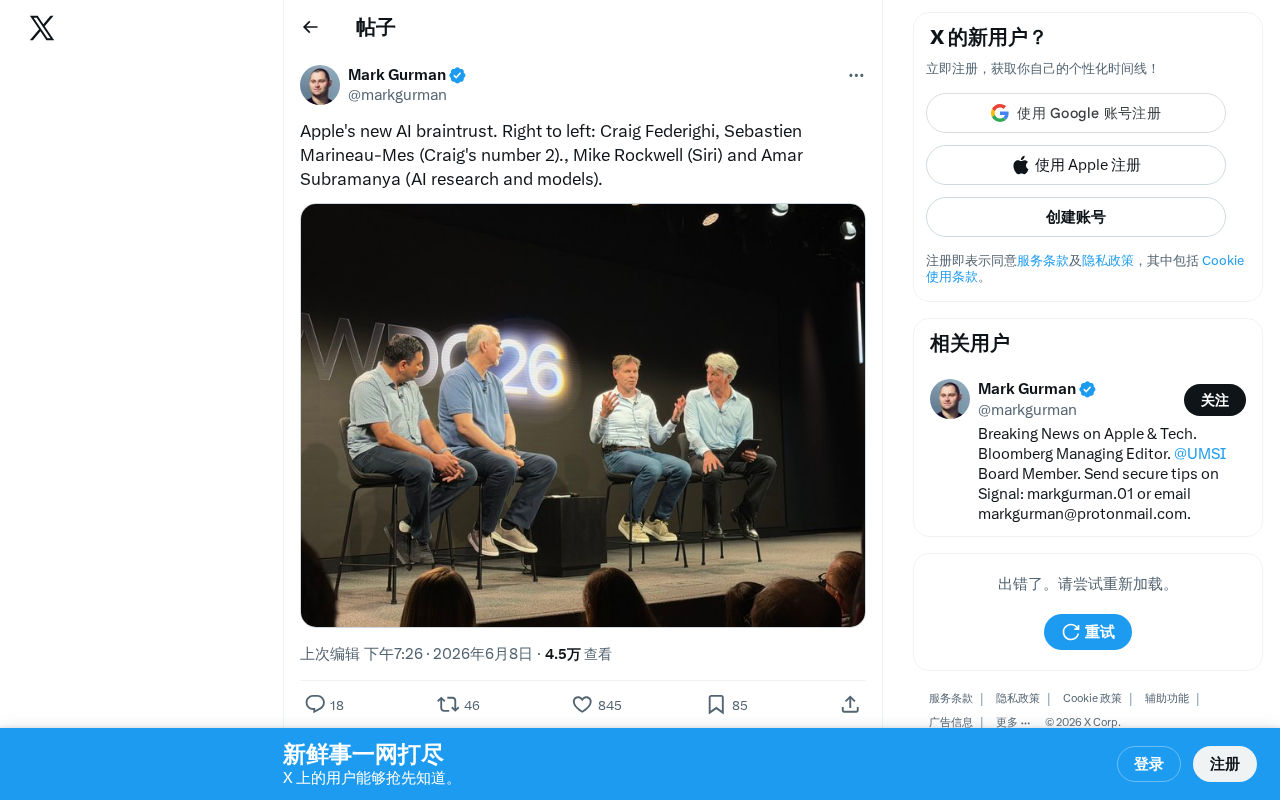
Apple reveals its four-person core AI leadership team and their distinct strategic roles.
Apple's core AI strategy team has made its first public appearance, featuring Craig Federighi (system integration), Sebastien Marineau-Mes (engineering execution), Mike Rockwell (Siri overhaul), and Amar Subramanya (AI model R&D). The lineup reveals Apple's approach of treating AI as an OS-level capability, prioritizing Siri's transformation, and maintaining in-house model development alongside ecosystem partnerships.
Apple's New AI Brain Trust Steps Into the Spotlight
Recently, a photo that has drawn widespread attention across the tech world began circulating on social media — Apple's core AI strategy decision-making team made their first collective public appearance. From right to left in the photo: Craig Federighi, Sebastien Marineau-Mes, Mike Rockwell, and Amar Subramanya — four key figures who hold the reins of Apple's AI future.
The public reveal of this lineup sends a clear signal: Apple is consolidating its internal AI resources with unprecedented intensity, building a complete AI leadership structure that spans system architecture, model R&D, product delivery, and user interaction.
Four Core Leaders, Each With a Distinct Role
Craig Federighi: The Commander of Apple's Software Empire
As Apple's Senior Vice President of Software Engineering, Craig Federighi has long overseen the development of core operating systems including iOS and macOS. In Apple's AI strategy, he plays the role of chief coordinator. All AI features ultimately need to reach users through the operating system layer, making Federighi the critical hub for Apple Intelligence deployment. His repeated demonstrations of Apple Intelligence's system-level integration capabilities at WWDC speak volumes about his central position in the AI strategy.
Sebastien Marineau-Mes: Federighi's Right-Hand Man
Often referred to externally as "Craig's number two," Sebastien Marineau-Mes handles key software engineering execution within Apple. As Federighi's direct deputy, he takes on a significant share of the hands-on work driving AI feature implementation and cross-team coordination. The importance of this role lies in the fact that the grand vision of an AI strategy requires exceptional engineering execution to become reality — and Marineau-Mes is the bridge connecting strategy to execution.
Mike Rockwell: Siri's New Chief
Mike Rockwell was previously well known for leading the development of Apple Vision Pro. Now he has shifted to overseeing Siri — a personnel move that speaks volumes in itself. As Apple's most important AI user interface, Siri has long been criticized by outsiders for lagging behind competitors. Putting an executive who successfully delivered a complex hardware product in charge of reshaping Siri demonstrates Apple's determination and sense of urgency around the Siri overhaul. Rockwell's involvement signals that Siri may be in for a major architecture-level upgrade.
Amar Subramanya: The Core of AI Research and Models
Amar Subramanya is responsible for Apple's AI research and model development — the technological foundation of the entire AI strategy. In today's fiercely competitive large language model landscape, Apple needs to find a unique balance between on-device models and cloud-based models. Subramanya's team carries the critical mission of developing the underlying models for Apple Intelligence, and their work directly determines the upper bound of Apple's AI product capabilities.
The Deeper Logic Behind Apple's AI Strategy
The composition of this team reveals several key characteristics of Apple's AI strategy:
System-level integration comes first. Having the head of software engineering lead the AI team shows that Apple remains committed to treating AI as an extension of operating system capabilities, rather than a standalone product. This stands in stark contrast to the approach taken by Google and Microsoft, which have launched independent AI products.
Reshaping Siri is the top priority. Dedicating a heavyweight executive specifically to Siri indicates that Apple fully understands voice assistants are one of the most critical user entry points in the AI era — and failure is not an option.
In-house models and ecosystem development go hand in hand. Establishing a dedicated AI research and model lead means Apple will not rely entirely on third-party models, but instead aims to maintain autonomy over its core technology.
Final Thoughts
The collective debut of Apple's AI brain trust marks an acceleration in AI positioning by the world's most valuable tech company. The four core leaders have clearly defined roles and complementary strengths, covering the complete chain from foundational research to system integration, from voice interaction to engineering delivery. As AI competition grows ever more intense, whether Apple can leverage this team to come from behind and take the lead is well worth watching.
Related articles

AI Large Model Learning Roadmap Breakdown: Three Stages from Application Development to Model Fine-Tuning
Deep breakdown of a popular AI large model learning roadmap covering LangChain, RAG, Agent, and LoRA fine-tuning across three stages, with analysis of its strengths and limitations for career changers.

AI Agent Development: A Complete 6-Week Systematic Learning Roadmap
A 6-week systematic learning roadmap for AI Agent development, covering core architecture, ReAct principles, multi-agent collaboration, RAG integration, and deployment.
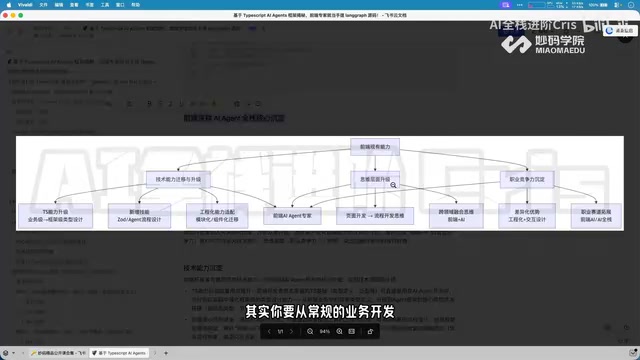
Four Core Advantages Frontend Developers Have When Transitioning to AI Agent Development
Frontend developers have key advantages for AI Agent development: TypeScript ecosystem fit, low-barrier full-stack bridging, and state management isomorphism. Learn the transition path here.