Apple Siri AI Officially Launches: EU and China Temporarily Excluded Due to Regulatory Restrictions
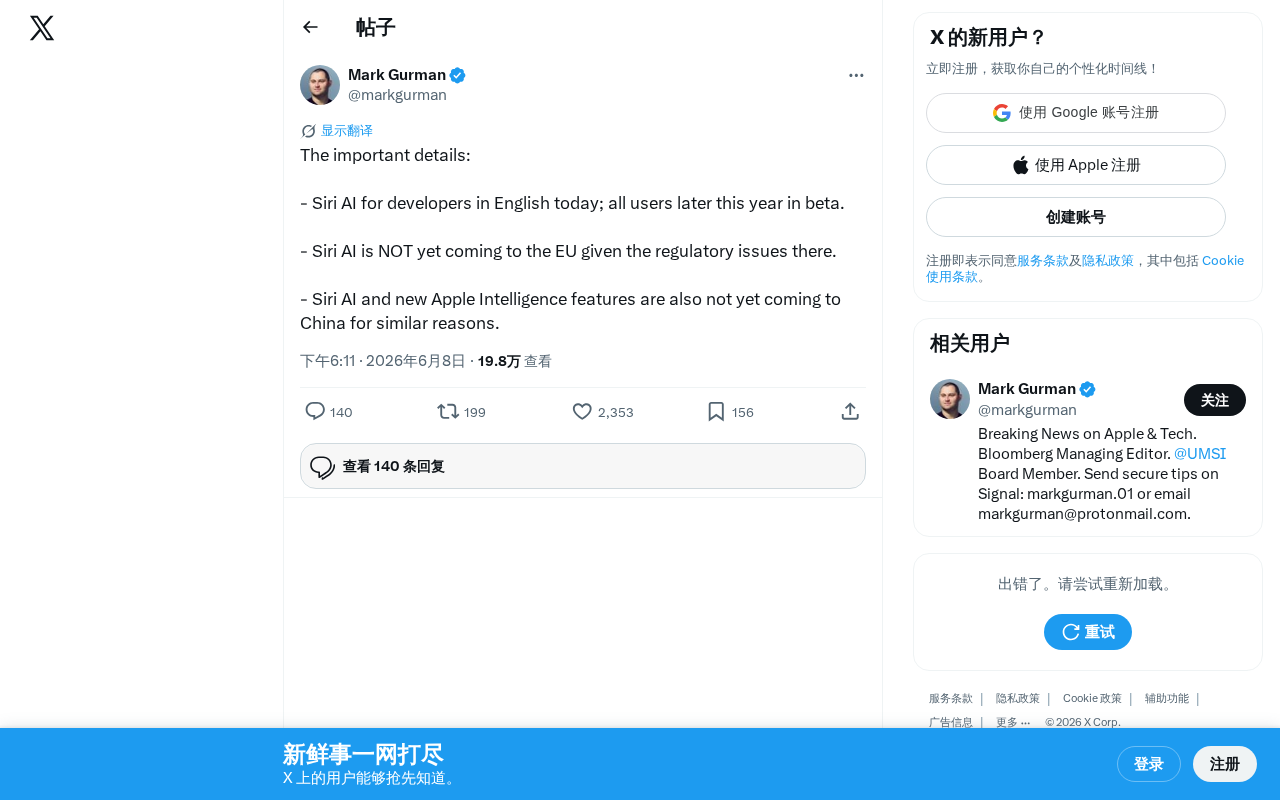
Apple launches Siri AI for developers but excludes EU and China over regulatory hurdles.
Apple has officially unveiled its Siri AI release plan, offering developer access immediately (English-only) with a public beta coming later this year. However, the EU and China are temporarily excluded due to regulatory restrictions including the EU's AI Act and China's generative AI compliance requirements. This highlights the growing fragmentation of global AI products driven by divergent regulatory frameworks.
Key Takeaways at a Glance
Apple has officially announced important release details for Siri AI, and what's most notable isn't just the features themselves, but the regional restriction strategy. This decision reflects the profound impact of the global AI regulatory landscape on how tech giants deploy their products.
Siri AI Release Timeline and Coverage
According to Apple's announcement, the Siri AI rollout will proceed in phases:
- Developer version: Available to developers starting today, English-only
- Public beta: Beta version rolling out to all users later this year
This "developers first, users follow" approach is Apple's standard playbook—it allows developers to adapt to the ecosystem early while optimizing the product experience through early feedback. Interestingly, the English-only limitation means that even in regions where it's available, non-English speakers will have a constrained experience.
EU Excluded: A Microcosm of the AI Regulation Battle
Apple has explicitly stated that Siri AI will not launch in the EU for the time being due to regulatory issues. This isn't an isolated case—Apple has previously delayed multiple Apple Intelligence features in Europe due to compliance requirements under the EU's Digital Markets Act (DMA).
The EU's strict AI regulatory framework, particularly the now-effective AI Act, imposes multiple requirements on high-risk AI systems including transparency, data governance, and human oversight. Apple's choice to delay rather than risk non-compliance reflects the conservative strategy tech companies adopt when facing uncertain regulatory environments.
China Also Missing Out on Apple Intelligence
Similar to the EU, Siri AI and the new Apple Intelligence features will also temporarily be unavailable in the Chinese market. Apple attributes this to "similar reasons"—namely, regulatory restrictions.
China has explicit registration and approval requirements for generative AI services, including algorithm filing and content safety assessments. Multiple international AI services have previously been unable to officially operate in mainland China due to failure to meet compliance requirements. For Apple, China is its third-largest market, and this absence will undoubtedly impact iPhone's competitiveness in the region—especially as domestic brands like Huawei are aggressively advancing on-device AI capabilities.
The Deeper Impact of Global AI Regulatory Divergence
Apple's release strategy reveals an increasingly apparent trend: global AI products are fragmenting due to regulatory differences.
- United States: Relatively relaxed regulation makes it the first-launch market for new AI features
- EU: Heavy regulation causes product delays, potentially leaving users permanently behind other regions
- China: An independent regulatory system requiring local compliance increases operational costs for multinational enterprises
This divergence doesn't just affect consumer experience—it's reshaping tech companies' global product strategies. In the future, we're likely to see more and more "region-exclusive" AI features rather than unified global products.
Practical Advice for Users and Developers
For developers, now is the window to get early access to the Siri AI ecosystem and seize first-mover advantage. For regular users, the beta is expected to launch in the second half of this year, and you can participate through the Apple Beta Software Program. As for users in the EU and China, the only option for now is to wait for further news once Apple reaches consensus with local regulators.
Related articles

Getting Started with Claude Code: An AI Programming Tool Anyone Can Learn Quickly
A complete guide to Claude Code: installation, setup, natural language programming, CLAUDE.md configuration, real-world use cases, and pricing plans for beginners.
5 Ways to Deploy LLMs Locally: From Getting Started to Production
A complete guide to 5 local LLM deployment methods: LlamaCPP, Ollama, LM Studio, vLLM/SGLang, and MLX-LM — from personal dev to production environments.

Gemini 3.5 Live Translate Launch: A Deep Dive into the Speech-to-Speech Translation Model Supporting 70+ Languages
Google launches Gemini 3.5 Live Translate, a speech-to-speech translation model supporting 70+ languages. Learn about its end-to-end architecture, Grab partnership, and developer access via Live API.