Apple Smart Glasses Design Leaked: Oval Camera, Colorful Options, and a Three-Phase Product Roadmap
Apple smart glasses leaked with oval camera, multiple frame styles, and a three-phase AR evolution roadmap.
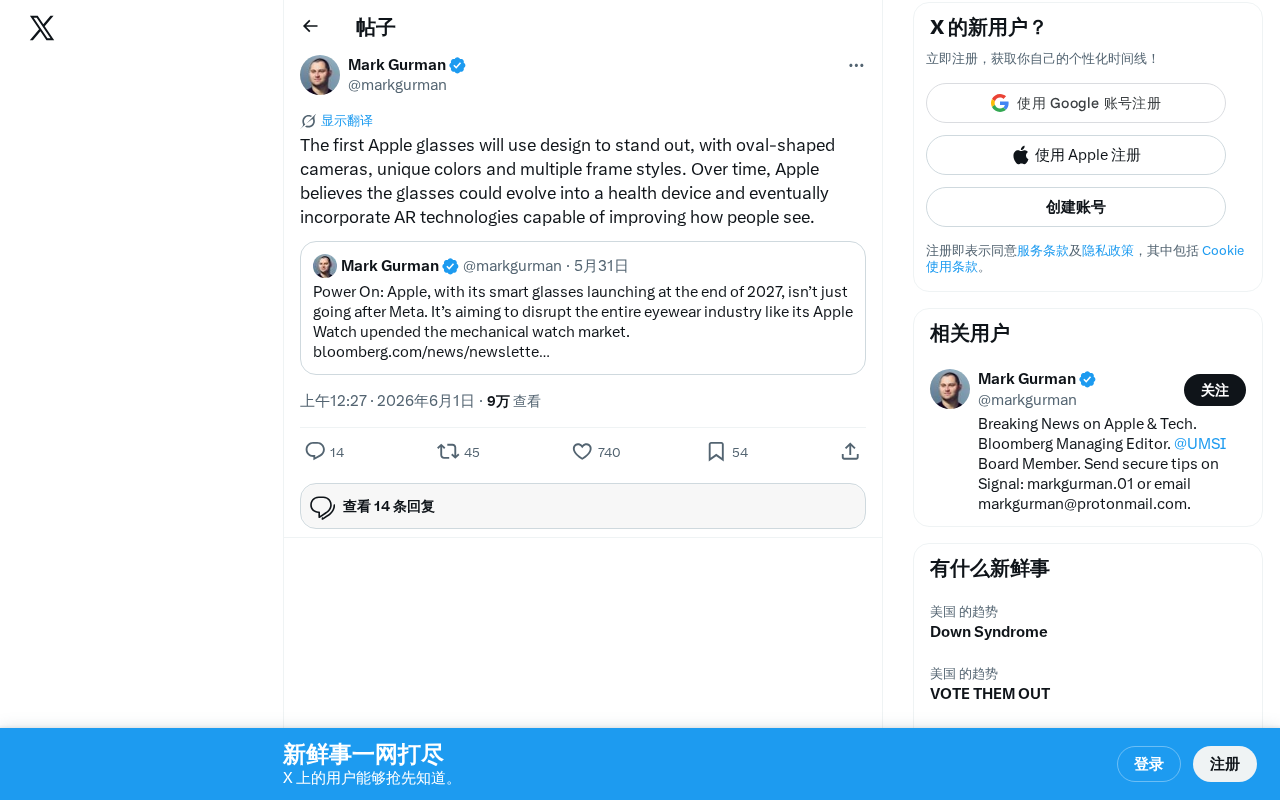
Leaked details reveal Apple's first smart glasses will feature an oval-shaped camera, multiple color options, and diverse frame styles—positioning the device as a fashion accessory first. Apple's roadmap outlines three phases: a design-driven smart accessory, a health monitoring device, and ultimately a full AR terminal. With advantages in custom silicon, ecosystem integration, and privacy branding, Apple aims to overcome the category's social acceptance challenges.
Apple Smart Glasses: First Design Details Revealed
According to leaked tech information, Apple's first smart glasses will feature a distinctive industrial design as their core selling point, clearly differentiating them from existing smart glasses on the market. The product will feature an oval-shaped camera, multiple unique color options, and various frame styles for users to choose from.
This strategy aligns perfectly with Apple's longstanding product philosophy — using design to drive technology adoption rather than letting technology dictate product form. Looking back at the success of AirPods, Apple Watch, and similar products, Apple has consistently prioritized "wearability" and "fashion appeal." Notably, the smart glasses category has long struggled with the so-called "Glasshole Effect" — a term that originated in 2013 when Google Glass launched and wearers faced social rejection due to the device's conspicuous camera. At the time, numerous restaurants and bars explicitly banned Google Glass, and people's fear of being recorded at any moment became the biggest barrier to product adoption. This historical lesson profoundly influenced the design direction of all subsequent smart glasses products, as manufacturers realized that device appearance must closely resemble regular eyewear and camera visibility must be minimized to gain social acceptance. Apple's "design-first" strategy is a direct response to this industry lesson.
Apple Glasses Design Highlights: Oval Camera and Diverse Frame Options
The Rationale Behind the Oval Camera
Choosing an oval shape over a traditional circular camera likely reflects multiple considerations. First, an oval form better complements the aesthetic lines of eyeglass frames, integrating more naturally into the temple or frame structure and reducing the social pressure that comes with an overtly "techy" appearance. Second, an oval sensor may provide a more optimal field-of-view ratio in certain scenarios, more closely matching the human eye's natural vision.
From a technical perspective, traditional camera sensors are mostly rectangular or square, but in miniaturized wearable devices, sensor shape selection must balance optical design, packaging space, and image quality. An oval sensor can provide a wider horizontal field of view while moderately narrowing the vertical dimension — better matching the human eye's effective vision of approximately 120° horizontal and 60° vertical. Additionally, oval packaging offers better space utilization in elongated areas like eyeglass temples, helping reduce overall thickness so the temples don't become overly bulky, which would compromise wearing comfort and aesthetics.
Multi-Color and Multi-Frame Strategy
Apple's plan to offer multiple unique colors and frame styles means the smart glasses are positioned from the outset as a fashion accessory rather than purely a tech product. This parallels the Meta Ray-Ban smart glasses strategy, though Apple clearly intends to push design diversity much further. The multi-frame strategy also suggests Apple may collaborate with fashion brands or establish an accessory ecosystem similar to Apple Watch bands.
The business logic behind this strategy is clear: glasses are among the most visible accessories on a person's face, and style preferences vary enormously across users. Offering only a single design — no matter how powerful the features — would exclude a large pool of potential buyers. Apple has already validated this model with Apple Watch: from sport bands to Hermès collaborations, different appearance options allow the same product to reach everyone from fitness enthusiasts to business professionals.
Apple Smart Glasses Product Roadmap: From Fashion Piece to AR Terminal
Apple's plans for these glasses extend far beyond a camera device. According to the leaks, Apple envisions smart glasses evolving through three phases:
Phase One: Design-Driven Smart Accessory — Enter the market with basic features like a camera and AI assistant, using outstanding design to attract users to wear them. The core goal of this phase is to build the habit of wearing smart glasses daily, making the device part of everyday style and establishing a user base for future upgrades.
Phase Two: Health Monitoring Device — As sensor technology matures, the glasses will gradually incorporate health monitoring capabilities. The close contact between glasses and the face makes them an ideal platform for monitoring intraocular pressure, blood oxygen, and even early disease screening. The eye area has rich blood vessel distribution, allowing optical sensors to non-invasively detect multiple physiological indicators — an advantage that wrist-worn devices cannot match.
Phase Three: AR Terminal — The ultimate goal is to integrate AR technology, fundamentally improving how people "see" the world. This may include real-time information overlay, vision enhancement, and even assistive features for people with visual impairments. Achieving this phase requires breakthroughs across multiple technology domains including micro-display technology (such as MicroLED waveguides), eye tracking, and real-time 3D environmental understanding. The industry broadly agrees that mature consumer-grade AR glasses still require 3-5 years of technological development.
Smart Glasses Market Competitive Landscape
The smart glasses market is currently heating up rapidly. Meta Ray-Ban has already proven the market viability of consumer smart glasses — the Ray-Ban Meta smart glasses, launched through Meta's partnership with Ray-Ban parent company EssilorLuxottica, exceeded market expectations after their late 2023 release. Priced from $299, the product offers photo/video capture, phone calls, and AI assistant features while looking virtually identical to regular Ray-Ban Wayfarers. Reports indicate sales have surpassed several million units, proving consumers are willing to pay for smart devices that "look like regular glasses." This product's success sent an important market signal to the entire industry: the breakthrough for smart glasses isn't about stacking high-end features like AR displays, but about nailing the basic experience while maintaining a fashionable appearance.
Meanwhile, Chinese companies including ByteDance and Baidu are also actively investing in the space. Apple's market entry at this point, while not the earliest, carries distinct advantages:
- In-house chip design capability: Apple Silicon's power efficiency advantage ensures an optimal balance between battery life and performance. The Apple Silicon architecture — spanning from M-series desktop chips to S-series watch chips — demonstrates Apple's ability to optimize computing performance across different power levels. The S-series chip used in Apple Watch is roughly fingernail-sized yet handles complex tasks like health monitoring and activity tracking. For smart glasses, chips must simultaneously drive the camera, AI inference, and wireless communication modules within extremely limited thermal headroom and battery capacity (typically just a few hundred milliamp-hours). Apple's priority access to TSMC's advanced process nodes (such as 3nm) enables the design of ultra-low-power yet computationally capable custom chips.
- Ecosystem synergy: Seamless integration with iPhone, Apple Watch, and AirPods, forming a complete personal device network
- Privacy-focused brand image: At a time when cameras trigger privacy concerns, Apple's privacy stance serves as a crucial endorsement. Apple has long positioned "privacy as a fundamental human right" as a core brand principle, and its on-device processing approach means camera-captured data can be analyzed locally by AI without cloud uploads — especially critical for smart glasses that may inadvertently capture others.
- Design and supply chain control: Deep expertise in miniaturization and materials engineering
Summary and Outlook
Apple's "design-first" strategy for smart glasses is a wise choice. For smart glasses to truly reach the mainstream, they must first solve the question of "will people want to wear them" rather than "can we implement a certain feature." From Vision Pro's premium positioning to the lightweight approach of smart glasses, Apple is building a complete spatial computing product matrix covering the full spectrum from professional to consumer use cases.
This Spatial Computing strategy reflects a top-down product coverage system: Vision Pro at $3,499 targets professional creators and enterprise users with a full mixed reality experience; the rumored lower-cost Vision product will cover the mid-range market; and smart glasses aim at the broadest consumer audience. This "high-end first, then scale down" strategy mirrors iPhone's development trajectory — establishing a technology benchmark and brand recognition with premium products, then gradually expanding the user base through technology trickle-down. The three product lines may also share data and experiences; for example, spatial content created on Vision Pro could be viewed in a lightweight format through the glasses.
While the final release date remains unconfirmed, the design philosophy clearly points in one direction: making technology truly invisible in everyday life. When smart glasses are no longer seen as "geek toys" but rather as "everyday accessories" — that's when this product category will truly explode.
Related articles

CodeGraph: Give Your Coding Agent a Code Map, Save 47% Tokens
CodeGraph is an open-source project with ~40K GitHub stars that uses Tree-sitter to build a local queryable code map, helping Claude Code and Cursor reduce 47% token usage and 58% tool calls.

AI Finishes Writing Code, Automatically Strikes a Gong to Alert You: Open-Source Physical Feedback Tool DAgent
A developer built a physical feedback device with chopsticks and a small gong that auto-strikes when AI finishes coding. Now open-sourced as DAgent, it also simulates IPO bell-ringing when creating new files.

Level Up Claude Code: Building an Enhanced Plan Mode with Grill Me
Learn how to install and use the Grill Me Skill for Claude Code, replacing AI guesswork with structured questioning to clarify requirements before generating execution plans.