Apple Smart Glasses: The Ambition and Market Strategy Targeting Billions of Eyewear Users
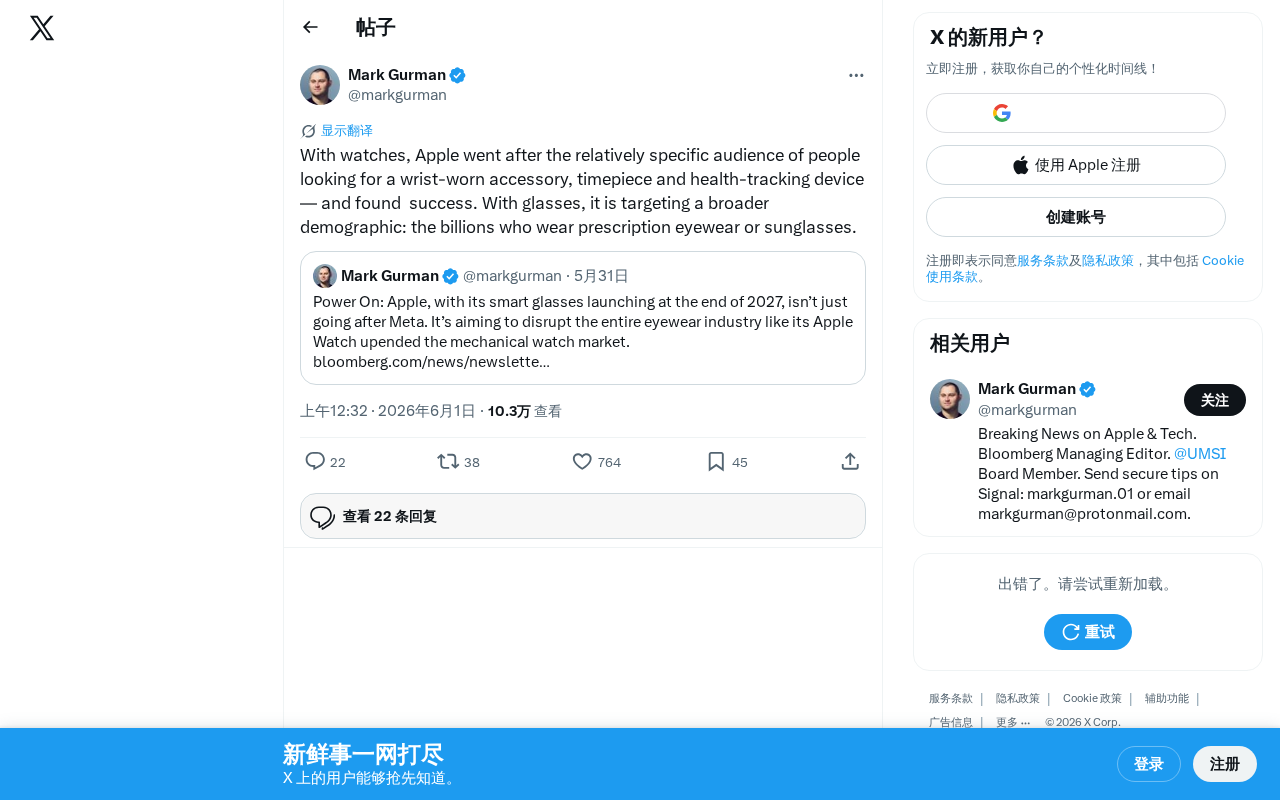
Apple targets billions of eyewear users with smart glasses, using a replacement strategy to lower adoption barriers.
Apple's smart glasses strategy represents a fundamental shift from the Apple Watch approach—instead of asking users to adopt a new device category, it targets the 4+ billion existing eyewear users with a simple replacement logic. Leveraging Vision Pro's spatial computing expertise, ecosystem integration, and industrial design prowess, Apple aims to gradually deliver smart features in a lightweight glasses form factor, despite significant technical challenges in display, battery, and thermal management.
From Apple Watch to Smart Glasses: Apple's Strategic Shift
Apple's strategy in the wearable device space is undergoing a fundamental transformation. When Apple Watch was launched, it targeted a relatively specific audience—users who needed a wrist accessory, timepiece, and health tracking device. Despite the limited target demographic, Apple Watch still became the world's best-selling smartwatch.
When Apple Watch first launched in 2015, the smartwatch market was still in its early exploratory phase. Competitors at the time included Samsung's Gear series and Pebble, but none managed to truly crack the mass market. Apple initially positioned Apple Watch as a three-in-one product: a precision timepiece, communication device, and health tracker—even releasing an 18K gold Edition version priced at $17,000 in an attempt to enter the luxury market. However, what truly drove Apple Watch sales was the addition of cellular connectivity in the 2017 Series 3, followed by the ECG monitoring feature introduced in Series 4. According to Counterpoint Research data, Apple Watch has consistently held approximately 30% of the global smartwatch market share, with annual shipments exceeding 50 million units.
However, Apple's next move—smart glasses—reveals ambitions far grander than the watch.
A Potential Market of Billions: The Core Logic Behind Smart Glasses
Unlike smartwatches, Apple's smart glasses target a vastly larger population: the billions of people worldwide who need to wear prescription glasses or sunglasses. According to the World Health Organization, approximately 2.6 billion people globally suffer from myopia, most of whom need corrective glasses or contact lenses. Including sunglasses users, the total number of eyewear wearers worldwide is estimated to exceed 4 billion. The global eyewear market surpassed $180 billion in 2023 and is projected to exceed $270 billion by 2030. This market is dominated by Essilor Luxottica, which owns well-known brands like Ray-Ban and Oakley while controlling the entire value chain from lens manufacturing to retail endpoints. Apple entering this market means either competing head-on or collaborating with this giant that generates over €25 billion in annual revenue.
The significance of this strategic shift is profound:
- Apple Watch's target users: A specific group with demand for wrist devices, requiring users to add an entirely new wearable category
- Smart glasses' target users: A massive population already wearing glasses daily, who simply need to replace their existing product
This logic of "replacement" rather than "addition" dramatically lowers the adoption barrier. For people who already wear glasses every day, switching to a pair with smart features feels far more natural than adding another device to their wrist.
Apple Smart Glasses' Differentiated Competitive Advantages
Technical Evolution from Vision Pro to Lightweight Glasses
Apple has already demonstrated its deep technical expertise in spatial computing through Vision Pro. But Vision Pro's bulky form factor and high price point mean it's destined to remain a niche product. Smart glasses represent a viable path to bringing these cutting-edge technologies to the masses in a lighter, more everyday form.
Spatial Computing refers to a computing paradigm that merges digital information with the physical environment, involving multiple core technologies including computer vision, SLAM (Simultaneous Localization and Mapping), eye tracking, and gesture recognition. Apple's Vision Pro, released in 2024 at $3,499, features an M2 chip and a dedicated R1 chip—the latter specifically processes data streams from 12 cameras, 5 sensors, and 6 microphones, achieving ultra-low latency passthrough display at 12 milliseconds. Vision Pro's Micro-OLED displays, supplied by Sony, exceed 4K resolution per eye. While these technologies currently require substantial hardware volume, they provide a clear technology roadmap for future miniaturization—Apple needs to progressively compress these capabilities into an eyeglass form factor, which may require 3-5 years of iterative development.
Merging Fashion Appeal with Tech Functionality
Glasses are inherently a fashion accessory. Apple's long-standing expertise in industrial design, combined with its powerful brand premium, positions it well to create smart glasses that combine tech functionality with fashion appeal. Meta's collaboration with Ray-Ban on smart glasses has already validated the viability of this direction.
Meta's Ray-Ban Meta smart glasses launched their second generation in 2023, starting at $299. The product features a 12-megapixel camera, open-ear speakers, and Meta AI voice assistant, supporting photo capture, video recording, phone calls, and music playback—but lacks AR display capability. Reports indicate second-generation sales far exceeded expectations, with 2024 shipments potentially reaching several million units. Meta CEO Mark Zuckerberg has described smart glasses as a "Trojan horse" leading to AR glasses—first attracting users to accept the smart glasses form factor through practical features, then gradually adding AR display capabilities. Meta plans to launch the full-color AR-capable Orion glasses between 2025-2027, with a prototype already demonstrated in 2024 weighing approximately 100 grams.
Smart Glasses Industry Landscape and Technical Challenges
Multiple heavyweight players are already positioned in the smart glasses space: Meta's collaboration with Ray-Ban has iterated to its second generation with positive market reception; Google is also re-exploring the AR glasses direction. While Apple isn't the earliest entrant, its ecosystem integration capability—the seamless synergy between iPhone, AirPods, and Apple Watch—could become its greatest differentiating moat.
However, the challenges are equally significant:
- How to integrate sufficient computing power and battery life in a slim glasses form factor
- How to effectively solve heat dissipation issues
- How to keep prices within a range acceptable to mass consumers
The technical challenges facing smart glasses are far more complex than those of smartwatches. In display technology, current mainstream approaches include waveguides and Micro-LED projection. Waveguides require light to undergo multiple total internal reflections within an extremely thin glass substrate before projecting into the eye, but suffer from limited field of view (typically only 30-50 degrees), insufficient brightness, and rainbow artifacts. Regarding batteries, the space within typical glasses temples can only accommodate approximately 1-2Wh of battery capacity—an Apple Watch battery is about 1.2Wh—making it extremely challenging to power more capable computing and display systems within similar volumes. Heat dissipation is equally problematic—facial skin is extremely sensitive to temperature, with device surface temperatures exceeding 41°C causing discomfort, severely limiting processor power consumption. Additionally, lens optical quality must meet the precision requirements of prescription correction, further increasing design complexity.
These technical and commercial challenges are hurdles Apple must overcome one by one.
Summary: A Strategic Leap from Niche Market to Mass Replacement
Apple's strategic evolution from watches to glasses reflects a clear business logic: moving from serving specific needs in a niche market to replacing existing behaviors in a mass market. If Apple Watch proved Apple could establish dominance in an entirely new product category, then smart glasses will test whether Apple can replicate this success in a larger, more complex market. The base of billions of eyewear users makes the upside of this bet far exceed the watch business.
From a product strategy perspective, Apple will likely adopt a gradual approach similar to Apple Watch: the first generation focusing on core features that don't depend on displays—audio, camera, and AI assistant—keeping weight under 40-50 grams to ensure all-day wearing comfort; subsequent iterations would gradually introduce lightweight AR displays, ultimately achieving a complete spatial computing experience. This "get users wearing them first, then progressively enhance" strategy both reduces technical risk and buys time for market education.
Key Takeaways
Related articles

Six AI Coding Tools Compared: Claude Code and Cursor Lead the Pack
In-depth comparison of six AI coding tools in 2026: Claude Code, Cursor, Codex, Trae, Qoder, CodeBuddy. Analyzed across Agent capabilities, IDE experience, and team collaboration with scenario-based recommendations.

Roo Code Deep Dive: A Guide to the Multi-Model AI Coding Assistant for VS Code
Deep dive into Roo Code (formerly Roo Cline) VS Code extension: multi-AI backend switching, auto-diff code review, terminal command execution, and Architect Mode explained with practical tips.

NotebookLM Service Restored: Google's AI Research Assistant Back Online
Google NotebookLM is fully back online after a service outage. Learn about the incident details, NotebookLM's core features, and backup tips for AI-dependent researchers.