Art Student Hand-Crafts Chinese Pokémon GO: Walk to Cultivate Immortality and Catch Demons
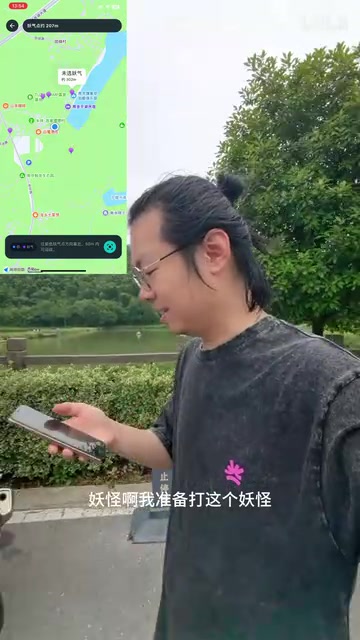
Art student uses AI to build a Chinese mythology-themed Pokémon GO with cultivation mechanics.
An art student indie developer leveraged AI programming tools to create a Chinese-style LBS mobile game prototype combining Pokémon GO's location-based gameplay with xianxia (cultivation) culture. The game features GPS-based demon encounters, pre-battle divination mechanics, and a "Destiny Scroll" collection system, all wrapped in traditional Chinese mythology. The project demonstrates how AI tools are lowering barriers for non-programmers to build complex games.
An art student indie developer has combined the classic Pokémon GO gameplay with Chinese cultivation (xianxia) culture to create an LBS (Location-Based Service) mobile game prototype centered on "walking to cultivate immortality and catch demons." Without a professional programming background, they achieved a complete outdoor live demonstration using AI-assisted development and personal creativity. This project not only showcases the limitless possibilities for individual developers in the AI era but also provides an interesting approach to Chinese-style game design.
Core Gameplay: Measuring the Path of Immortality with Footsteps
The core design philosophy of this "Chinese Pokémon GO" is crystal clear — replacing Pokémon GO's AR location-based pet-catching mechanics with a Chinese traditional cultivation worldview. Players are no longer trainers but cultivators; they no longer catch Pokémon but vanquish demons and increase their cultivation level.
The reason Pokémon GO became a phenomenon lies in its three-layer design structure: the exploration loop (GPS tracking incentivizes walking), the collection loop (Pokédex-driven collecting desire), and the social loop (gym battles and community events). Since its July 2016 launch, Pokémon GO has generated over $6.5 billion in cumulative revenue, fully validating the commercial potential of LBS + collection gameplay. This Chinese-style game attempts to retain this classic framework while injecting a completely different cultural core.
From the developer's outdoor field test, the game has already implemented several key functional modules:
- GPS Positioning and Monster Distribution: Monsters are randomly distributed on the map based on geographic location, and players must physically walk to the corresponding location to trigger combat. The developer mentioned that "monsters at other locations aren't necessarily findable, because outdoors you don't know if the positioning is in the mountains or in the water," suggesting that monster appearances may be linked to terrain data. From a technical perspective, LBS games fundamentally rely on GPS positioning modules, map tile rendering engines (such as Mapbox or OpenStreetMap), and server-side geofence calculations. Today, the proliferation of open-source map solutions and lightweight positioning SDKs has made it possible for indie developers to implement such features.
- Distance Trigger Mechanism: The screen displays the distance to the target monster (68, 67, 66...), and players must walk close enough to enter combat range — identical to Pokémon GO's design.
- "Reforging the Mortal Body" Exercise Incentive: The developer packaged "walking exercise" as the cultivation term "reforging the mortal body," a cultural wrapper that makes exercise more immersive. In cultivation culture, "reforging the mortal body" is a core concept where practitioners transform their mundane physical form through cultivation — forming a clever metaphorical parallel with strengthening one's body through walking in reality.

Combat and Collection System: Fortune Divination + Destiny Scroll
In combat system design, this game incorporates numerous Chinese elements, creating a stark cultural contrast with Pokémon GO's "throw a Poké Ball" mechanic.

Pre-battle Divination Mechanic: After encountering a monster, players can first "boost their qi" to check their odds of winning. The field test showed "approximately 5 to 7 out of 10 chance of winning," meaning the game has a built-in win rate calculation system based on the player's cultivation level and monster strength. This is a clever design — it adds strategic depth (you can choose to retreat if outmatched) while incorporating traditional Chinese divination culture. In Chinese folk beliefs, consulting oracles before traveling and divining before taking action are deeply rooted cultural habits. Integrating this tradition into game mechanics transforms the functional operation of "checking win probability" into a cultural experience.
Battle Reward System: After defeating a monster, players can obtain items, cultivation advancement (such as "cultivation remarkably increased by 12%"), and the monster's collection CG. Here, "cultivation level" corresponds to Pokémon GO's experience point system, while "items" may be used for subsequent cultivation or combat assistance. The complete level framework in the cultivation system — from "Qi Refining Stage" to "Tribulation Crossing Stage" — has achieved extremely high public recognition thanks to web novels, naturally possessing clear growth paths and goal-setting that make it perfectly suited as a game's numerical progression backbone.

Destiny Scroll (Pokédex System): All defeated and collected monsters are recorded in the "Cultivation Archives" under the "Destiny Scroll," which players can review at any time. This is essentially Pokémon's Pokédex system, but the name "Destiny Scroll" certainly carries more Chinese aesthetic flavor. From the demo footage, each monster comes with exclusive CG illustrations — as an art student, the developer clearly has a natural advantage in art assets.
An Art Student Making Games: The Personal Development Paradigm of the AI Era
The most noteworthy aspect of this project is the developer's identity — an art student. In conventional thinking, independently developing an LBS game containing GPS positioning, map rendering, combat systems, and database management would require at least a small team's collaboration. But with AI-assisted programming tools becoming increasingly mature, the technical barrier is being dramatically lowered.
The developer used "hand-crafted" to describe their development process and stated they "never expected to actually pull it off." This sense of surprise precisely reflects the empowering effect of current AI programming tools (such as Cursor, Claude, etc.) on non-professional developers. The core principle of these tools is code generation and completion capabilities based on Large Language Models (LLMs) — developers can describe requirements in natural language, and AI automatically generates corresponding code. This transforms programming from "writing line by line" to a workflow of "requirement description + review and modification." Developers don't need to memorize API documentation or syntax details; they only need to understand program logic and architecture design. Art students possess excellent visual design abilities and creative thinking — when programming is no longer an insurmountable obstacle, they may actually create more distinctive products than developers with purely technical backgrounds.
From the current demonstration, although the game is still at the prototype stage, the core loop is already functional: walk → discover monster → battle → receive rewards → collect in Pokédex → continue walking. If social battles, monster cultivation, region-exclusive monsters, and other features are added later, it has full potential to develop into a complete indie game project.
The Market Gap for Chinese-Style LBS Games
Looking back at the LBS game market, Pokémon GO has dominated since its 2016 launch but has never officially launched in the Chinese market. Tencent once released Let's Hunt Monsters, but it shut down in 2022. This means the Chinese-style LBS game track is currently almost entirely vacant.
The rise and fall of Let's Hunt Monsters is worth reflecting on. Launched in April 2019, the game combined AR monster-catching with blockchain digital collectibles and other concepts, topping the iOS free chart on its first day, but announced shutdown after only three years of operation. Reasons for its failure include: severe GPS drift caused by China's high-density urban architecture seriously affecting the experience, lack of Pokémon-level IP appeal, and excessive commercialization in later operations leading to player attrition. This history demonstrates that market demand for Chinese-style LBS games genuinely exists, but product design and operational strategy require more refined localized thinking.
The "cultivation and demon-catching" theme chosen by this developer naturally aligns with Chinese players' cultural identity. Classic of Mountains and Seas monsters, cultivation systems, feng shui geography... if these elements are deeply bound to real geographic locations (such as encountering mountain spirits in mountainous areas or water demons near bodies of water), it would create a uniquely immersive experience. It's worth noting that the Classic of Mountains and Seas (Shanhai Jing), a pre-Qin era geographic bestiary, records approximately 400+ extraordinary creatures, many of which are inherently tied to specific geographic environments — such as "Jingwei" originating from Fajiu Mountain, the "Nine-Tailed Fox" from Qingqiu, and "Zhulong" residing at Zhong Mountain. This natural "monster-geography" correspondence, if mapped to real-world terrain data (elevation, water systems, vegetation types, etc.), could achieve a true sense of "different lands breed different demons" — a cultural advantage that Western IPs cannot replicate.
Of course, there's still a long road from prototype to product — map licensing, server costs, anti-cheat mechanisms, and more are all real challenges. But as a proof of concept, this project is already exciting enough.
Key Takeaways
Related articles

AI Programming Learning Roadmap: A Complete Six-Stage Guide from Beginner to Expert
A systematic breakdown of the six-stage AI programming learning roadmap, from zero-code start to mastering Cursor and professional tools, methodology frameworks, advanced patterns, and project practice.

Deep Dive into Devin's Background Agent Architecture: Behind the 80% AI-Committed Code
Deep analysis of Devin's background agent architecture: brain-sandbox separation, environment setup, MCP integration, memory systems, and multi-agent collaboration challenges.

Claude Code in Practice: An In-Depth Efficiency Comparison Between Claude and DeepSeek for Programming
A hands-on comparison of Claude vs DeepSeek V4 for AI programming: code quality, development efficiency, and cost differences. DeepSeek costs 1/6 to 1/10 of Claude but requires 1-2x more time.