Ayanna Howard Named President of Spelman College: AI Robotics Expert to Lead Historic Black Women's College
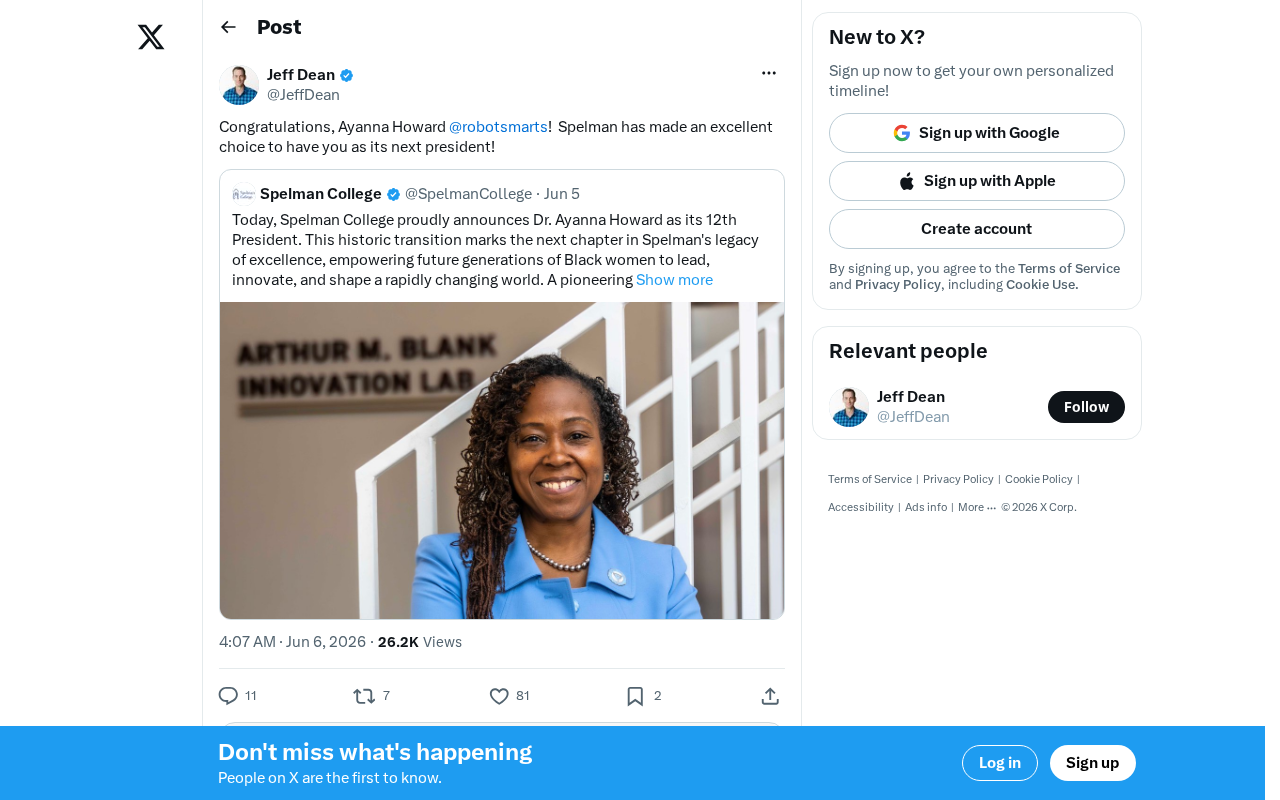
AI robotics expert Ayanna Howard named president of Spelman College, a historic Black women's institution.
Ayanna Howard, a leading AI and robotics scholar with experience at NASA's JPL and as Georgia Tech's engineering dean, has been appointed president of Spelman College. Her appointment signals the HBCU's commitment to placing STEM and AI at the center of its mission, with implications for advancing diversity in tech and responsible AI development.
A Distinguished Robotics and AI Scholar Steps Into Higher Education Leadership
Ayanna Howard, a renowned scholar in robotics and artificial intelligence, has been named the next president of Spelman College. The announcement has drawn widespread attention and congratulations from both the tech and education communities.
Ayanna Howard's Career Journey: From NASA to the Academic Frontier
Dr. Ayanna Howard is a towering figure in robotics and artificial intelligence. She previously worked at NASA's Jet Propulsion Laboratory (JPL), contributing to robotics research related to Mars exploration. Located in Pasadena, California, and managed by Caltech, JPL is one of the world's most important deep-space exploration research institutions, responsible for landmark missions including the Voyager probes, the Curiosity rover, and the Perseverance rover. During her time at JPL, Dr. Howard's work on Mars exploration robots involved solving cutting-edge technical challenges such as autonomous navigation in extreme environments, compensating for remote control communication delays (which can reach up to 20 minutes between Earth and Mars), and terrain recognition. These experiences laid a solid foundation for her later academic research in human-robot interaction and intelligent systems.
She then served as Dean of the College of Engineering at Georgia Tech, becoming the first African American woman to hold that position.
Her research spans human-robot interaction, intelligent robotic systems, and AI applications in healthcare, with a particular focus on using robotics to help children with special needs in rehabilitation therapy. This work falls within the important application domain of Socially Assistive Robotics (SAR) — robots that use gamified interactions to guide children with autism spectrum disorder, cerebral palsy, or developmental delays through specific motor training and social skills exercises. Compared to traditional rehabilitation therapy, robots offer unlimited patience, highly consistent behavior, and the ability to precisely record training data. Children also tend to show higher engagement and lower social anxiety with robot companions. The systems developed by Dr. Howard's team use computer vision and machine learning algorithms to assess children's motor performance in real time and adaptively adjust training difficulty, enabling personalized rehabilitation programs.
Dr. Howard is not only an exceptional technologist but also a prominent advocate for diversity and inclusion in the tech sector.
Why Spelman College Chose an AI Expert as President
A Historic Black Women's College with a Special Mission
Located in Atlanta, Spelman College is one of the most prestigious Historically Black Colleges and Universities (HBCUs) in the nation, with a longstanding commitment to developing African American women leaders. HBCUs are higher education institutions established before the passage of the Civil Rights Act of 1964, primarily dedicated to serving African American students. There are currently approximately 107 HBCUs in the United States. While they represent only about 3% of all American colleges and universities, they produce approximately 20% of African American college graduates, along with a significant proportion of African American doctors, lawyers, and engineers. HBCUs provided invaluable higher education opportunities for African Americans during the era of racial segregation and continue to play an irreplaceable role in closing educational equity gaps. As a top-tier HBCU focused on women's education, Spelman's alumni network wields significant influence in politics, business, and academia.
Choosing a leading AI and robotics scholar as president sends a clear signal: the institution is placing STEM education and cutting-edge technology at the core of its future development strategy.
Deep Integration of Technology and Liberal Arts Education
The significance of this appointment goes far beyond a personnel change. At a time when artificial intelligence is rapidly reshaping every industry, having a leader with deep AI expertise at the helm of an institution known for cultivating women's leadership could have far-reaching impacts in several areas:
- Advancing AI education access: Integrating AI literacy into the liberal arts education system, enabling students outside STEM majors to understand and leverage AI tools
- Promoting diversity in tech: Paving the way for more African American women to enter the AI and robotics fields, addressing the tech industry's persistent lack of diversity. The severity of this problem cannot be overstated — according to Stanford University's 2024 AI Index Report and other studies, African Americans represent less than 5% of AI professionals in the United States, women account for approximately 25%-30%, and African American women make up an even smaller fraction. This homogeneity in talent composition is not merely a social equity issue — it directly affects the quality of AI systems. Development teams lacking diverse perspectives are more likely to introduce systemic biases in training data selection, model design, and application scenario definition, leading to real-world problems such as facial recognition systems with lower accuracy for darker skin tones and hiring algorithms that discriminate against female candidates
- Leading responsible AI development: Dr. Howard has long focused on AI ethics and algorithmic bias, and her leadership is expected to advance more socially responsible technology research. Algorithmic bias refers to AI systems producing systematically unfair treatment of specific groups in their decision-making processes, typically rooted in historical biases in training data, design flaws in model architecture, or inadequate evaluation criteria. Dr. Howard's contributions in this area are particularly notable — her research has revealed humans' tendency toward "over-trust" in robots and AI systems, meaning people tend to uncritically accept AI recommendations even when those recommendations contain obvious errors. She also authored the book Sex, Race, and Robots, systematically exploring how social biases become encoded in AI systems and how technical and institutional design can mitigate these issues, making her one of the most influential voices in the responsible AI movement
What This Appointment Means for the AI Industry
When top talent from the AI field begins moving into the highest levels of higher education leadership, it represents a noteworthy trend in itself. It signals that artificial intelligence is no longer merely a technical topic — it is becoming a core force shaping educational philosophies, talent development models, and even social structures.
Ayanna Howard's career trajectory — from NASA engineer to university dean to college president — also demonstrates an unconventional career path for AI professionals: the combination of technical expertise and leadership can create impact on a much broader stage.
Globally, AI talent development and diverse participation have become critical dimensions of national competitiveness. Spelman College's choice may well provide a compelling case study for how to redefine higher education in the age of AI.
Key Takeaways
Related articles

Codex VS Claude Code: The Token Economics Behind a 10x Price Gap
Same coding task: Codex costs $15, Claude Code costs $155. Deep dive into the real reasons behind the 10x gap — it's not pricing, it's token volume, output style, and context strategy.

Gemma 4 Open-Source Model Local Deployment Guide: Ollama Installation & Mobile Setup
Step-by-step guide to deploying Google's Gemma 4 open-source model locally with Ollama and running the lightweight version on mobile with tool calling support.

The Decline of Tokenmaxxing: Why Selling Outcomes Matters More Than Selling Tokens
The Tokenmaxxing craze is fading as enterprise AI procurement shifts from chasing Token counts to focusing on actual business outcomes. Learn why outcome-based AI evaluation is the right approach.