BioAgents: A Multi-Agent AI Framework for Autonomous Research in Biological Sciences
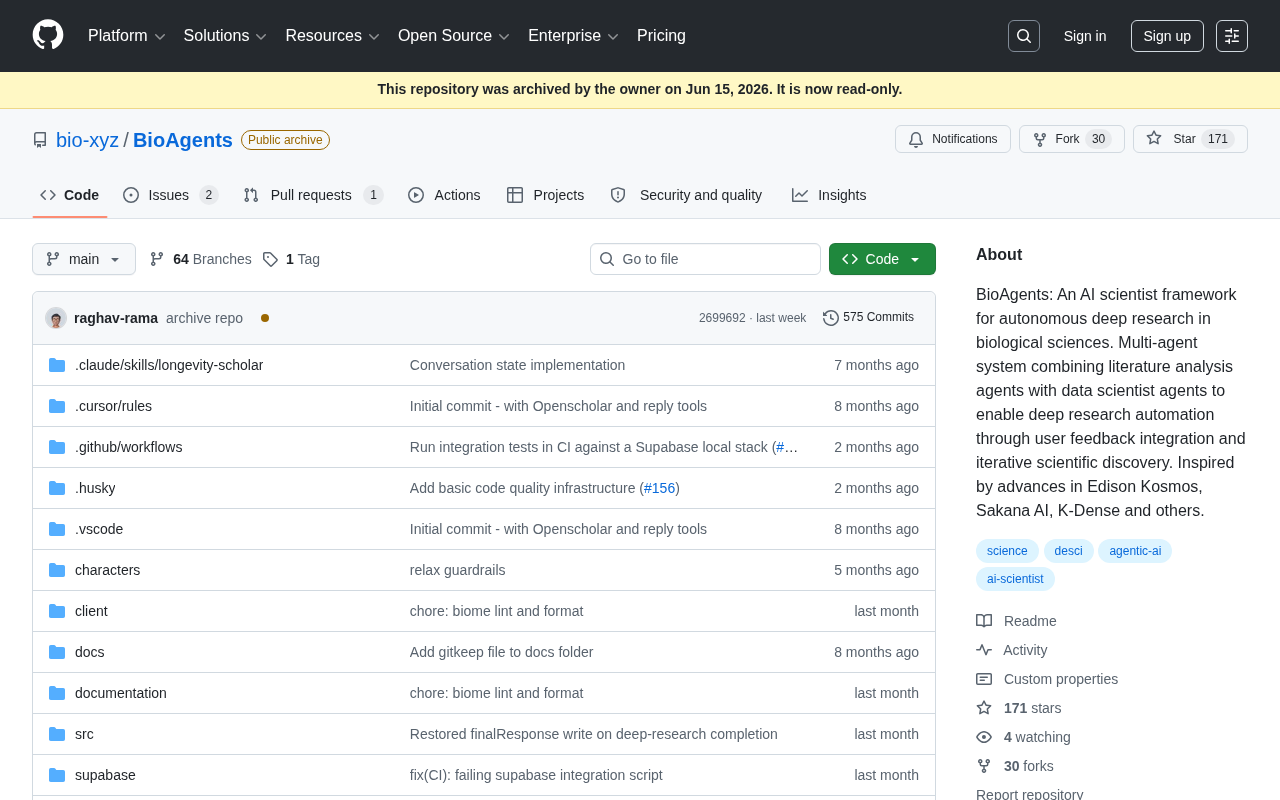
BioAgents is a multi-agent AI framework enabling autonomous biological science research through iterative discovery.
BioAgents is an open-source multi-agent AI framework for biological sciences that combines literature analysis agents and data scientist agents to automate deep research. Built in TypeScript by the bio-xyz team, it features human-in-the-loop feedback integration and iterative scientific discovery workflows, positioning itself in the growing AI for Science ecosystem alongside projects like Sakana AI's AI Scientist and Microsoft's AutoGen.
Project Overview
BioAgents is an AI scientist framework designed for the biological sciences, aimed at automating autonomous deep research. Developed by the bio-xyz team, the project adopts a multi-agent system architecture that combines literature analysis agents with data scientist agents. Through user feedback integration and an iterative scientific discovery workflow, it advances the intelligent transformation of biological science research.
Multi-Agent Systems (MAS) represent a core paradigm in distributed artificial intelligence. The fundamental idea is to decompose complex tasks into collaborative behaviors among multiple specialized agents. Each agent possesses autonomous perception, decision-making, and action capabilities, exchanging information and coordinating tasks through predefined communication protocols. In AI-driven scientific research, the advantage of multi-agent architectures lies in their ability to simulate the division of labor in real research teams—just as literature reviewers, data analysts, and experimental designers each play their roles in a laboratory, software agents can be assigned roles based on their specialized capabilities, achieving a balance between complexity and expertise.
The project draws inspiration from cutting-edge AI research including Edison Kosmos, Sakana AI, and K-Dense. It has currently earned 171 stars on GitHub, is developed in TypeScript, and has 30 forks. Edison Kosmos is a research project exploring AI's capacity for autonomous scientific discovery, dedicated to enabling AI systems to conduct systematic invention like Edison. Sakana AI is a Japanese AI company founded by former Google Brain researchers, whose "AI Scientist" system can autonomously complete the entire research workflow from literature review and hypothesis generation to paper writing, sparking widespread discussion in academia. K-Dense focuses on information retrieval and integration techniques for knowledge-intensive reasoning tasks. Together, these projects represent the technological frontier of AI's transition from passive tool to active researcher.
Core Architecture: Multi-Agent Collaborative System
Literature Analysis Agents
The first core component of BioAgents is the Literature Analysis Agents. In biological science research, the vast body of papers, preprints, and databases forms the foundation of knowledge. Literature analysis agents are responsible for automatically retrieving, reading, summarizing, and correlating relevant literature, helping researchers quickly build a comprehensive understanding of specific topics.
These agents can identify research trends, discover knowledge gaps, extract key experimental data and conclusions, and provide a solid knowledge foundation for subsequent research hypothesis generation. Notably, the scale of biomedical literature is enormous—PubMed alone indexes over 36 million articles, with more than 1 million new papers added annually. Traditional manual literature review methods can no longer keep pace with the speed of knowledge growth, making AI-driven literature analysis an essential need. Literature analysis agents typically need to integrate semantic search, Named Entity Recognition (NER), relation extraction, and other natural language processing techniques to extract structured scientific knowledge from unstructured text.
Data Scientist Agents
The second core component is the Data Scientist Agents, which focus on computationally intensive tasks such as data processing, statistical analysis, and model building. In biological science research, from genomics to proteomics, from clinical trial data to ecological observations, data analysis capabilities are indispensable.
Biological science data possesses unique complexity: genomic data involves sequence analysis of billions of base pairs, proteomics requires processing high-dimensional data from mass spectrometers, and sparse matrices from single-cell RNA sequencing demand specialized dimensionality reduction and clustering algorithms. Additionally, biological data faces statistical challenges including batch effects, sample heterogeneity, and multiple testing correction. Traditional data analysis workflows often require bioinformatics experts to spend weeks or even months—this is precisely the pain point that data scientist agents aim to address.
Data scientist agents can automatically execute workflows including data cleaning, feature engineering, hypothesis testing, and visualization, transforming raw data into meaningful scientific insights. Through code generation and automated execution capabilities, these agents can dynamically select appropriate analytical methods and adjust parameters based on data characteristics, dramatically shortening the cycle from data to discovery.
Key Design Principles
Human-AI Collaboration Through User Feedback Integration
BioAgents is not a fully black-box automated system; rather, it emphasizes human-AI collaboration. Through user feedback integration mechanisms, researchers can provide guidance, correct directions, or validate intermediate results at critical nodes in the research process. This design ensures that the AI system's output remains consistent with researchers' scientific intuition and domain knowledge.
This design choice reflects a fundamental challenge facing current AI research systems: scientific discovery relies not only on data-driven pattern recognition but also on domain intuition, causal reasoning, and judgment about experimental feasibility. While current large language models excel at information synthesis, they still have obvious limitations in distinguishing correlation from causation, evaluating experimental costs and risks, and judging the biological plausibility of results. The Human-in-the-Loop design preserves AI's efficiency advantages while ensuring scientific rigor by introducing human expert judgment at critical decision points. This approach also aligns with the spirit of peer review in scientific research.
Iterative Scientific Discovery Workflow
Scientific research is inherently an iterative process—proposing hypotheses, designing experiments, collecting data, analyzing results, and refining hypotheses. BioAgents internalizes this cycle as the system's core workflow, supporting multiple rounds of autonomous research exploration, with each round deepening and expanding upon the discoveries of the previous one.
This iterative design draws from Karl Popper's falsificationism in the philosophy of science—good scientific theories should be falsifiable, and scientific progress is achieved through continuously proposing and testing hypotheses. At the computational level, this process can be analogized to the exploration-exploitation tradeoff in reinforcement learning: the system needs to find a balance between deeply mining existing discoveries (exploitation) and exploring entirely new research directions (exploration). The intermediate results produced in each iteration update the system's knowledge state, guiding the direction selection for the next round of research.
Technology Choices and Ecosystem Positioning
The project chose TypeScript as its primary development language, which is relatively uncommon among AI research tools (most projects choose Python). This choice may be based on the following considerations:
- Web-native experience: Facilitates building interactive research interfaces and real-time collaboration features
- Full-stack unification: Using the same language for frontend and backend reduces development and maintenance complexity
- Ecosystem compatibility: Seamless integration with modern web technology stacks, facilitating deployment and distribution
It's worth noting that TypeScript's type system provides additional safety guarantees when building complex agent communication protocols and data flow pipelines. Strong type constraints can catch type errors in inter-agent message passing at compile time, which is crucial for the reliability of multi-agent systems. Furthermore, the rich asynchronous programming primitives in the Node.js ecosystem (such as Promise, async/await) are naturally suited for handling concurrent communication between agents and external API calls. However, this choice also means the project needs to use inter-process communication or API bridges when calling mature scientific computing libraries from the Python ecosystem (such as NumPy, SciPy, BioPython).
From an ecosystem positioning perspective, BioAgents operates in the rapidly growing AI for Science track. AI for Science (AI4S) has become a strategic high ground in global technology competition. DeepMind's AlphaFold solved the 50-year-old problem of protein structure prediction, and Meta's ESMFold further accelerated the progress of protein engineering. In drug discovery, Insilico Medicine used AI to compress the cycle from drug target discovery to preclinical candidate compounds from years to 18 months. Microsoft's AutoGen framework provides general infrastructure for building multi-agent dialogue systems, while BioAgents represents the trend of deep customization toward specific scientific domains on top of such foundations.
Compared to general-purpose projects like Sakana AI's AI Scientist and Microsoft's AutoGen, BioAgents is more focused on the vertical domain of biological sciences, potentially forming a differentiated advantage in specialization. The core value of this vertical strategy lies in the fact that while general-purpose AI systems possess broad reasoning capabilities, they often lack deep understanding of domain-specific data formats, experimental protocols, quality standards, and ethical constraints. AI systems for biological sciences need to understand FASTA sequence formats, master Gene Ontology (GO), and adhere to FAIR data principles—the internalization of such specialized knowledge is difficult for general systems to achieve.
Industry Significance and Future Outlook
Autonomous scientific research AI is becoming one of the most closely watched technological directions today. From Sakana AI's AI Scientist to automated discovery systems in major laboratories, AI is transitioning from an assistive tool to a research partner.
The emergence of BioAgents represents a concrete implementation attempt of this trend in the biological sciences. Due to its data-intensive nature, vast literature, and long experimental cycles, biological science is particularly well-suited for AI-assisted research intervention. It is estimated that a new drug takes an average of 10-15 years from target discovery to market launch, costing over $2.6 billion, with a significant portion of time consumed in literature research, data analysis, and hypothesis validation—areas where AI can accelerate progress. As large language model reasoning capabilities continue to improve and multimodal understanding deepens, systems like BioAgents are poised to play increasingly important roles in drug discovery, gene function annotation, disease mechanism research, and other directions.
Particularly noteworthy is that with the proliferation of laboratory automation (such as automated high-throughput screening platforms and robotic laboratories), AI research systems may expand from purely "dry lab" work (computational analysis) to closed-loop control of "wet lab" operations (experimental procedures), truly achieving a fully automated scientific discovery workflow from hypothesis generation to experimental validation.
However, the project is still in its early stages (171 stars), and its actual research capabilities, output quality, and reliability still require more community validation and real-world application cases. AI research systems also face deep challenges including reproducibility verification, hallucination control, and scientific ethics compliance—the resolution of these issues will determine whether such systems can truly earn the trust and widespread adoption of the scientific community.
Key Takeaways
Related articles
Sakana AI Launches RSI Lab: The Path to Recursive Self-Improvement Where AI Builds AI
Sakana AI launches RSI Lab for recursive self-improvement, letting AI autonomously improve its own architecture. Explore their four-stage roadmap and key breakthroughs.
The Clotilda: Underwater Archaeological Discovery of America's Last Slave Ship
The Clotilda, America's last slave ship, was discovered by underwater archaeologists in Alabama nearly 160 years after sinking. Learn about the search, key evidence, and other slave trade shipwreck discoveries.
Sakana AI in Practice: Reshaping Banking Lending Operations with AI Agents — Technology and Strategy
Deep dive into how Sakana AI applies AI Agents to banking lending operations, covering end-to-end support from information gathering to approval document generation, plus technical challenges and human-AI collaboration design.