Bolt.new Mobile App Teaser: Vibe Coding Coming to Your Phone
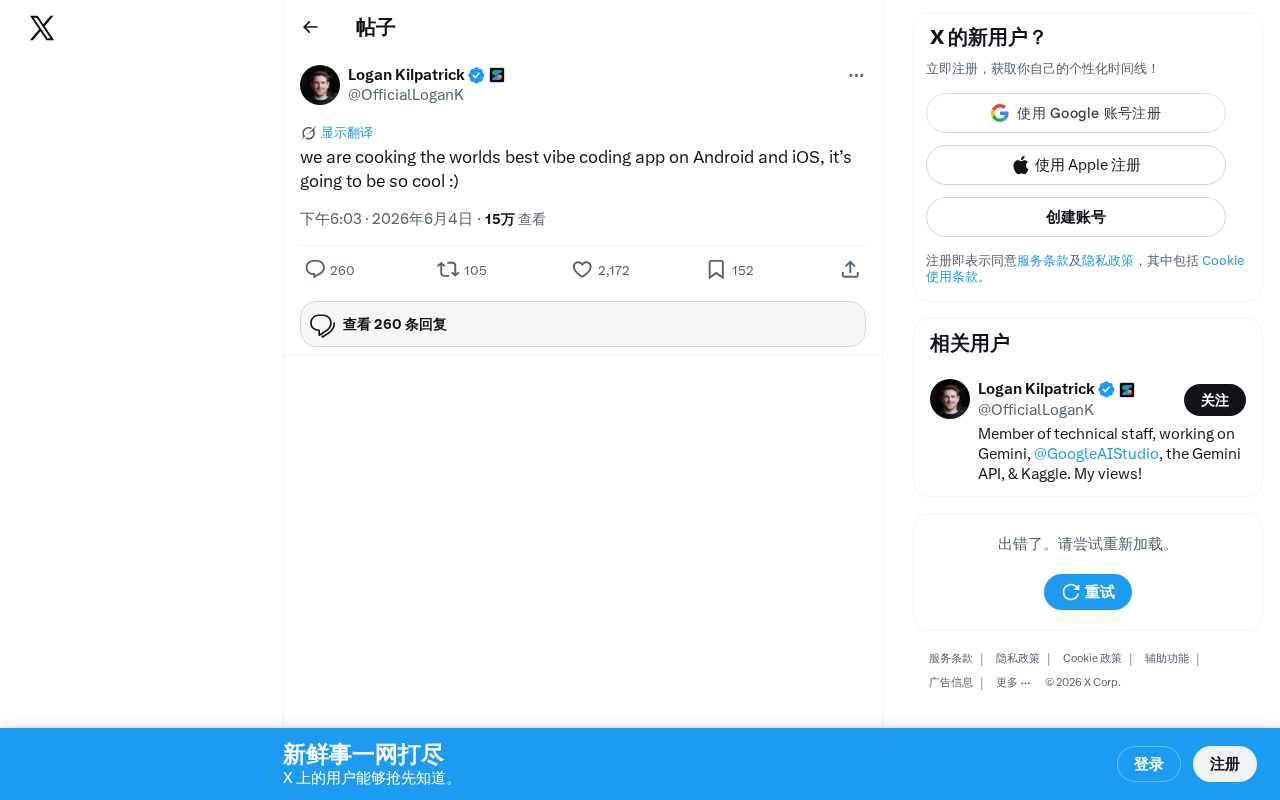
Bolt.new announces development of a mobile Vibe Coding app for Android and iOS platforms.
The Bolt.new team has teased development of a Vibe Coding app for Android and iOS, signaling AI-assisted programming's expansion to mobile. Built on their WebContainers technology, the app could enable natural language app generation, real-time preview, and one-click deployment from phones. This move reflects the broader industry trend of programming tools becoming accessible to non-developers.
Vibe Coding Coming to Mobile
Recently, the Bolt.new team posted an exciting teaser on social media: they're developing "the world's best Vibe Coding app" for Android and iOS. While details remain scarce, this move alone is noteworthy—it represents the trend of AI-assisted programming expanding from desktop to mobile.
Bolt.new is an AI full-stack development tool built by the StackBlitz team, leveraging WebContainers technology to create a development environment that runs entirely in the browser. WebContainers is a technology that runs Node.js in the browser without requiring any local development environment installation—users can start developing the moment they open the webpage. Bolt.new integrates multiple large language models (including Claude, GPT, etc.) and can automatically generate frontend and backend code, install dependencies, configure databases, and provide one-click deployment to platforms like Netlify based on natural language descriptions. Since its launch in 2024, Bolt.new has quickly become one of the most popular tools in the Vibe Coding space, with rapidly growing monthly active users.
What Is Vibe Coding?
Vibe Coding is a concept coined by prominent AI figure Andrej Karpathy, referring to an entirely new programming paradigm: instead of writing code line by line, developers describe their requirements in natural language and let AI handle the actual code generation. Developers take on more of a "director" role—describing ideas, reviewing results, and providing feedback—rather than personally writing every line of code.
Andrej Karpathy is the former Tesla AI Director, one of OpenAI's co-founders, and one of the most influential researchers and educators in deep learning. In February 2025, he first introduced the concept of "Vibe Coding" on social media, describing his experience of programming entirely through AI (primarily Claude Sonnet in Cursor). He stated that he "fully gave in to the vibes, embraced exponentials, and forgot that the code even exists"—simply describing requirements in English, accepting all AI-generated code, and occasionally scanning the results with his eyes. The concept quickly sparked widespread discussion in the tech community, becoming one of the hottest programming paradigm topics of 2025.
This approach has already achieved tremendous success on desktop. Tools like Bolt.new, Cursor, and Lovable enable users with zero programming background to rapidly build application prototypes or even deploy complete web applications. The current desktop Vibe Coding ecosystem has formed a multi-layered landscape: Cursor is an AI-enhanced IDE based on VS Code, targeting professional developers with code completion, multi-file editing, and conversational programming capabilities; Lovable (formerly GPT Engineer) focuses on generating complete web applications directly from natural language descriptions, positioning itself more toward non-technical users; additionally, there are products like Replit Agent, v0.dev (a UI generation tool from Vercel), and Windsurf. These tools share the common trait of leveraging LLM code generation capabilities to transform the core programming interaction from "writing code" to "describing requirements," but they each have different focuses in terms of target users, technical depth, and use cases.
The Significance of Mobile Vibe Coding
Lowering the Barrier to Creation
Bringing Vibe Coding to mobile means anyone can quickly build applications through natural language, anywhere. Imagine describing an idea on your phone during your commute and having AI generate a working application prototype—this would dramatically reduce the cost of converting "inspiration" into "product."
This trend can be compared to the evolution of other creative tools throughout history. Just as Canva enabled non-designers to create professional-grade designs, and iMovie allowed ordinary people to edit videos, Vibe Coding tools are enabling non-programmers to build software applications. The deeper driving force behind this shift is the breakthrough in LLM code generation capabilities—when AI can understand natural language intent and convert it into runnable code, the core bottleneck of programming shifts from "technical implementation ability" to "requirement expression ability." Gartner predicts that by 2028, 75% of enterprise software engineers will use AI code assistants, and the number of "citizen developers" (non-professional programmers) will significantly exceed that of professional developers. The emergence of mobile Vibe Coding tools will further accelerate this trend.
Development Anytime, Anywhere
Conventional wisdom holds that programming requires a large screen and a full keyboard. But the core interaction method of Vibe Coding is natural language conversation, which is naturally suited to mobile input methods. The combination of voice input + AI code generation could create entirely new mobile development workflows.
Bringing a complete development environment to mobile faces multiple technical challenges. First, there are computing resource limitations—operations like code compilation and dependency installation demand significant CPU and memory, and mobile device hardware still has constraints. Second, there are interaction design challenges—traditional code editing relies on precise cursor positioning and keyboard shortcuts, which provide a poor experience on touchscreen devices. Third, there are screen space limitations—code reading and debugging typically require viewing multiple files and terminal outputs simultaneously. However, the Vibe Coding paradigm neatly bypasses these traditional pain points: when the core interaction becomes natural language conversation, mobile input methods (typing, voice) actually become advantages, while code generation and execution can be handled by cloud servers, with the phone only needing to display the final results.
Competitive Landscape
Mobile AI programming tools are still in their early stages, with the market lacking truly excellent products. With their experience and technical advantages accumulated on the web, if the Bolt.new team can be first to launch a mobile product with excellent user experience, they'll have the opportunity to capture first-mover advantage in this emerging market.
Potential Features of the Bolt.new Mobile App
While official feature details haven't been announced yet, based on Bolt.new's existing product capabilities, we can reasonably speculate that this mobile app might include the following features:
- Natural language app generation: Describe requirements through conversational interaction, with AI automatically generating complete code
- Real-time preview: Instantly view generated application results on your phone
- One-click deployment: Publish applications directly from your mobile device
- Voice interaction: Support voice-based requirement descriptions to further simplify the input process
Considering Bolt.new's existing WebContainers technology architecture, the mobile app will likely adopt a hybrid architecture of cloud compilation + local preview. Users input requirements on their phone via natural language or voice, requests are sent to cloud servers for code generation and compilation, and the generated application interface is rendered locally in real-time through a WebView. This architecture ensures both code generation quality and speed while providing a smooth user experience within the limited hardware constraints of mobile devices.
Industry Trends in AI Programming Tools
Bolt.new's move reflects an important trend in the AI programming tools space: the transformation from professional developer tools to mainstream creative tools. When programming no longer requires a keyboard and IDE, but only an idea and a phone, "everyone is a developer" will no longer be just a slogan.
This also means competition in the AI programming space is entering a new phase. In the coming months, we may see more teams following suit with mobile initiatives, and competition among mobile Vibe Coding tools will intensify. Notably, competition in this space isn't limited to product experience—the underlying LLM's code generation capabilities, cloud infrastructure response speed, and ecosystem completeness (template libraries, plugin marketplaces, community support, etc.) will all be key factors determining success.
Let's look forward to the official release of Bolt.new's mobile product.
Key Takeaways
Related articles

Claude Code for Test Development in Practice: An AI Programming Workflow That Doubles Your Efficiency
A practical guide to Claude Code for test development: auto-generating test scripts, Plan Mode workflows, MCP + Playwright integration, and Subagent parallel tasks to build systematic AI-assisted workflows.

Hermes Agent Hands-On Review: An AI Efficiency Revolution for Indie Game Developers
Indie game developer reviews Hermes Agent vs OpenClaude: intelligent context compression, real-time Memory, remote control via Telegram, and practical use cases in game dev, social media, and email.
Vibe Coding Beginner's Guide: Tool Selection Across Three Categories with Practical Examples
A comprehensive guide to Vibe Coding's three tool categories: Agent frameworks, CLI Coding, and IDE tools, with practical examples including Snake game and data analysis workbench.