Building a Lucky Calendar Website with AI and Zero Code: From Idea to Launch

A non-programmer built and launched a Lucky Calendar website using only AI conversations.
A Bilibili content creator with zero programming experience developed and launched a "Lucky Calendar" website entirely through conversations with AI tools like Claude Code. The process included building the framework, iterating on design, integrating dynamic data via APIs, and deploying to GitHub Pages — proving that AI programming tools now enable non-technical creators to go from idea to live product independently.
From Paper Calendar to Online Product: An AI Programming Journey by a Zero-Code Creator
When a creator with absolutely no programming background builds a fully functional, publicly accessible website purely through conversations with AI, the result speaks for itself. A Bilibili content creator shared their complete process of developing a "Lucky Calendar" website from scratch using AI, demonstrating how AI programming tools can truly lower the technical barrier to entry.
The Inspiration: From Physical to Digital
The story starts simply — a friend gifted a paper lucky calendar for the New Year. Each day featured a different lucky phrase on a tear-off page. But once torn off, the content was gone forever.
This "pain point" sparked an idea: why not create a digital version? One that not only displays daily lucky phrases but also includes zodiac signs, lucky colors, a wishing well, and other rich features. This is where product thinking begins — starting from a real need and using technology to solve it.
The Development Process: Conversational Programming with AI
Step 1: Building the Basic Framework
The creator opened Claude Code (an AI programming tool) and typed the first instruction:
"Help me create a lucky calendar HTML page, mobile-style, with daily fortune and real-time clock"
With just this single sentence, AI generated the first runnable page. While basic in functionality, it already had fundamental calendar display capabilities.
Claude Code is an AI programming assistant from Anthropic, built on the Claude large language model. It understands natural language descriptions and generates corresponding code. Unlike traditional IDEs (Integrated Development Environments), it uses a conversational interaction model — users don't need to master programming syntax, just describe their needs in everyday language to get runnable code. Similar tools include GitHub Copilot, Cursor, and others that together form the current AI-assisted programming ecosystem. The emergence of these tools means that "programming" is shifting from "writing code" to "describing requirements."
Step 2: Iterating on Design Details
After the first version, the creator continued with visual requirements:
- Frosted glass effect
- Rounded corners
- A polished design aesthetic
Through repeated style adjustments and ongoing dialogue with AI, a satisfying visual result was achieved. This process is essentially "product-manager-style development" — you handle the requirements and aesthetic judgment, while AI handles the technical implementation.
The frosted glass effect (Glassmorphism) mentioned here is a popular UI design style in recent years, achieved through CSS's backdrop-filter property to create background blur and semi-transparent overlay effects, producing a visual texture similar to frosted glass. This design language was first adopted at scale by Apple in iOS 7 and later became one of the mainstream trends in web design. For non-technical users, implementing this effect requires precise combinations of CSS properties — including blur radius, opacity, border styles, and other parameters working together. AI can directly generate the corresponding code from natural language descriptions like "frosted glass effect," eliminating the need to consult documentation and repeatedly debug.
Step 3: Integrating Dynamic Data
A static page wasn't enough. The creator realized the data needed real-time updates, so they continued asking AI for help:
- Integrating a weather API for real-time weather display
- Connecting a "daily quote" endpoint
- Implementing dynamic fortune generation logic
The final result: time keeps ticking, weather keeps changing, and each day's fortune is different — a truly "living" calendar application.
This involves a key technical concept — API (Application Programming Interface). An API is a bridge for communication between different software systems, essentially a "data pickup window": you send a request in the specified format, and the other side returns the data you need. In this case, the weather API and "daily quote" endpoint are data channels provided by third-party services — the page sends requests to these services, which return real-time data (such as current temperature, random quotes, etc.). Common free weather APIs include QWeather, OpenWeatherMap, and others. The elegance of this architecture is that a simple frontend page can display rich dynamic content without maintaining its own database or server, greatly reducing development and operational complexity.
Step 4: Deploying to Production
After development was complete, a new question arose — how to make it accessible to others? The creator asked DeepSeek and received a step-by-step deployment tutorial:
- Upload the code to GitHub
- Enable GitHub Pages
- Wait about two minutes
- Get a public access link
With that, a website anyone could visit was officially live.
GitHub Pages is a free static website hosting service provided by GitHub and one of the most commonly used deployment solutions for individual developers. Users simply upload HTML, CSS, JavaScript, and other frontend files to a GitHub repository, enable the Pages feature, and GitHub automatically deploys these files to its global CDN (Content Delivery Network), generating a public access link in the format username.github.io/repository. Its core advantages include: completely free, no server purchase required, no domain configuration needed (though custom domains are supported), and built-in HTTPS security certificates — making it ideal for personal projects and static websites. Similar free hosting platforms include Vercel, Netlify, Cloudflare Pages, and others, each with unique features but sharing the same core philosophy — making deployment as simple as uploading files.
What This Case Tells Us About AI Programming
The Real Value of AI Programming
The most valuable aspect of this case isn't the technical complexity — it's the proof that AI programming tools can now enable non-technical people to independently complete the entire process from idea to launch.
Throughout the process, the creator played the roles of:
- Product Manager: Defining requirements and features
- Designer: Controlling visual effects and user experience
- Project Manager: Driving development progress and solving deployment issues
AI handled all the technical implementation.
A Methodology for Conversational Development
From this case, we can extract a methodology for zero-code AI development:
- Build the skeleton first: Describe the core functionality in one sentence and let AI generate a minimum viable version
- Polish the surface: Gradually introduce visual and interaction requirements, iterating to optimize
- Add the substance: Connect external data sources to bring the product to life
- Finally, go live: Use free hosting platforms to complete deployment
None of these steps require understanding the underlying code — you just need to clearly express "what you want."
The underlying logic of this methodology aligns closely with "iterative development" and "agile methods" in software engineering — rather than aiming for perfection in one shot, you approach the final goal through cycles of rapid building, rapid feedback, and rapid adjustment. The difference is that traditional agile development requires professional development teams, while AI programming allows individual creators to advance projects at a similar pace.
Limitations and Reflections
Of course, AI-assisted development currently has clear boundaries:
- Best suited for lightweight frontend display projects
- Complex backend logic and database operations still present significant challenges
- Code quality and security are difficult to guarantee
- Long-term maintenance and feature expansion may hit bottlenecks
However, for personal projects, creative validation, and MVP prototypes, AI programming is already good enough. MVP (Minimum Viable Product) is a core concept in lean startup methodology, systematically articulated by Eric Ries in The Lean Startup. The core idea is: build a product version with minimal resources and time that has core functionality, quickly release it to the market for user feedback, then iterate based on that feedback. AI programming tools dramatically reduce the cost of building MVPs — development work that previously took days or even weeks can now potentially be completed in hours, accelerating the speed of creative validation by an order of magnitude.
For creators who have ideas but lack technical skills, this is the best era — you just need to clearly tell AI what you want. Technology is no longer the bottleneck for creativity; communication skills and product intuition are the real competitive advantages.
Related articles
 Tutorials
Cursor + Codex Dual-IDE Collaboration: A Practical Methodology for Open-Source Project Customization
A complete methodology for open-source project customization based on real-world experience, detailing the Cursor+Codex dual-IDE workflow, seven-stage process, MVP validation, and AI source code reading techniques.
 Tutorials
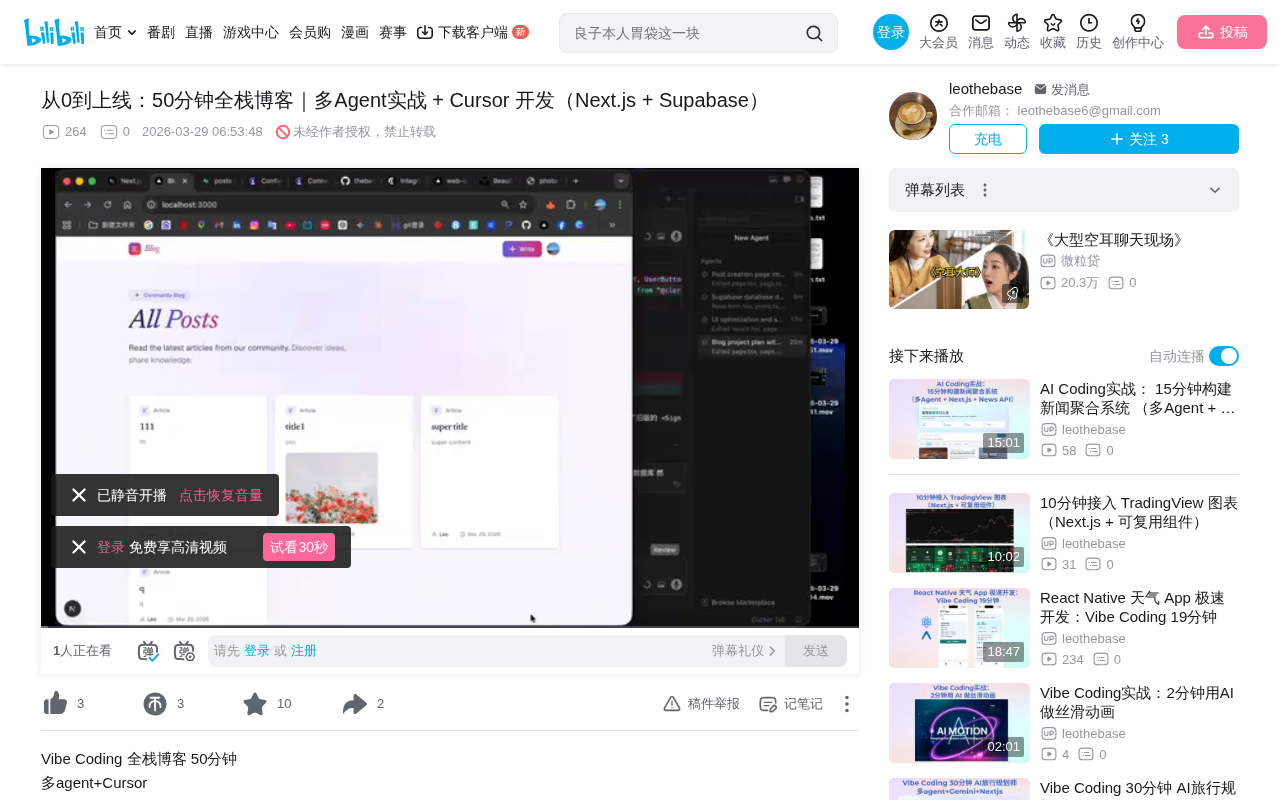
Cursor Multi-Agent in Practice: Building a Full-Stack Next.js Blog in 50 Minutes
Build a full-stack blog in 50 minutes using Cursor IDE's multi-Agent mode with Next.js, Clerk auth, and Supabase. Learn the 4-phase AI Agent workflow and key integration pitfalls.
 Tutorials
Building an AI Software Factory from Scratch: A Cursor Engineer's Hands-On Experience with Multi-Agent Collaboration
Cursor engineer Eric shares practical insights on building an AI software factory: automation levels, guardrail design, parallel Agent management, and scaling to 1000+ Agents for 24/7 development.