Building a WeChat Mini Program with AI + Cursor: A Full Workflow from Ideation to Frontend

Using three AI models for ideation and Cursor for coding to build a WeChat Mini Program from scratch.
A Bilibili creator tests whether AI alone can power a solo startup — from product ideation to frontend development of a WeChat Mini Program. Three AI models (DeepSeek, Claude, GPT) are compared for brainstorming, GPT generates the PRD, and Cursor's Compose 2.5 builds the frontend in four iterations. The experiment reveals key insights about AI model personalities, micro-payment business models, and how AI tools are compressing the idea-to-prototype timeline.
A Bold Business Hypothesis
Here's a seemingly simple math problem: roughly 800 million people in China can access WeChat Mini Programs and use mobile payments. If you could build a mini program that reaches just 10% of them, and each person is willing to pay 1 yuan to use it — that's 80 million yuan in revenue.
The hypothesis sounds tempting, but can it actually work? A Bilibili content creator decided to personally test this business logic, and his entire "team" consisted of just three members: DeepSeek, Claude, and GPT. The entire process — from product ideation to frontend development — was completed entirely with AI. It was a zero-experience AI-assisted entrepreneurship experiment.
Since launching in 2017, WeChat Mini Programs have grown into a massive commercial ecosystem. As of 2024, daily active users exceed 500 million, spanning e-commerce, utilities, gaming, lifestyle services, and more. The core advantage of mini programs lies in their lightweight "use and go" experience and the natural viral distribution power of WeChat's social graph. On the payment side, WeChat Pay is deeply embedded in the mini program ecosystem — the friction cost for a user to complete a 1-yuan payment is extremely low. No redirects, no entering bank card information — just a fingerprint or face scan to complete the transaction. This low-friction payment environment is precisely the infrastructure prerequisite that makes a "micro-payment" business model viable.
Comparing Product Ideas from Three Major AI Models
The most interesting part of this experiment was asking DeepSeek, Claude, and GPT — three of today's leading AI models — the same question: What kind of WeChat Mini Program could potentially achieve the business goal of "1 yuan × 80 million people"?
DeepSeek V4 Pro: Focused on AI Image Processing Tools
The desktop client integrated with DeepSeek V4 Pro offered three directions:
- Top pick: AI old photo restoration
- Alternative one: AI ID photos
- Alternative two: AI face reading analysis
All three directions revolve around image processing — utility products with clear user demand and strong willingness to pay. Old photo restoration particularly strikes an emotional chord with middle-aged and elderly users, and it's a market-validated niche.
DeepSeek is a large language model series developed by DeepSeek AI, a company founded by Liang Wenfeng, the founder of quantitative hedge fund High-Flyer. DeepSeek V4 Pro is its latest-generation model, excelling in code generation, logical reasoning, and Chinese language understanding. Its desktop application integrates conversation, document analysis, and other features, positioning itself as a productivity tool. DeepSeek's standout characteristic is its exceptional practicality in Chinese-language scenarios — it's particularly good at delivering directly actionable plans, which relates to the abundance of Chinese internet business cases in its training data.
Claude OPUS 4.7: Gathering Information Before Giving Solutions
Claude's approach was completely different — instead of giving a direct answer, it first analyzed the business logic, then asked back: "What resources, technical capabilities, and industry connections do you have?" This reflects Claude's signature deep-thinking style. It believes product direction should be based on the entrepreneur's actual resources rather than recommendations made in a vacuum.
This "gather information first, then answer" strategy is more professional from a consulting perspective, but feels insufficiently direct in a rapid-validation scenario.
Claude is an AI assistant developed by Anthropic, founded by former OpenAI Research VP Dario Amodei. The company's core philosophy centers on "AI safety." Claude OPUS is its highest-capability model tier, known for deep reasoning and cautious responses. Claude's design philosophy emphasizes "when uncertain, ask rather than fabricate" — this stems from Anthropic's Constitutional AI training methodology, where the model is trained to proactively seek clarification when information is insufficient rather than giving potentially misleading answers based on assumptions. This characteristic makes Claude excellent in scenarios requiring rigorous analysis but potentially "overly cautious" in rapid brainstorming situations.
GPT 5.5: Delivering the Most Comprehensive Analytical Framework
GPT not only analyzed the business logic but also ranked ten directions, ultimately recommending three:
- Life Keywords Report
- Side Hustle Potential Report
- AI-Era Career Risk Report
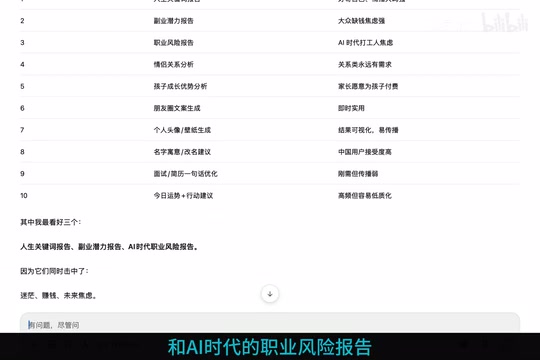
Ultimately, the creator chose the "AI-Era Career Risk Report" direction based on his own domain knowledge. This choice is quite interesting — it has topical appeal (AI replacement anxiety is a current hot topic), payment motivation (users are willing to spend 1 yuan to find out if their job will be replaced by AI), and a relatively manageable technical implementation threshold.
There's deep market insight behind this choice. According to McKinsey's 2024 report, approximately 30% of global work hours could be automated by AI before 2030. Goldman Sachs research indicates that roughly 300 million full-time jobs could be affected by generative AI. This uncertainty has created enormous information demand — people want to know if their careers are safe. From a behavioral economics perspective, "loss aversion" makes people pay far more attention to potential threats than potential gains, meaning questions like "Will your job be replaced by AI?" naturally have high click-through rates and high payment conversion rates. The 1-yuan price point sits precisely below the "impulse purchase" threshold — users barely need to make a rational decision to complete the payment.
From PRD to Code: The Full Cursor Development Workflow for a WeChat Mini Program
After settling on the direction, the creator had GPT directly generate a PRD (Product Requirements Document) for the WeChat Mini Program, then used Cursor for development — also testing the code generation capabilities of Cursor's newly released Compose 2.5.
A PRD (Product Requirements Document) is the core document product managers use to define product features, user flows, and technical requirements. In traditional development workflows, a PRD takes days or even weeks for a product manager to write before handing it off to the development team. In the new paradigm of AI-assisted development, the PRD plays a crucial "middle layer" role — it's both a structured expression of human intent and an input instruction for the AI code generator. A well-written PRD helps AI accurately understand product logic and reduces subsequent iteration cycles. This is why the creator chose to have GPT generate the PRD first, then have Cursor generate code based on the PRD, rather than directly describing requirements in natural language.
Project Initialization Steps
The development workflow was very clear:
- Open Cursor and create a new project folder
- Create a
DLCSfolder in the project directory - Create a new
PRD.mdfile in that folder - Copy and paste the GPT-generated PRD content and save
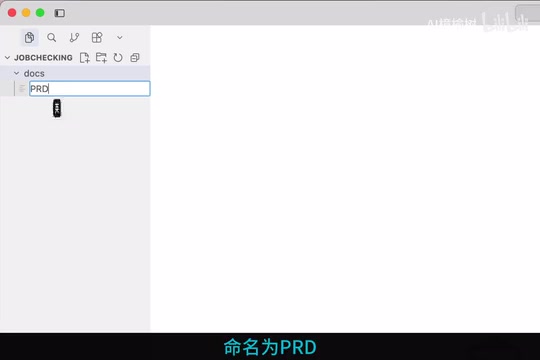
Next came the key operation: right-click the PRD.md document, click "Add File to Cursor Chat" to add the requirements document to Cursor's conversation context, then use natural language instructions to have Cursor start generating code.
Cursor is an AI-enhanced code editor based on VS Code, developed by Anysphere. Its core capability is deeply integrating large language models into the programming workflow, supporting code generation, code explanation, bug fixing, and project-level refactoring. Compose 2.5 is the latest version of Cursor's multi-file code generation feature. It can understand the entire project's context (including file structure, dependencies, and existing code), then generate or modify multiple files at once. Unlike traditional code completion tools (such as GitHub Copilot), Cursor's Compose mode is closer to an "AI programmer" — it doesn't just complete a single line of code but can understand requirements documents and generate complete functional modules. This enables non-programmers to accomplish complex development tasks through natural language instructions.
At the same time, you need to open WeChat Developer Tools, select the project folder, and enable cloud development mode. This way, every time Cursor modifies code, you can preview it in real-time in the developer tools.
Four Iterations to Complete the Mini Program Frontend
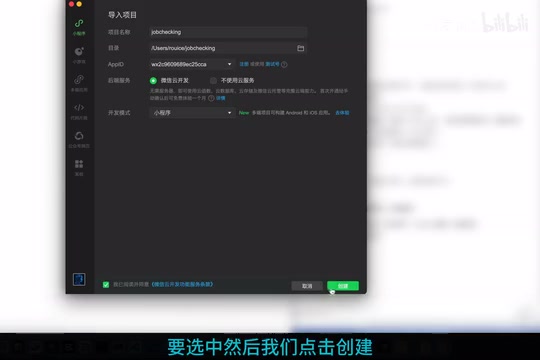
The entire frontend development went through four iterations:
- Round 1: Had Cursor clear WeChat's official demo template and start developing directly based on the PRD. The resulting version had many issues
- Round 2: Directly told Cursor "this doesn't work at all" and used a "tough love" approach to make it figure out optimizations on its own. This round produced a rough prototype, but the dark theme didn't fit the mini program's aesthetic
- Round 3: Continued with specific UI adjustment requests, but the results were still unsatisfactory
- Round 4: Finally reached an acceptable state with the frontend basically taking shape
This iteration process is very realistic — AI programming isn't a one-shot deal; it requires continuous human feedback and direction adjustment. But going from zero to a usable mini program frontend in just four rounds of conversation is genuinely impressive in terms of efficiency. It's worth noting that this cycle of "human sets direction → AI executes → human evaluates → AI corrects" is essentially a new model of human-machine collaboration. In traditional development, the same iteration requires multiple rounds of communication between product managers and developers, potentially taking days to weeks; in AI-assisted mode, this cycle is compressed to minutes or hours.
Key Observations from Practice
AI Models' "Personality Differences" Determine Use Cases
Given the same business question, the three models delivered distinctly different responses: DeepSeek leaned toward practical tools, Claude toward deep consulting, and GPT toward comprehensive analysis. This shows that in real-world applications, choosing the right AI model may be more important than choosing the right prompt. When quick decisions are needed, GPT and DeepSeek's direct style is more efficient; for complex problems, Claude's probing approach may be more valuable.
These differences aren't accidental — they stem from each model's different training objectives and data preferences. DeepSeek has extensive exposure to real-world Chinese internet business cases, so it tends to offer proven solutions. Claude, influenced by Anthropic's safety-first philosophy, tends to ensure thorough context understanding before offering advice. GPT, as the representative general-purpose model, has the broadest training data coverage and can therefore offer the most diverse options. For entrepreneurs, the best strategy may be to follow this creator's example — consult multiple AIs simultaneously, then use human judgment to make the final decision.
The Real-World Challenges of the "1-Yuan Payment" Model
800 million × 10% × 1 yuan = 80 million — the formula looks perfect, but the real-world conversion funnel is far more brutal than imagined. Reaching 10% of users means 80 million impressions, which itself requires enormous marketing spend. And between "willing to pay 1 yuan" and "actually paid 1 yuan," there are multiple steps: registration, trial experience, trust building, and more. That said, this "small amount, high frequency" business model is indeed a validated path within the WeChat Mini Program ecosystem.
Looking at industry data, the average payment conversion rate for WeChat Mini Programs typically ranges from 1%-5%, not the 100% assumed in the hypothesis. In other words, even if you reach 80 million users, actual paying users might only be 800,000 to 4 million, corresponding to revenue of 800,000 to 4 million yuan. Of course, if the product has strong social sharing attributes (test-type and report-type products are naturally suited for sharing on WeChat Moments), customer acquisition costs can be dramatically reduced. Historically, mini programs like "personality tests" and "annual reports" have indeed achieved viral spread, with single-day new user additions reaching the millions. The key is whether the product can trigger users' desire to share.
Cursor Is Dramatically Lowering the Development Barrier
From this case study, we can see that a person with no programming background, using AI-generated PRDs + Cursor for coding + WeChat Developer Tools for preview, can indeed build a mini program frontend in a very short time. While backend configuration, AI API integration, payment systems, and more still require follow-up work, the time from idea to visible prototype has been dramatically compressed.
The deeper significance of this shift is that software development is transitioning from "skill-intensive" to "judgment-intensive." In the past, entrepreneurs needed to spend months learning to code or tens of thousands of yuan hiring developers to validate an idea; now, the validation cost has dropped to a few hours and a few dollars in AI subscription fees. This means the market will see a surge of product experiments, and competition will shift from "who can build it" to "who can build it better and promote it faster." For solo entrepreneurs, this is both an opportunity (lower barriers) and a challenge (intensified competition).
Conclusion: AI Makes Solo Entrepreneurship Possible
This experiment has only completed the frontend portion so far — backend AI configuration will continue in the next installment. But even from what's been completed, it demonstrates an important trend: AI is making "solo entrepreneurship" possible. From market research (having AI analyze directions), to product design (having AI write PRDs), to technical development (having Cursor write code) — the entire chain can be AI-assisted.
This "AI-native entrepreneurship" model is emerging simultaneously in Silicon Valley and China. In Y Combinator's Winter 2024 batch, over 25% of startups had only 1-2 founders and heavily used AI tools for development. In China, similar "one-person companies" are also growing rapidly — with AI tools, one person can simultaneously play the roles of product manager, designer, developer, and market analyst. This doesn't mean team collaboration will disappear, but rather that the minimum viable unit for entrepreneurship is shrinking and the speed of idea validation is accelerating.
Of course, whether the 80-million-yuan goal can be achieved ultimately depends on whether the product truly solves a user pain point and whether the marketing strategy is effective. Technology is never the hardest part — finding the right direction is.
Related articles
Developing a 2D RPG with Godot 4: A Hands-On Tutorial for Complete Beginners
A complete tutorial on building a 2D RPG from scratch with Godot 4 and GDScript, covering tilemaps, character controls, enemy AI combat, and scene transitions for beginners.

The Ultimate Guide to Squeezing Every Drop from Mythos/Fable: Burning Through $8,000 in Inference Credits in 10 Days
Deep dive into maximizing Anthropic's Fable/Mythos model: 5-hour limit workarounds, dual account rotation, multi-Agent orchestration, and Mac Mini remote deployment to get $8,000 of inference from a $200 subscription.

Building a Travel Route Planning Mini-Program with AI in One Day: A Full Workflow from Design to Launch
Learn how to build a complete travel route planning WeChat Mini-Program in one day using AI tools like Modao AI and Cursor, covering UI design, code generation, debugging, and deployment.