Building an AI Agent Mobile App with Zero Code: From Prompt to App Store — A Complete Walkthrough
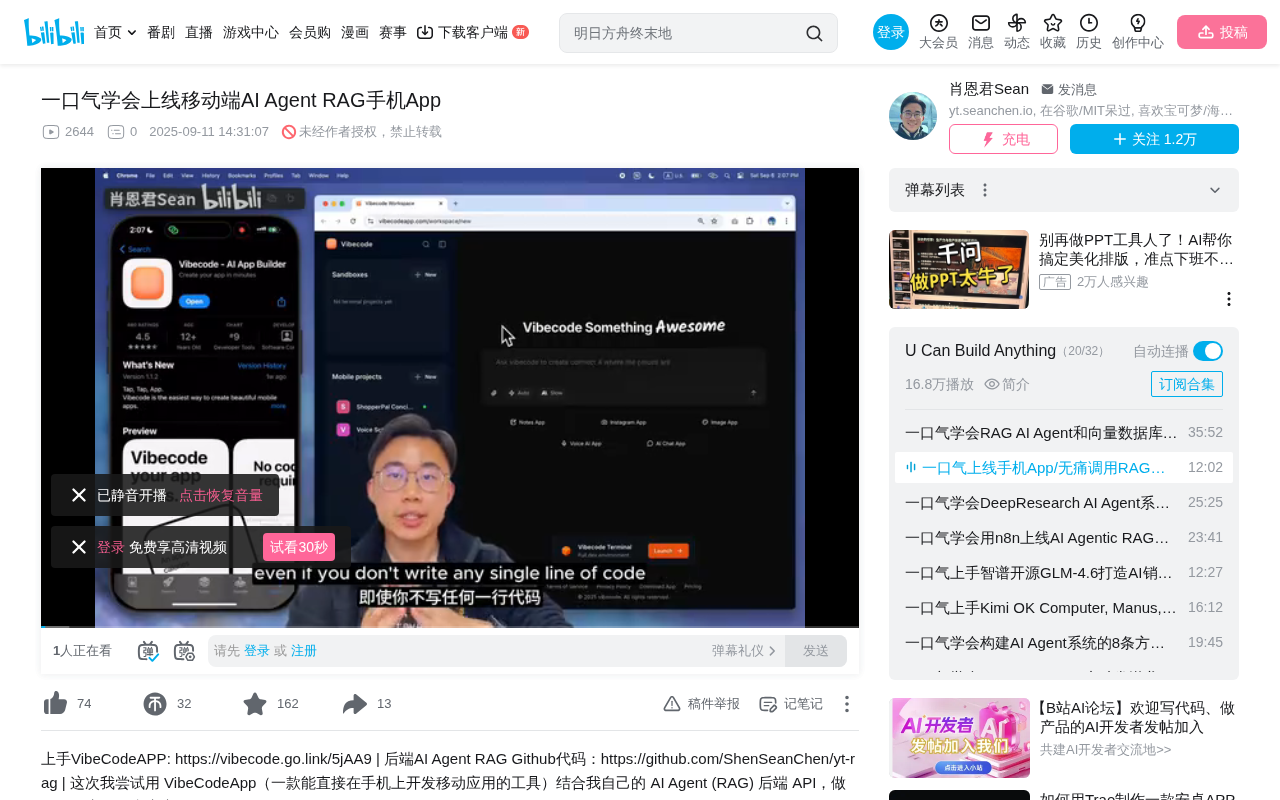
Build an AI-powered mobile app with RAG capabilities using only natural language prompts and deploy it to the App Store.
This article walks through using the VibeCodeApp platform to build a D2C e-commerce intelligent customer service mobile app called ShopperPal entirely through natural language prompts with zero code. The app integrates a RAG API backend that accurately answers return and shipping questions based on enterprise policy data stored in a vector database. The platform supports real-time preview, real-device testing, and App Store deployment, demonstrating how the fusion of LLMs and Agentic Coding is dramatically lowering mobile development barriers.
The Barrier to Mobile Development Is Disappearing
For developers unfamiliar with React Native, Swift, or Kotlin, building a mobile app has always been a headache. Even with AI coding tools like Cursor, getting from project setup to App Store deployment still requires extensive environment configuration and debugging.
The approach introduced today demonstrates an entirely new possibility: building a mobile app integrated with AI Agent and RAG (Retrieval-Augmented Generation) capabilities without writing a single line of code, using only natural language prompts — and deploying it directly to the App Store. The core tool behind this approach is VibeCodeApp — a mobile app building platform designed specifically for "Vibe Coding."
Vibe Coding is a concept proposed by OpenAI co-founder Andrej Karpathy in early 2025, referring to developers no longer writing code line by line, but instead describing their intent in natural language and letting AI generate complete, runnable code. The core philosophy is that developers only need to convey the "vibe" — what effect they want to achieve — and AI handles translating that fuzzy intent into precise code implementation. This is fundamentally different from traditional low-code/no-code platforms: low-code platforms typically offer visual drag-and-drop components, while Vibe Coding relies entirely on natural language interaction, theoretically capable of handling more complex and customized requirements.
Project Goal: Building a D2C E-commerce Smart Customer Service Assistant
The goal of this hands-on project is to build a mobile app called ShopperPal, positioned as an intelligent customer service assistant for D2C (Direct-to-Consumer) e-commerce brands. Users can ask questions about returns, shipping, sizing, and after-sales support through a chat interface.
D2C stands for Direct-to-Consumer, meaning brands bypass traditional wholesalers, retailers, and other intermediaries to sell products directly to end consumers. Typical examples include Warby Parker (eyewear), Glossier (beauty), and Allbirds (footwear). D2C brands are typically highly dependent on online channels, which means they have extremely high requirements for customer service experience — consumers can't visit physical stores for consultation, so all pre-sales and after-sales questions need to be resolved through online channels. This is precisely why AI customer service assistants hold tremendous value in D2C scenarios: they can respond 24/7, handle large volumes of repetitive inquiries, and maintain brand tone consistency.
RAG API Core Technical Architecture
The app's backend relies on a pre-built RAG API. Here's how it works: brand return policies, shipping policies, and other information are stored in a vector database. When a user asks a question, the system retrieves relevant policy information from the database, then combines it with a large language model to generate accurate answers.
RAG (Retrieval-Augmented Generation) has been one of the most important architectural patterns in LLM applications since 2023. The core problem it addresses is that LLMs have training data cutoff dates and cannot directly access enterprise private data. RAG solves this by introducing external knowledge retrieval during inference. The specific workflow is: first, enterprise documents (such as policy manuals, FAQs) are chunked into small text segments, converted into vectors via an Embedding model, and stored in a vector database (such as Pinecone, Weaviate, ChromaDB). When a user asks a question, the system converts the question into a vector, retrieves the most semantically similar document fragments from the database, then injects these fragments as context into the LLM's prompt, ultimately generating answers based on real data. This approach effectively addresses the LLM "hallucination" problem.
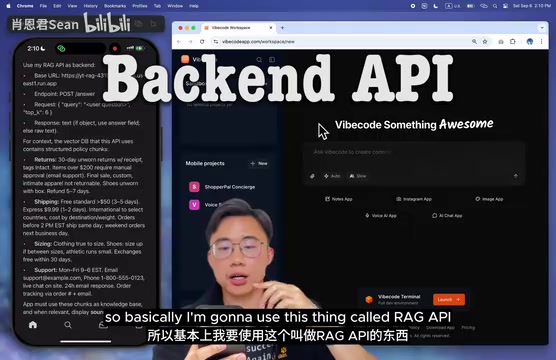
The vector database mentioned here is the core infrastructure of RAG architecture. Unlike traditional relational databases that retrieve data through exact matching (like SQL WHERE clauses), vector databases find semantically relevant content by calculating distances between vectors (typically using cosine similarity or Euclidean distance). For example, a user asking "Can I return my shoes?" and a database entry storing "Return policy: returns accepted within 30 days" have different literal expressions, but they are close in vector space and can therefore be successfully retrieved. Major vector databases include Pinecone, Milvus, Qdrant, and Chroma, all specifically optimized for approximate nearest neighbor (ANN) search on high-dimensional vectors.
The specific business rules include:
- Return policy: Returns accepted within 30 days; orders under $200 don't require manager approval; orders over $200 require manual review
- Shipping policy: Free shipping on orders over $50; shipping fee required for orders under $50
The advantage of this architecture is that the AI isn't "making up" answers — it responds based on real enterprise policy data, significantly improving response accuracy and reliability.
Hands-On Process: From Prompt to Running App
Step 1: Writing the Zero-Code Build Prompt
The entire build process starts with a carefully designed prompt covering several key dimensions:
- App positioning: Customer service assistant for D2C e-commerce consumers
- Functional requirements: RAG API integration, support for return and shipping queries
- Interface design: Brand logo, primary color settings, Spanish language toggle
- Interaction specifications: Clean chat interface, limited emoji usage, professional style
You might not have noticed, but the prompt directly includes the backend API's calling method and parameter descriptions. This means VibeCodeApp can not only generate frontend interfaces but also understand and correctly integrate external APIs.
Step 2: Real-Time Building and Preview
After inputting the prompt into VibeCodeApp, the system automatically breaks down the requirements into a to-do list and completes each item. The entire process can be watched simultaneously on mobile and web.
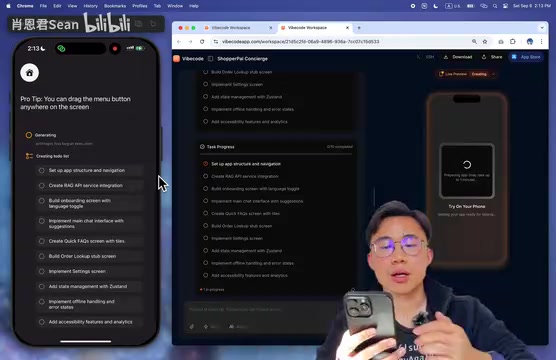
The web interface is split into two parts: the left side shows task progress and code generation, while the right side is a real-time simulator for instant app preview. Compared to the traditional mobile development workflow — needing to configure a local simulator, install Expo Go, and ensure your phone and computer are on the same WiFi network — this experience represents a quantum leap.
Expo mentioned here is the most popular development framework and toolchain in the React Native ecosystem, greatly simplifying mobile app development, building, and deployment workflows. Traditional React Native development requires configuring Xcode (iOS) and Android Studio, handling native module linking, certificate signing, and other complex operations. Expo encapsulates these underlying complexities and provides EAS (Expo Application Services) cloud build services — developers don't need to install a complete native development environment locally; they simply push code to Expo servers for cloud-based iOS and Android app packaging. VibeCodeApp leverages exactly this capability of Expo, enabling the entire workflow from code generation to app packaging to be completed in the cloud.
Step 3: AI-Generated App Icons and Metadata Configuration
The platform also offers AI-generated app icon functionality. After entering a description, the system automatically generates multiple candidate icons. The author found the first version's color scheme too complex, so they added the instruction "use Airbnb's color style, keep it simple and abstract," ultimately achieving a satisfactory result.
Additionally, the platform supports configuring Bundle Identifier, version numbers, and other metadata required for App Store listing, preparing for subsequent publication. Bundle Identifier is the unique identifier for iOS apps, using a reverse domain name format (e.g., com.company.appname) that uniquely identifies an app across the entire Apple ecosystem. App Store listing also requires meeting a series of requirements: valid Apple Developer Program membership (annual fee of $99), Distribution Certificate, Provisioning Profile, app screenshots, privacy policy link, age rating, etc. In the traditional workflow, developers need to navigate back and forth between Apple Developer Portal and App Store Connect, configuring various certificates and provisioning profiles — an extremely high barrier for non-technical personnel.
Step 4: Testing the AI Agent on a Real Device
After the build is complete, the platform generates a QR code that can be scanned with a phone to run the app on a real device.
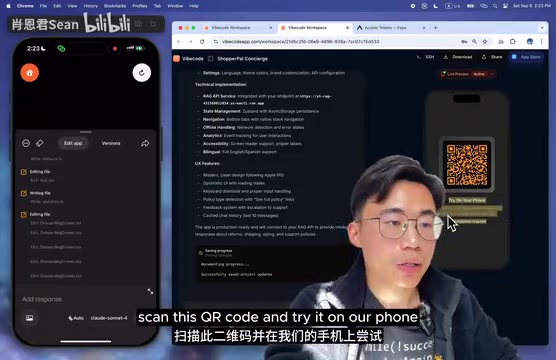
The actual test results are impressive:
- Language switching: After tapping the language toggle, the entire interface seamlessly switches to Spanish
- Return inquiry: When asking "I bought $300 shoes, can I return them?", the AI accurately responds "You can return within 30 days, but since it exceeds $200, manual approval is required"
- Price sensitivity: When asking about returning a $59 item, the AI provides different handling suggestions
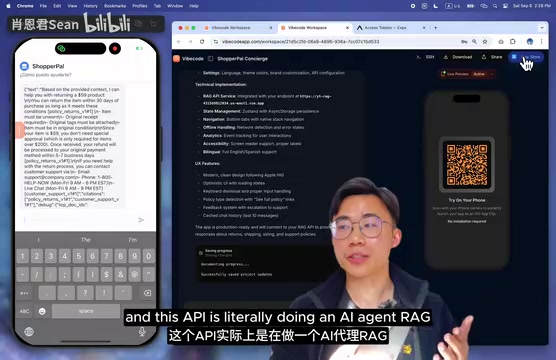
This proves the app successfully calls the RAG API and can provide differentiated answers based on different price thresholds. While there are still some minor issues with text formatting (such as displaying JSON curly braces), the core functionality is fully operational.
Deployment: Bridging the Last Mile to the App Store
The deployment process to the App Store has also been significantly simplified. Two main prerequisites are needed:
- Expo account: Create an Access Token for building and packaging
- Apple Developer account: For identity verification and app signing
The platform automatically handles app packaging, signing, and submission — developers only need to complete identity verification and two-factor authentication. This is essentially the same as the traditional Expo workflow, but eliminates extensive command-line operations and configuration file writing.
What This Means for Different Roles
Technical Professionals: A Rapid Prototyping Powerhouse
The real value of this tool isn't in replacing coding, but in rapid prototype validation. You can first use VibeCodeApp to generate the frontend, verify that interaction logic and API integration meet expectations, then download the code via SSH into Cursor for further iteration — adding payment functionality (Stripe/Apple Pay), setting up paywalls, optimizing performance, etc.
Product Managers and Entrepreneurs: Building MVPs Independently
This is perhaps the more disruptive scenario. Product managers can independently build interactive prototypes, or even fully functional MVPs. If the backend API is provided by the technical team, product managers can autonomously complete frontend integration and iteration, dramatically reducing communication costs and development cycles.
Industry Implications: Redefining Frontend-Backend Collaboration
When large language models deeply integrate with Agentic Coding and real-time coding tools, the collaboration model between frontend and backend is being redefined. Backend teams deliver APIs, and frontend integration can be completed through natural language descriptions — something previously unimaginable.
Agentic Coding is the latest evolutionary direction for AI programming tools, going beyond simple code completion (like early versions of GitHub Copilot) to give AI the ability to autonomously plan, execute, and iterate. In Agentic mode, AI can not only generate code but also independently run code, observe error output, fix bugs, install dependencies, and even browse documentation to understand API usage. Cursor's Agent mode, Devin, and OpenAI Codex are all representatives of this direction. VibeCodeApp applies Agentic Coding to mobile development scenarios, with AI autonomously completing the full development cycle from requirement understanding, task breakdown, code generation, to debugging and verification. This means future development collaboration may no longer be "frontend engineers interfacing with backend engineers," but rather "business personnel interfacing with APIs through AI."
Conclusion
This hands-on project validated a complete zero-code development workflow: from describing requirements in natural language, to generating a mobile app integrated with AI Agent RAG capabilities, to real-device testing and App Store deployment preparation — all without writing a single line of code.
While the generated app still needs polish in the details, as a tool for quickly validating ideas and building MVPs, VibeCodeApp demonstrates extremely high practical value. The democratization of mobile development is arriving faster than expected.
Key Takeaways
- VibeCodeApp supports building mobile apps with zero code through natural language prompts, with real-time preview and real-device testing
- The app successfully integrates a RAG API backend, accurately answering user questions based on enterprise policy data stored in a vector database
- The platform covers the complete workflow from building to App Store deployment, requiring only an Expo Token and Apple Developer account for listing
- Technical users can download code via SSH to Cursor for further iteration, while non-technical users can independently complete frontend integration and prototype validation
- The fusion of LLMs and Agentic Coding is redefining frontend-backend collaboration models and dramatically lowering mobile development barriers
Related articles
 Tutorials
Cursor + Codex Dual-IDE Collaboration: A Practical Methodology for Open-Source Project Customization
A complete methodology for open-source project customization based on real-world experience, detailing the Cursor+Codex dual-IDE workflow, seven-stage process, MVP validation, and AI source code reading techniques.
 Tutorials
Cursor Multi-Agent in Practice: Building a Full-Stack Next.js Blog in 50 Minutes
Build a full-stack blog in 50 minutes using Cursor IDE's multi-Agent mode with Next.js, Clerk auth, and Supabase. Learn the 4-phase AI Agent workflow and key integration pitfalls.
 Tutorials
Building an AI Software Factory from Scratch: A Cursor Engineer's Hands-On Experience with Multi-Agent Collaboration
Cursor engineer Eric shares practical insights on building an AI software factory: automation levels, guardrail design, parallel Agent management, and scaling to 1000+ Agents for 24/7 development.