Building Cloud Computing Clusters from Old Phones: Google and UCSD Explore a New Path to Sustainable Computing
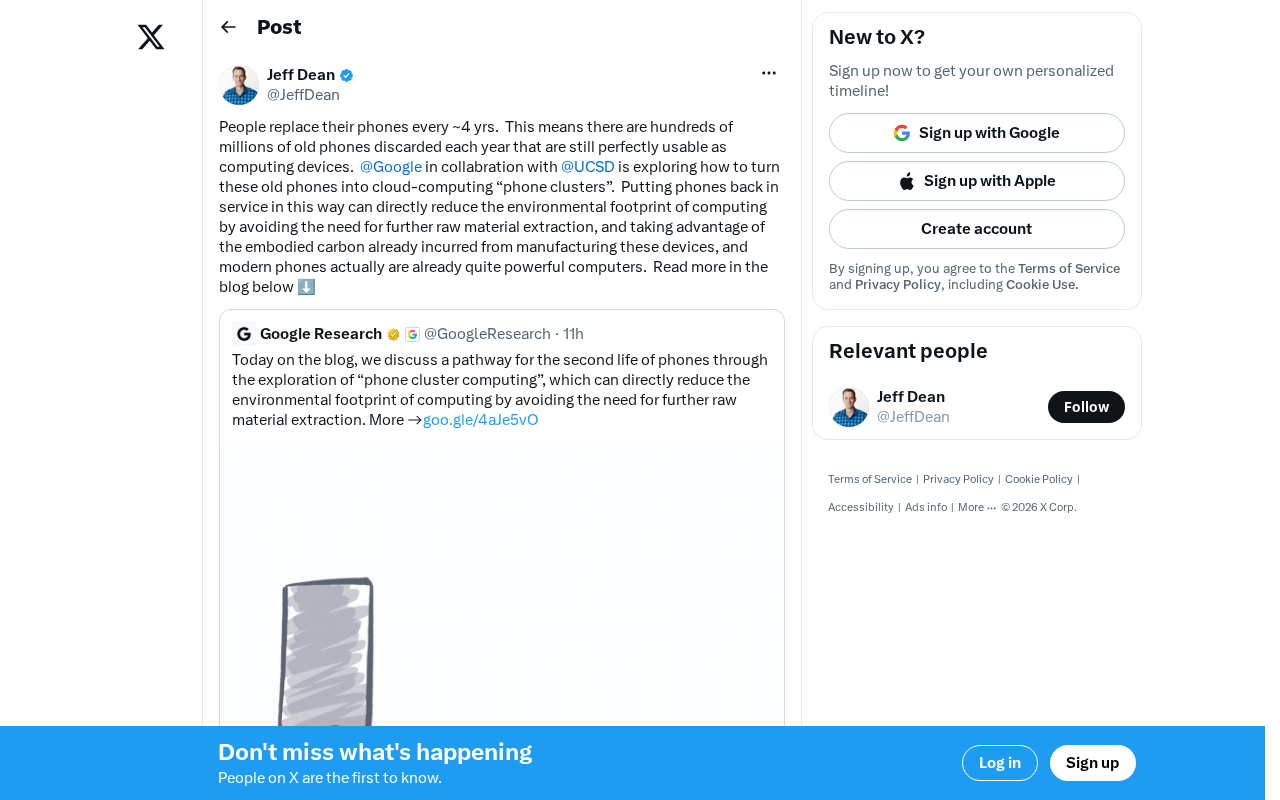
Google and UCSD explore repurposing old smartphones as energy-efficient cloud computing cluster nodes.
Google and UCSD are researching how to assemble discarded smartphones into cloud computing clusters, leveraging the high energy efficiency of ARM chips to reduce e-waste and data center carbon footprints. While challenges like hardware heterogeneity, network bottlenecks, and battery management remain, the approach shows promise for edge computing and federated learning scenarios, offering a sustainable "reuse" alternative to recycling.
Turning Old Phones into Cloud Computing Nodes: A Bold Vision
People replace their phones every 4 years on average, meaning hundreds of millions of old phones are discarded each year — yet they remain perfectly functional as computing devices. According to the UN's Global E-waste Monitor, approximately 62 million metric tons of electronic waste were generated worldwide in 2022, with smartphones and small IT devices among the fastest-growing categories. However, less than 20% of global e-waste is formally recycled, with large volumes flowing into informal dismantling channels or ending up directly in landfills, causing toxic substances like lead, mercury, and cadmium to leach into soil and groundwater. Even with formal recycling, precious metal recovery rates fall far short of 100%, and the recycling process itself generates carbon emissions.
Google and the University of California, San Diego (UCSD) are collaborating to explore a bold idea: assembling these old phones into cloud computing "Phone Clusters" and putting them back to work. This approach essentially opens a "third path" beyond recycling and disposal — instead of dismantling devices, it directly leverages their full computing capabilities. Within the circular economy framework, this qualifies as the highest-priority "Reuse" strategy, which takes precedence over "Recycle."
The core logic behind this concept is remarkably clear: modern smartphones are already quite powerful computers, equipped with high-performance processors, ample memory, and excellent energy efficiency. Rather than letting these devices gather dust in drawers or end up in landfills, why not reorganize them to handle computing tasks?
Environmental Benefits of Phone Clusters: A New Path to Reducing Carbon Footprints
The environmental significance of this approach operates on multiple levels:
Avoiding new raw material extraction. Building data centers requires vast quantities of rare metals and semiconductor materials, yet these materials already exist in old phones. By reusing existing devices, we can directly reduce further demands on Earth's resources.
Leveraging already-generated embodied carbon. Every phone has already produced substantial carbon emissions during manufacturing — known as "embodied carbon." Embodied carbon is a core concept in Life Cycle Assessment (LCA), referring to the total cumulative greenhouse gas emissions across a product's entire supply chain, from raw material extraction, transportation, and manufacturing to final assembly. Multiple studies estimate that a smartphone's embodied carbon is approximately 50–80 kilograms of CO₂ equivalent, with chip manufacturing accounting for the largest share — semiconductor fabs require continuously running clean rooms with air conditioning and chemical processing systems, consuming staggering amounts of energy. By comparison, a phone generates only about 5–10 kilograms of carbon emissions per year during its use phase. This means that for a phone used for just 4 years, over 70% of its lifecycle carbon emissions come from the manufacturing stage. If a phone is discarded after only 4 years of use, the "return on investment" for those emissions is extremely low. Extending a device's effective lifespan effectively amortizes the carbon cost per unit of computation and is the most direct way to reduce this "carbon debt."
Lowering the environmental footprint of computing infrastructure. Traditional data centers are not only expensive to build — their cooling systems also consume enormous amounts of energy during operation. Cooling systems in traditional data centers typically account for 30%–40% of total energy consumption, measured by the PUE (Power Usage Effectiveness) metric. PUE is defined as the ratio of a data center's total power consumption to the actual power consumed by IT equipment, with an ideal value of 1.0, meaning all electricity goes toward computation. The global average PUE for data centers is approximately 1.58, meaning for every 1 kWh spent on computing, an additional 0.58 kWh is consumed for cooling, lighting, and other infrastructure. Even industry leaders like Google maintain a PUE of around 1.10, where cooling remains a non-negligible energy drain. Phone chips are inherently designed for low power consumption, with a Thermal Design Power (TDP) of typically just 3–5 watts — far below the 100–300 watts of server CPUs. Heat dissipation can be achieved through natural convection, eliminating the need for dedicated cooling infrastructure entirely, giving them an inherent energy efficiency advantage.
Technical Feasibility Analysis: Strengths and Challenges Coexist
From a technical perspective, building cloud computing clusters from old phones presents both challenges and advantages.
Technical Advantages of Phone Clusters
Modern flagship phone processors approach the performance of entry-level laptops, and some AI inference tasks can even be completed efficiently on-device. ARM (Advanced RISC Machines) architecture chips far exceed traditional x86 server chips in energy efficiency. This difference stems from fundamentally different design philosophies: x86 originated in desktop and server scenarios, using Complex Instruction Set Computing (CISC) to pursue peak single-core performance; ARM started from embedded and mobile devices, using Reduced Instruction Set Computing (RISC) design where each instruction's execution logic is simpler, transistor utilization is higher, and Performance per Watt is the primary optimization target. This is also why AWS's Graviton (which claims approximately 60% energy savings over comparable x86 instances) and Apple's M-series chips both follow the ARM path. Old phone clusters are, in a sense, the "grassroots version" of this trend.
Technical Challenges to Overcome
Phone clusters need to solve a series of engineering problems including network interconnection, task scheduling, fault tolerance, and battery degradation management. Among these, the heterogeneity challenge in task scheduling is particularly prominent. In traditional data centers, server hardware is typically homogeneous (identical CPU models, memory, and network interfaces), allowing task schedulers to assume equal capability across nodes. Phone clusters, however, face an extremely heterogeneous environment: phones from different eras may carry processors spanning multiple generations from the Snapdragon 660 to the Snapdragon 8 Gen2, memory ranging from 2GB to 12GB, varying operating system versions, and widely differing battery health states. This requires scheduling systems with the intelligence to perceive each node's capabilities in real time — similar to the "speculative execution" mechanism in big data frameworks like Apache Spark, but with far greater complexity.
The computing power of a single phone is limited, and efficiently decomposing and distributing tasks across hundreds or thousands of phones is a non-trivial distributed computing problem. Furthermore, phones interconnect via Wi-Fi rather than the high-speed InfiniBand networks (with bandwidth reaching hundreds of Gbps) found inside data centers, meaning network bandwidth and latency bottlenecks can severely impact computation tasks requiring frequent inter-node communication. The extreme hardware heterogeneity across different brands and generations of phones also makes software adaptation a major challenge.
New Thinking in Sustainable Computing: From Edge Computing to Federated Learning
This research direction reflects the tech industry's deeper reflection on sustainable development. As AI training and inference drive explosive growth in computing demand, data center expansion faces dual pressures from energy and environmental constraints. Google and UCSD's exploration represents a form of "reverse thinking" — rather than building more new facilities, it seeks to extract residual value from existing resources.
Even if phone clusters ultimately cannot fully replace traditional data centers, they may find unique applications in edge computing and specific types of distributed tasks. Federated Learning is a particularly fitting direction. Federated Learning is a distributed machine learning paradigm proposed by Google in 2016, with the core principle of "data stays put, models move" — training data remains on individual end devices, which complete model training locally and upload only model parameter updates (gradients), while a central server aggregates these updates to improve the global model. This approach is naturally suited for privacy-sensitive scenarios (such as personalized prediction in phone keyboards) and aligns perfectly with the architectural characteristics of phone clusters: each phone independently completes local computation, requiring only low-bandwidth parameter synchronization communication. Google's Gboard keyboard already uses Federated Learning in production to improve next-word prediction, demonstrating the practical feasibility of this technology on mobile devices. If phone clusters focus on such tasks, they can bypass the dependency on high-bandwidth interconnects that traditional distributed computing requires.
Beyond Federated Learning, edge computing scenarios such as Content Delivery Network (CDN) caching and IoT data preprocessing may also be potential use cases for phone clusters. More importantly, this line of thinking could inspire more innovative approaches to e-waste reuse.
Conclusion
Hundreds of millions of old phones represent an enormous pool of sunk computing resources. The collaborative research between Google and UCSD aims to transform this "e-waste" into valuable computing infrastructure while reducing environmental burden. Although there is still a long road from the lab to large-scale deployment — with challenges like unified management of heterogeneous hardware, overcoming network bottlenecks, and ensuring battery safety all requiring solutions — the direction itself deserves attention. It reminds us that the greenest computing resources may be the ones we already own but have yet to fully utilize. In an era of exponentially growing AI computing demand, this mindset of "seeking growth from existing stock" may hold more long-term value than simply pursuing ever more powerful new hardware.
Related articles
Xiaomi MIMO vs. Huawei Pangu AI Strategy Comparison: The Android vs. iOS Battle of the Agent Era
Xiaomi releases open-source MIMO Code while Huawei enters the Agent era with Pangu. Compare their AI strategies: Xiaomi's Android-like open ecosystem vs. Huawei's iOS-like vertical integration.
What Is Google WebMCP? A Deep Dive into the New Standard for AI Agents to Directly Invoke Web Functionality
A deep dive into Google WebMCP (Web Model Context Protocol): how it works, its technical implementation, and use cases. Learn how WebMCP lets AI Agents directly invoke web tools.
AI Can't Kill Old-School Programming: Why Fundamentals Are Still a Developer's Moat
Vibe Coding is trending, but can it replace solid fundamentals? A deep analysis of why core principles, systems thinking, and knowledge frameworks remain a developer's moat in the AI era.