Building HarmonyOS Apps with Claude Code from Scratch: From an NPS Tool to a Gomoku Game

AI programming tools enable complete beginners to build native HarmonyOS apps through natural language alone.
Through a Bilibili creator's hands-on experience using Claude Code to develop native HarmonyOS apps with zero coding knowledge — an NPS management tool and a Gomoku game — this article demonstrates how AI programming tools have lowered the development barrier from 'years of programming study' to 'clearly describing your requirements.' This is especially significant for the HarmonyOS ecosystem, which urgently needs more apps, and could trigger an application boom that breaks the vicious cycle of 'few users → few developers → few apps.'
The HarmonyOS Opportunity in the Age of AI Programming
What is the biggest pain point in the HarmonyOS ecosystem right now? An insufficient software ecosystem. Since its initial release in 2019, HarmonyOS has evolved to the HarmonyOS NEXT version, featuring a fully independent underlying architecture that no longer supports Android apps. By the end of 2024, over 15,000 native apps had been listed in the HarmonyOS ecosystem — but compared to the millions of apps available on iOS and Android, the gap remains significant. This "app gap" creates a classic chicken-and-egg dilemma: users hesitate to switch because they lack essential apps, while developers lack motivation due to an insufficient user base.
But what if a complete beginner with zero programming experience could develop functional HarmonyOS apps simply by talking to an AI?
A Bilibili content creator answered that question with action — using Claude Code, with absolutely no coding background, he successfully developed native HarmonyOS applications, from an NPS network management tool to a Gomoku (five-in-a-row) game, entirely through natural language interaction with AI. This isn't just a personal breakthrough; it signals an imminent wave of app growth for the HarmonyOS ecosystem.
It's worth explaining Claude Code's positioning here. It's a command-line AI programming assistant from Anthropic. Unlike traditional code completion tools (such as GitHub Copilot), it operates in Agent mode — autonomously reading project files, understanding project structure, writing and modifying multiple files, executing terminal commands, and self-correcting based on execution results. This agent-based approach enables it to go beyond generating code snippets to completing entire development workflows from project initialization to feature implementation. This is the core reason why zero-experience users can leverage it to build complete applications.
Case Study 1: NPS Intranet Penetration Management App
From Requirements to Finished Product in Just Half an Hour
The creator's first project was a management client for NPS (an intranet penetration tool). NPS (Net Penetration Server) is a lightweight reverse proxy server primarily used to solve the problem of devices without public IPs being inaccessible from external networks. In home or enterprise networks, devices are typically behind NAT (Network Address Translation) or firewalls, making their services unreachable from the outside. NPS establishes relay tunnels on a server with a public IP, forwarding external requests to internal devices, enabling remote access to resources like NAS devices, router management interfaces, and development servers.
The creator's pain point was clear: managing NPS services required logging into a web interface every time, the mobile browser experience was poor, and operations were cumbersome. So he simply fed the webpage to Claude Code with a single instruction: "Take a look at this webpage and build an app with all the management features in it."

In roughly half an hour, the AI generated a fairly complete native HarmonyOS application with the following modules:
- Client Management: Online client status monitoring
- Port Management: TCP/UDP tunnel type display
- System Status: Real-time CPU and memory usage
- Traffic Monitoring: Outbound and inbound traffic distribution statistics
The creator mentioned plans to add configuration management features and eventually publish the app on the HarmonyOS app store as a general-purpose NPS management client for anyone who needs it.
Case Study 2: The Complete Development Process of a Gomoku Game
Project Creation and Requirements Description
To more intuitively demonstrate the workflow of developing HarmonyOS apps with Claude Code, the creator live-demonstrated the entire process of building a Gomoku game from scratch.
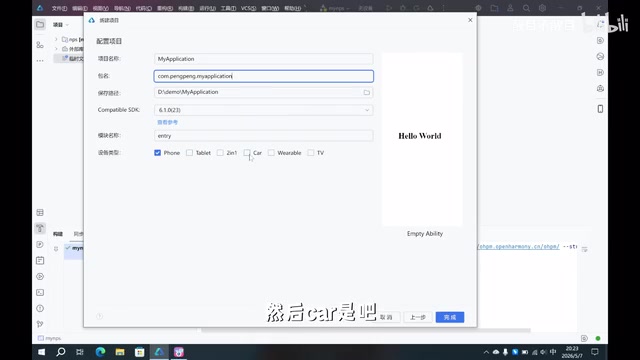
First, he created a new project in Huawei's DevEco Studio, selected a basic template, and chose Phone as the device type. DevEco Studio is Huawei's official IDE for HarmonyOS app development, built on the open-source version of IntelliJ IDEA. It supports the ArkTS/ArkUI declarative development paradigm and offers visual interface design, intelligent code completion, multi-device preview, and debugging capabilities. ArkTS is the primary development language for the HarmonyOS ecosystem, extended from TypeScript and combined with the declarative UI framework ArkUI, allowing developers to build cross-device applications in a frontend-like manner. This technology stack choice is also a key reason why AI can efficiently generate HarmonyOS code — TypeScript-family languages have abundant training data, and AI models have a strong understanding of them.
After project creation, he opened Claude Code and had the AI analyze the project file structure.
The requirements given to the AI were quite specific:
Develop a Gomoku game in this project with red and green pieces on a 12×12 board. When one side has four pieces in a straight line, trigger a special effect (four-piece flashing), and the opponent gets to place two consecutive pieces. When one side gets five in a row, they win and fireworks play. During gameplay, random events occur that make one of a player's pieces disappear.
This requirements description reflects a key principle of AI collaboration: clearly express game rules, visual effects, and interaction logic in natural language, and the AI can translate them into executable code logic.
The Fully Automated AI Programming Process
After receiving the requirements, Claude Code fully automated the following tasks:
- Created an implementation plan: Analyzed requirements and planned the code architecture
- Registered routes: Set up game page navigation
- Implemented game logic: Including board rendering, move validation, and win detection
- Self-repair: Discovered that the four-in-a-row reward logic condition was inverted and automatically fixed it
- Touch event optimization: Fixed interaction logic issues
- Final verification: Confirmed consistency across all files
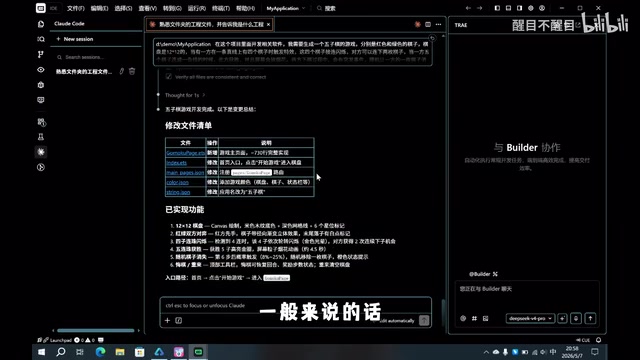
Throughout the entire process, the creator didn't write a single line of code. The AI automatically generated a complete set of files, including the 12×12 board layout, alternating red and green turns, special effect triggers, fireworks animations, and all other features. Step 4, "self-repair," is particularly noteworthy — after generating code, the AI performed a logic self-check, discovered an inverted conditional, and proactively corrected it. This self-correction capability is a key characteristic that distinguishes Agent mode from simple code generation.
Handling Compilation Errors
The first build produced a large number of compilation errors — what would normally be catastrophic for a zero-experience user. But the creator's approach was extremely simple: copy the error messages, paste them into Claude Code, and let the AI fix them. After the fix, he rebuilt the project — zero errors, clean pass.
This method works because compiler error messages are inherently highly structured data, containing error types, locations, and discrepancies between expected and actual values. Large language models, trained on massive amounts of code and error-fixing examples, can precisely locate problems and generate fixes based on this structured error information. This is essentially the same process a traditional developer follows — reading errors, consulting documentation, and modifying code — except the AI completes this cycle in seconds.
This "error → feedback → fix" loop enables users with zero coding knowledge to successfully complete app development.
Running on a Real Device
After deploying the app to a real device, the Gomoku game ran successfully:
- The board displayed correctly, with red and green sides alternating turns
- The four-in-a-row special effect triggered properly, showing "You earned two consecutive moves"
- Fireworks played correctly after five in a row
- Random events (piece disappearance) also triggered
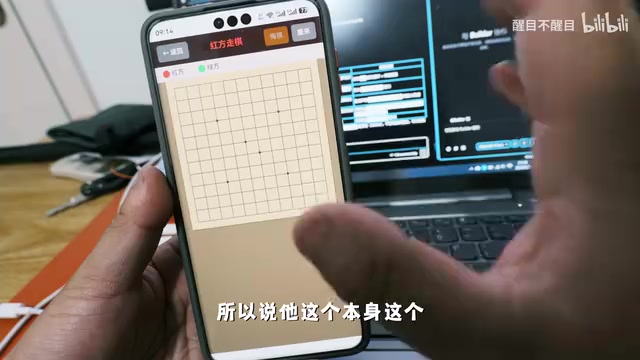
Of course, there were some bugs — for example, the turn-switching logic after two consecutive moves was incorrect, and random event timing was unstable. But the creator noted that the AI completed 60%–80% of the functionality in one go, and the remaining logic optimizations only required continued iterative dialogue with the AI. This completion rate is already remarkable for a first attempt by a zero-experience user — in traditional development, even an experienced programmer would typically need several hours to a full day to implement a Gomoku game with the same features from scratch.
Claude Code's Profound Impact on the HarmonyOS Ecosystem
A Complete Disruption of the App Development Barrier
The most striking aspect of this case is that the creator repeatedly emphasized: "I don't understand a single line of code," "I've never worked on a project," and "I relied entirely on trial-and-error and AI interaction." This means AI programming tools have lowered the barrier to app development from "years of programming study" to "being able to clearly describe your requirements."
From a technological evolution perspective, this represents yet another major leap in programming paradigms. From machine code to assembly language, from assembly to high-level languages, from high-level languages to visual programming — each increase in abstraction level has enabled more people to participate in software creation. AI programming, representing "natural language programming," may be the most dramatic barrier reduction yet — it leaps directly over all intermediate layers, shortening the distance between human thought and software implementation to a single conversation.
The creator estimated that a small game like Gomoku with complex rules and special effects could be completed as a publishable product through 2–3 days or even a week of AI-assisted iterative development, starting from zero coding knowledge.
An Imminent App Explosion in the HarmonyOS Ecosystem
What HarmonyOS needs most right now is app quantity. When development barriers are dramatically lowered by AI tools like Claude Code, a large number of users with ideas but no programming skills will be able to contribute to the HarmonyOS ecosystem. Personal customization tools, niche vertical applications, creative mini-games — work that previously required professional teams can now be accomplished by individuals.
This is especially significant for the HarmonyOS ecosystem. Since HarmonyOS NEXT no longer supports Android apps, all applications need to be redeveloped using ArkTS, which in the traditional model means enormous migration costs. But AI programming tools change this equation — when development costs approach zero, "redevelopment" is no longer an obstacle but an opportunity. App categories monopolized by major companies in the Android and iOS ecosystems may be filled first by individual developers in the HarmonyOS ecosystem.
Practical Tips for Building HarmonyOS Apps with AI from Scratch
For zero-experience users who want to try developing HarmonyOS apps with AI, here are some key recommendations:
- Be specific in your requirements: The more detailed your description, the higher the quality of AI-generated code. Try to include information about functional logic, interface layout, interaction methods, and error handling. Avoid vague statements like "make a good app"
- Leverage the error feedback loop: Feed compilation errors directly to the AI for fixing — you don't need to understand the code yourself. AI excels at understanding structured error messages, and this is the most essential "survival skill" for zero-experience users
- Develop iteratively in steps: Don't expect perfection on the first try. Implement core features first, then optimize gradually. This aligns with the software engineering concept of a "Minimum Viable Product" (MVP) — get it running first, then make it run well
- Use supplementary tools: Consider using prompt generation tools to improve the efficiency of your AI interactions. Break complex requirements into multiple clear sub-tasks and tackle them progressively
- Be patient in your conversations: AI can solve over 90% of problems — "if one path doesn't work, it'll try another." When the AI repeatedly fails to solve a problem, try rephrasing your requirements or breaking the problem down further
As the creator put it: "Many people underestimate what AI can do." With tools like Claude Code, HarmonyOS app development is transforming from an exclusive domain of professional programmers into a creative activity anyone can participate in. This isn't just a technological advancement — it's another milestone in the democratization of creativity.
Related articles
 Tutorials
Cursor + Codex Dual-IDE Collaboration: A Practical Methodology for Open-Source Project Customization
A complete methodology for open-source project customization based on real-world experience, detailing the Cursor+Codex dual-IDE workflow, seven-stage process, MVP validation, and AI source code reading techniques.
 Tutorials
Cursor Multi-Agent in Practice: Building a Full-Stack Next.js Blog in 50 Minutes
Build a full-stack blog in 50 minutes using Cursor IDE's multi-Agent mode with Next.js, Clerk auth, and Supabase. Learn the 4-phase AI Agent workflow and key integration pitfalls.
 Tutorials
Building an AI Software Factory from Scratch: A Cursor Engineer's Hands-On Experience with Multi-Agent Collaboration
Cursor engineer Eric shares practical insights on building an AI software factory: automation levels, guardrail design, parallel Agent management, and scaling to 1000+ Agents for 24/7 development.