Career Switch to AI Software Testing from Scratch: A Complete 3-Month Learning Roadmap
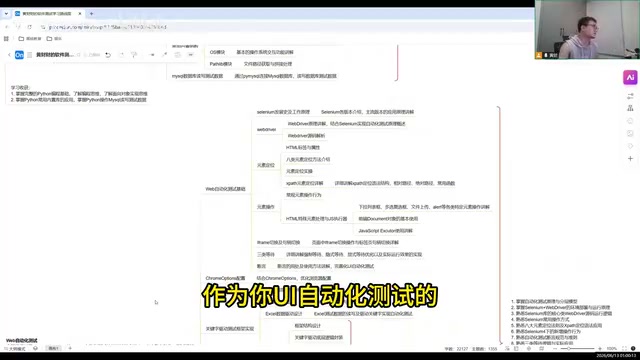
A structured 3-month roadmap to transition into AI-powered software testing from zero experience.
This guide presents a comprehensive learning roadmap for breaking into AI software testing, covering four phases: testing fundamentals, Python automation development (Selenium, API testing, CI/CD), AI-powered testing (Harness framework, RAG knowledge bases, MCP/Agent toolchains), and career guidance. Designed for beginners and experienced testers alike, it can be completed in 1-3 months.
How Should You Plan Your Software Testing Studies in the AI Era?
As AI technology deeply permeates the software development process, the software testing profession is undergoing unprecedented transformation. Traditional manual testers who don't embrace automation and AI tools will face increasing career pressure. Based on years of testing education experience and feedback from beginner students, Chinese tech educator Huang Caicai has compiled a comprehensive learning roadmap covering four major modules: Software Testing Fundamentals → Python Test Development → AI-Powered Testing → Career Guidance.
The core design philosophy behind this roadmap is: driven by real-world work scenarios and high-frequency interview topics, cutting out the fluff and focusing on hard skills. Whether you're switching careers from scratch, a fresh graduate entering the field, or a working test engineer looking to level up, you'll find a relevant learning path here.
Phase 1: Software Testing Fundamentals — The Required Foundation
For beginners or career switchers, the first step is building a complete software testing knowledge framework. The goal of this phase is clear: equip you with all the skills needed to independently conduct functional manual testing.
The specific content covers the following areas:
- Industry Awareness & Career Analysis: Understanding the current state, growth trajectory, and salary levels of software testing roles
- Software Engineering Principles: Understanding the software development lifecycle and where testing fits within it
- Core Testing Knowledge: Testing models, test case writing, defect management, testing processes, and documentation skills
- Essential Tool Skills: Basic Linux operations, MySQL database queries, Postman API debugging, JMeter performance testing, and Fiddler packet capture analysis
These topics may seem basic, but they form the foundation of your entire testing career. A common mistake career switchers make is rushing to learn automation before they can even write proper test cases — and that's a fatal weakness in interviews.
Phase 2: Python Test Development — The Core Automation Battleground
Python Programming Fundamentals
Automation testing is tied to programming ability, and Python — with its clean syntax and rich testing ecosystem — has become the go-to language for test development. The Python knowledge you need to master in this phase includes:
- Basic syntax structures and coding conventions
- Efficient use of the PyCharm IDE
- File operations, object-oriented programming, and reflection mechanisms
- Exception handling and flexible use of built-in functions
It's worth emphasizing that the Python requirements for test development differ from those of pure development roles. The focus is on being practical and sufficient — enough to support you in designing and implementing automation testing frameworks.
UI Automation Testing Framework Development
With Selenium at its core, the learning path for UI automation testing is very clear:
- Foundation Layer: WebDriver principles, element locating and interaction, iFrame/window switching, three types of wait mechanisms, assertion systems
- Framework Layer: Keyword-driven design, Excel/YAML data-driven approaches, POM (Page Object Model) design pattern
- Engineering Layer: Pytest test case management, Fixture mechanisms, Conftest configuration, Allure test report integration
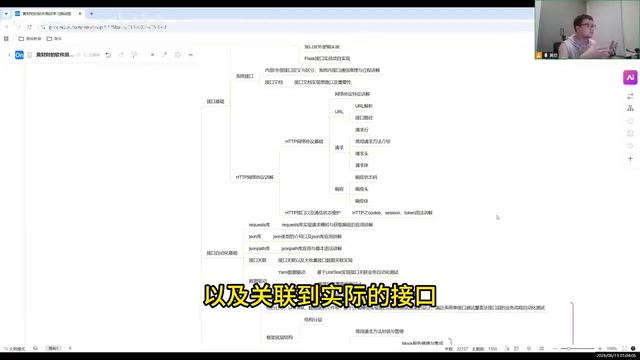
Here's a key insight: knowing how to write automation scripts and knowing how to design an automation framework are two very different things. What interviewers really care about is whether you can design a customized framework based on the company's actual needs. Different companies use different tech stacks — some use Unittest, others use Pytest; some use Excel for data-driven testing, others use YAML — and you need to understand the applicable scenarios and trade-offs of each approach.
API Automation Testing Framework Design
API automation is currently the most frequently used and most heavily tested technical area in the industry. The learning path is as follows:
- Theoretical Foundation: API definitions and principles, HTTP protocol mechanics, RESTful conventions
- Technical Implementation: Request simulation and response handling with the Requests library, JSON parsing, API chaining and business flow orchestration
- Framework Design: Keyword-driven encapsulation, Mock service setup, test data encryption and auto-generation, multiple data-driven patterns (Excel/YAML/SQL/PY files)
- Extended Capabilities: Log collection and generation, email notifications, environment switching and configuration management
The design philosophy for API automation frameworks is similar to UI automation — the core principle is making the framework flexibly extensible based on actual business needs. For example, data generator encapsulation and Mock service setup are modules added on demand based on specific business scenarios.
CI/CD Continuous Integration Practice
This phase also covers using Jenkins and Git to integrate automated testing into continuous integration pipelines. This is the critical step from "being able to write automation scripts" to "being able to implement automation in production."
Phase 3: AI-Powered Testing — The Core Competitive Edge
This is the most forward-looking part of the entire learning roadmap and an increasingly frequent topic in interviews. The entire AI-powered testing system revolves around the Harness engineering framework, with the goal of achieving a "constrained, orderly, high-quality" AI-assisted testing production workflow.
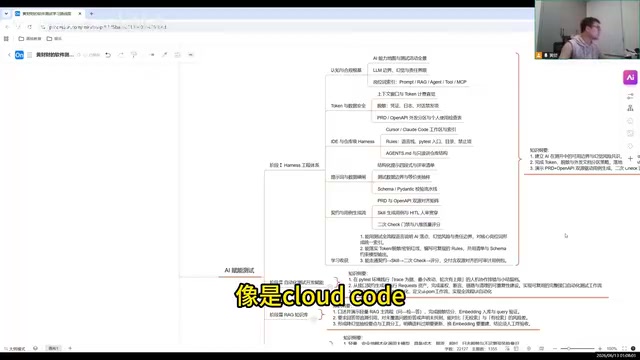
The Harness Engineering Framework: Making AI Controllable and Usable
When using AI tools like Cursor, Codex, and Claude Code, you first need to establish a Harness management system:
- Cognitive Layer: Understanding LLM capability boundaries, data compliance red lines, and token consumption mechanisms
- Management Layer: Defining Rules, Agents, Skills, and other constraint rules
- Application Layer: Writing high-quality prompts to implement a complete workflow of "requirement analysis → test case generation → secondary validation → quality scoring"
The core idea is: let AI generate content, then let AI evaluate quality, combined with human confirmation, forming a triple-validation mechanism to ensure deliverables meet production standards.
AI-Driven Automation Test Development
Building on the existing Pytest framework, AI can deeply participate in the following areas:
- Test Case Governance: Optimizing the Pytest system, managing Fixtures, and automatically debugging failed test cases
- API Automation Workflow: Auto-generating Pytest case skeletons from API documentation → complete business flow test cases → secondary validation and review
- UI Automation Workflow: Auto-generating page objects based on the POM design pattern → automatic debugging → generating complete UI automation test cases
The keyword here is "workflow" — it's not about sporadically asking AI to write a few lines of code, but about establishing a complete automated pipeline from document input to test case output.
RAG Knowledge Base System: A High-Frequency Interview Topic
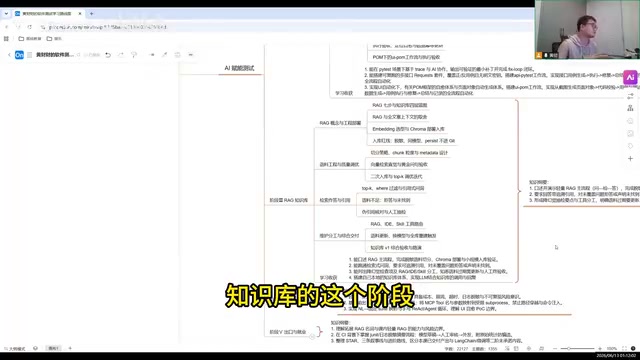
RAG (Retrieval-Augmented Generation) knowledge bases are currently one of the most frequently asked technical topics in AI-powered testing interviews. The core content you need to master includes:
- Basic concepts of vectors and vector databases
- Selection and application of Embedding models
- Design and optimization of document chunking strategies
- Methods for improving knowledge base answer accuracy
- Strategies for reducing AI hallucinations
- Knowledge base maintenance, updating, and rebuilding mechanisms
The ultimate goal is to build a personal or team-level dedicated knowledge base, consolidating project documentation, testing standards, historical defects, and other information so that AI has reliable sources to draw from when answering questions.
MCP and Agent Toolchain — Advanced Topics
At a more advanced level, you also need to understand MCP (Model Context Protocol), Function Calling, Agent and Tools, and other technologies. Learn to customize intelligent agents and enhance existing AI tools' capabilities through the MCP protocol, turning AI into a true "testing assistant" rather than a simple code generator.
Phase 4: Career Guidance — Turning Skills into Job Offers
No matter how strong your technical skills are, if you can't package and present them effectively, it's hard to land your ideal offer. The career guidance module covers three key areas:
- Resume Writing: Providing templates and teaching you how to highlight your AI-powered testing expertise based on your background
- Resume Optimization: Making your resume "look more valuable" to increase interview invitation rates
- Interview Skills: Mastering interview details, response strategies, and especially professional ways to articulate AI-related topics
Summary: Timeline and Path Recommendations
This roadmap may look massive, but if you follow a structured course, you can complete everything from testing fundamentals to AI-powered testing in as little as 1-2 months. Even for self-learners, with proper planning, you can cover all core skills within 3 months.
For learners at different stages, here are the recommended priorities:
- Complete Beginners / Career Switchers: Fundamentals → Python → API Automation → AI-Powered Testing (follow the sequence — don't skip steps)
- 1-3 Years of Experience: Focus on filling gaps in automation framework design skills, then quickly transition into AI-powered testing
- 3+ Years of Experience: Go straight to AI-powered testing (Harness, RAG, MCP/Agent) — these are the skills that create the biggest competitive advantage right now
As AI reshapes the software testing industry, the sooner you build systematic AI testing capabilities, the stronger your position will be in the job market.
Related articles
Sakana AI Launches RSI Lab: The Path to Recursive Self-Improvement Where AI Builds AI
Sakana AI launches RSI Lab for recursive self-improvement, letting AI autonomously improve its own architecture. Explore their four-stage roadmap and key breakthroughs.

The Clotilda: Underwater Archaeological Discovery of America's Last Slave Ship
The Clotilda, America's last slave ship, was discovered by underwater archaeologists in Alabama nearly 160 years after sinking. Learn about the search, key evidence, and other slave trade shipwreck discoveries.
Sakana AI in Practice: Reshaping Banking Lending Operations with AI Agents — Technology and Strategy
Deep dive into how Sakana AI applies AI Agents to banking lending operations, covering end-to-end support from information gathering to approval document generation, plus technical challenges and human-AI collaboration design.