ChatGPT Can Now Build and Publish Web Apps Directly — The Zero-Code Development Era Has Arrived
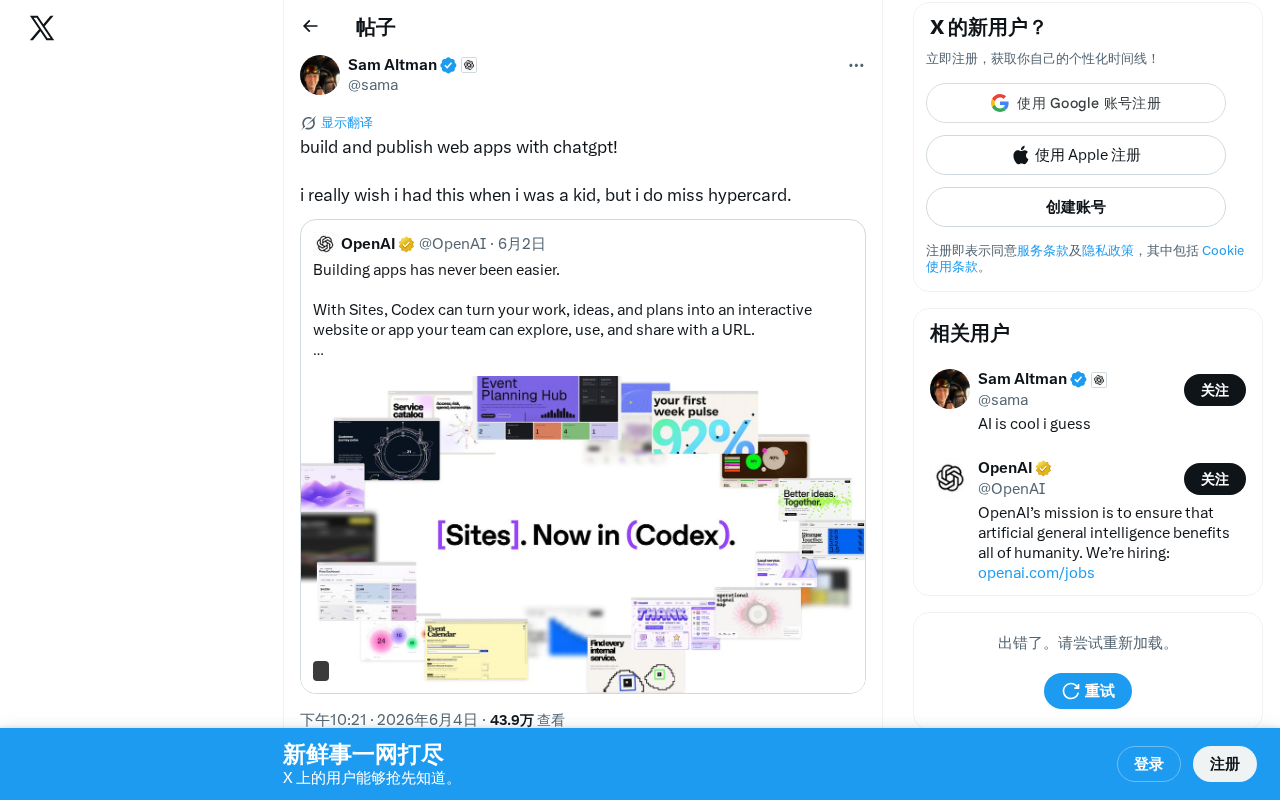
ChatGPT now lets users build and publish web apps through natural language conversation alone.
OpenAI has introduced a new ChatGPT feature that allows users to build and publish web applications entirely through natural language conversation, requiring no programming knowledge. Drawing comparisons to Apple's legendary HyperCard, this capability leverages LLM code generation to compress the entire development workflow into a single chat. The feature has significant implications for education, maker culture, and the future of zero-code development.
ChatGPT Adds Web App Building and Publishing Capabilities
OpenAI recently rolled out an exciting new feature for ChatGPT — users can now build web applications directly through conversation and publish them online with a single click. This launch has stirred deep emotions among developers and tech enthusiasts alike, with some even drawing comparisons to the legendary HyperCard.
From Conversation to Application: A Zero-Barrier Web Development Experience
The core value of this feature lies in dramatically lowering the barrier to web app development. Users don't need to know HTML, CSS, JavaScript, or any other front-end technology — they simply describe the app they want in natural language, and ChatGPT automatically generates the code and provides publishing options.
From a technical standpoint, this feature relies on the powerful code generation capabilities of large language models (LLMs). OpenAI significantly enhanced code comprehension and generation in GPT-4 and subsequent models, enabling them to produce complete HTML, CSS, and JavaScript code from natural language descriptions. Traditional web app development requires mastery of three core technologies: HTML for page structure, CSS for visual styling, and JavaScript for interactive logic — plus front-end frameworks like React and Vue on top of that. A key reason AI code generation has achieved breakthroughs in web development is the extremely high degree of standardization in web technologies — LLMs have learned from billions of lines of code on GitHub during training, enabling them to understand common design patterns and best practices to generate well-structured, ready-to-run application code. The publishing feature means OpenAI provides hosting services on the backend, allowing user-generated apps to be deployed directly with a publicly accessible URL, compressing requirements analysis, coding, debugging, and deployment into a single conversational workflow.
For non-technical users, this means they can quickly turn their ideas into accessible web applications. For developers, it's a powerful rapid prototyping tool that can accomplish in minutes what previously might have taken hours.
The Spiritual Successor to HyperCard
Some users expressed nostalgia for HyperCard after trying this feature. HyperCard was a revolutionary application development tool released by Apple in 1987 that enabled ordinary users to create interactive applications through a simple graphical interface and scripting language.
HyperCard was developed by legendary Apple engineer Bill Atkinson and came bundled free with Macintosh computers. It used a metaphor of "cards" and "stacks" — each card was equivalent to a screen page, and multiple cards formed a stack (i.e., an application). Users could place buttons, text fields, images, and other elements on cards and define interactive logic through the HyperTalk scripting language. HyperTalk's syntax was close to natural English — for example, "go to next card" would navigate to the next page. HyperCard spawned a vast array of educational software, interactive encyclopedias, and early multimedia works, and is even considered one of the conceptual precursors to the World Wide Web — classic games like Myst were originally developed using HyperCard. Unfortunately, Apple officially discontinued HyperCard development in 2004, but the philosophy it represented — "everyone can program" — has had a lasting impact.
Why HyperCard Is Worth Remembering
HyperCard's greatness lay in its design philosophy — empowering everyone to be a creator, not just a consumer. It blurred the line between "user" and "developer," giving ordinary people the ability to create digital tools.
ChatGPT's web app building feature carries on this spirit in a meaningful way. While the underlying technology is completely different (AI-generated code vs. visual programming), the core philosophy is the same: lower the barrier to creation so more people can turn their ideas into reality.
Profound Impact on Education and Maker Culture
"I really wish I had this tool when I was a kid" — this sentiment captures what many people feel. Imagine a child interested in programming being able to build their first web app through natural language conversation — what a powerful motivator for learning that would be.
In the field of computer science education, discussions about AI code generation tools are deepening. Proponents argue that these tools help beginners overcome the "syntax barrier," allowing them to experience the satisfaction of programming more quickly and sparking motivation for continued learning. This aligns closely with constructivist learning theory in education — learners build knowledge through hands-on creation. MIT Media Lab's Scratch programming language is a successful implementation of this philosophy, using visual building blocks to make programming accessible to children, while AI tools lower the barrier even further to the natural language level. However, critics worry that over-reliance on AI could leave learners without an understanding of underlying principles, creating a situation where they know "what" but not "why." How to strike a balance between convenience and deep learning is a question educators need to seriously consider.
The emergence of these AI development tools could bring the following changes:
- Spark creativity: Let students focus on "what to build" rather than "how to build it"
- Accelerate the learning loop: See results quickly and establish positive feedback cycles
- Lower the cost of experimentation: Encourage experimentation and iteration
The Future of Zero-Code Development
From HyperCard to ChatGPT web app building, we've witnessed nearly 40 years of technological evolution. Each generation of zero-code or low-code tools has attempted to solve the same problem: how to get more people involved in digital creation.
Looking back at this evolution, the trajectory is clear: from HyperCard in 1987, to Microsoft Access and FileMaker in the 2000s, to website builders like Wix and Squarespace that emerged in the 2010s, and modern low-code platforms like Bubble, Webflow, and Retool — each generation of tools has tried to lower the development barrier. Low-code platforms typically offer visual drag-and-drop interfaces and pre-built components, while zero-code platforms eliminate coding requirements entirely. AI-driven code generation represents the latest paradigm in this space — rather than relying on predefined component libraries or templates, it dynamically generates customized application code by understanding natural language intent, theoretically achieving greater flexibility and broader scenario coverage.
ChatGPT's approach may be the closest to natural interaction we've seen yet — you simply say what you want, and AI makes it happen. Of course, this also raises new questions: when creation becomes this easy, true value will increasingly reside in the creativity itself, rather than in the technical ability to implement it.
Key Takeaways
Related articles

AI Large Model Learning Roadmap Breakdown: Three Stages from Application Development to Model Fine-Tuning
Deep breakdown of a popular AI large model learning roadmap covering LangChain, RAG, Agent, and LoRA fine-tuning across three stages, with analysis of its strengths and limitations for career changers.

AI Agent Development: A Complete 6-Week Systematic Learning Roadmap
A 6-week systematic learning roadmap for AI Agent development, covering core architecture, ReAct principles, multi-agent collaboration, RAG integration, and deployment.
Four Core Advantages Frontend Developers Have When Transitioning to AI Agent Development
Frontend developers have key advantages for AI Agent development: TypeScript ecosystem fit, low-barrier full-stack bridging, and state management isomorphism. Learn the transition path here.