ChatGPT Memory System Upgrade Explained: Cross-Conversation Context and Long-Term Memory Practicality
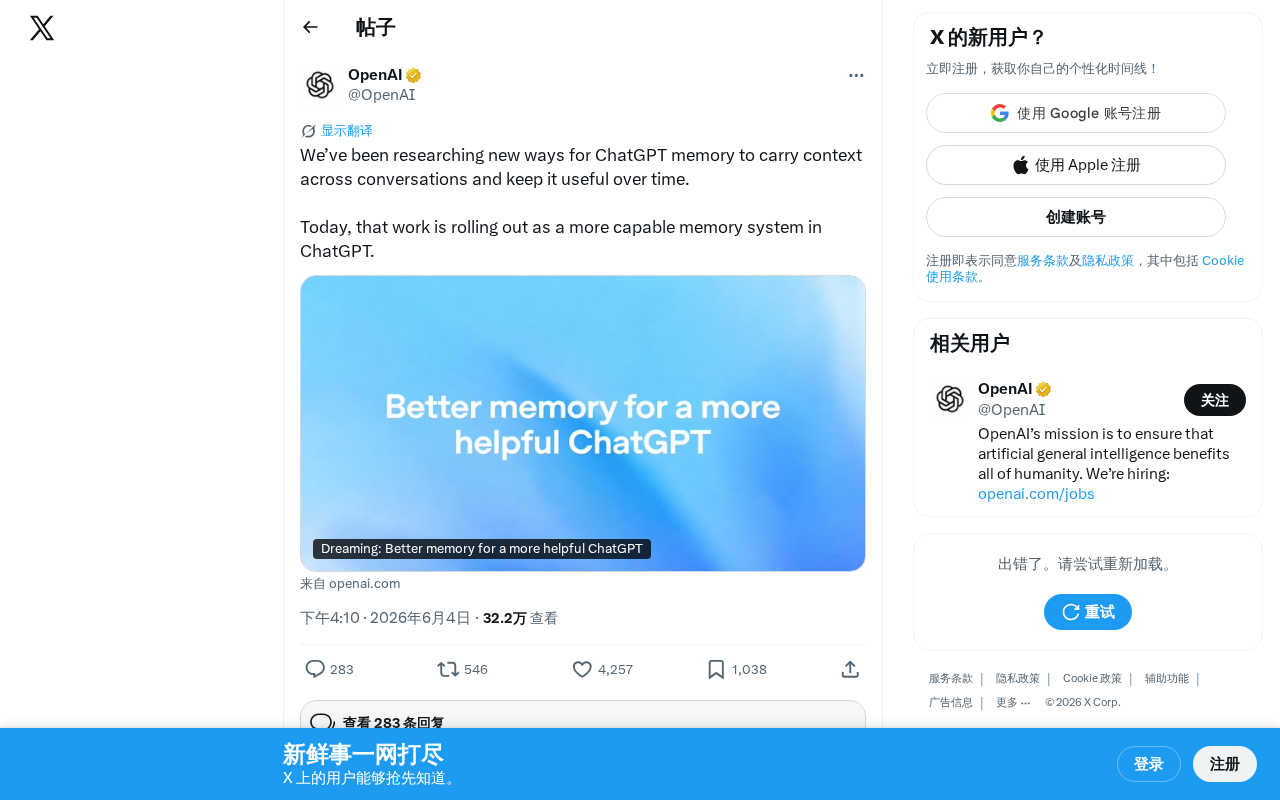
ChatGPT's memory upgrade enables smarter cross-conversation context and dynamic long-term memory management.
OpenAI has announced a significant upgrade to ChatGPT's memory system, focusing on two key areas: enhanced cross-conversation context transfer that maintains logical continuity between sessions, and intelligent long-term memory management that keeps stored information relevant while retiring outdated data. The upgrade positions ChatGPT competitively against Google Gemini's ecosystem-based approach and Claude's extended context windows, while raising important questions about privacy, user control, and paid tier access.
ChatGPT Memory System Upgrade Overview
OpenAI has officially announced a major upgrade to ChatGPT's memory system. This update isn't a simple feature iteration—it's a systematic capability enhancement built on the team's long-term research. The core objectives are twofold: enabling ChatGPT to more effectively pass context between multiple conversations, and ensuring that stored memories remain practically useful over extended periods of use.
Why ChatGPT's Memory Capability Matters So Much
In everyday use, many users share a common pain point: every time they start a new conversation, they need to re-explain their background, preferences, and requirements to ChatGPT. This "amnesia" experience not only reduces efficiency but also hinders AI from truly becoming a personalized assistant.
To understand the root of this problem, you need to understand how large language models fundamentally work. ChatGPT's underlying architecture is a stateless large language model (LLM)—each conversation is an independent inference process, and the model itself doesn't change its parameter weights based on user interactions. Memory functionality is typically implemented through a Retrieval-Augmented Generation (RAG) architecture: the system extracts and stores key user information in an external database, and when a new conversation begins, it retrieves relevant memory fragments and injects them into the prompt, making the model "appear" to remember previous content. This upgrade likely involves more advanced information extraction, semantic indexing, and dynamic retrieval strategies.
Previously, ChatGPT already had basic memory functionality, capable of remembering preference information that users explicitly mentioned in conversations. However, this memory mechanism was relatively passive and crude, with several obvious limitations:
- Fragmented memories: Stored information tends to be scattered factual snippets lacking structured organization
- Context discontinuity: Limited ability to connect context across conversations, making it difficult to understand deeper relationships between pieces of information
- Insufficient timeliness: Stored memories lack effective update and retirement mechanisms, easily accumulating outdated information
Core Directions of This Memory Upgrade
Based on information disclosed by OpenAI, this upgrade focuses on two key dimensions.
Enhanced Cross-Conversation Context Transfer
The new memory system significantly enhances the ability to "carry context" between different conversations. ChatGPT no longer just remembers isolated user preferences—it can understand the logical thread connecting conversations.
It's important to distinguish between two frequently confused concepts: Context Window and Persistent Memory. The context window is the text length limit a model can process in a single inference—for example, GPT-4 Turbo supports a 128K token context window, but this only works within a single conversation and information disappears once the conversation ends. Persistent memory, on the other hand, is a cross-conversation information retention mechanism that requires additional system architecture to implement information extraction, storage, updating, and retrieval. This upgrade focuses precisely on the latter—enabling information to continue functioning across conversation boundaries.
For example: if a user discussed technical architecture choices for a project last week, and this week asks about implementation details, ChatGPT can automatically connect the decision-making context from the previous conversation and provide coherent, targeted suggestions. This capability transforms the conversation experience from "starting from scratch every time" to "picking up where we left off."
Maintaining Long-Term Memory Practicality
Another noteworthy focus is keeping memories useful over extended time spans. The new system introduces smarter memory management mechanisms that can automatically identify which information remains relevant and which has become outdated, preventing the memory store from becoming a bloated but inefficient pile of information.
This mechanism is similar to the human brain's forgetting curve—important and frequently used information is reinforced and retained, while outdated information is gradually phased out or updated. In terms of technical implementation, this likely involves a combination of strategies: decay algorithms based on access frequency (similar to LRU/LFU mechanisms in cache eviction strategies), automatic updates based on semantic conflict detection (triggering replacement when new information contradicts old memories), and reinforcement learning based on user behavior feedback (strengthening the weight of relevant memories when users adopt suggestions). This dynamic memory management is a key technical challenge that distinguishes it from simple database storage, and represents one of the core technical breakthroughs of this upgrade.
Industry Impact and AI Assistant Competitive Landscape
The memory capability upgrade touches the core battlefield of AI assistant competition. In the current large model competition, the gap in foundational model capabilities is gradually narrowing, while personalized experiences and long-term user retention are becoming the new key differentiators.
Current memory capabilities of major competitors:
| Product | Memory/Context Capability | Current Stage |
|---|---|---|
| ChatGPT | Cross-conversation memory + context transfer | Significantly enhanced after this upgrade |
| Google Gemini | Cross-application context integration | Continuously iterating leveraging Google ecosystem |
| Claude (Anthropic) | Ultra-long context window | Persistent memory features still being explored |
It's worth analyzing each company's differentiation strategy in depth. Google Gemini has taken a fundamentally different path from OpenAI regarding memory capabilities. Thanks to Google's massive product ecosystem (Gmail, Google Calendar, Google Drive, Google Maps, etc.), Gemini can build user profiles through cross-application data integration rather than relying solely on conversation history. For example, Gemini can learn about scheduling from a user's calendar, understand work context from emails, and infer interest preferences from search history. This "passive memory" model doesn't require users to actively provide information, but it also raises greater privacy concerns. Claude, meanwhile, has chosen to expand its context window (up to 200K tokens) as a short-term solution, partially compensating for the lack of persistent memory by accommodating more information within a single conversation. By comparison, ChatGPT's memory primarily comes from users' active conversational interactions, making the data source more transparent and controllable.
This upgrade from OpenAI signals that ChatGPT is evolving from a powerful conversational tool toward an intelligent partner with continuous learning and personalized adaptation capabilities. The entire industry's competition is shifting from "single conversation quality" to "long-term usage experience."
Issues Worth Watching
Although official details remain limited, several questions deserve ongoing attention:
-
Privacy and data security: Stronger memory capabilities mean more user data being persistently stored, and OpenAI needs to find a balance between enhanced functionality and privacy protection. This challenge is multidimensional: from a technical perspective, persistently stored user data faces security risks such as data breaches and unauthorized access, requiring protective measures like end-to-end encryption, access controls, and audit logs; from a compliance perspective, the EU GDPR's "right to be forgotten" requires that users have the right to request deletion of their personal data, which creates inherent tension with AI memory system design—if memory information has already influenced how the system understands a user, is simply deleting memory entries sufficient? Additionally, different jurisdictions' data localization requirements add complexity to global deployment. OpenAI needs to embed "privacy by design" principles into its product design.
-
User control: Whether users can granularly view, edit, and delete specific memory content directly impacts user trust
-
Paid tier differences: Whether enhanced memory features will become exclusive to Plus or Team users, and what level of upgrade free users can expect
Conclusion: From Stateless Q&A to an AI Partner with Memory
This memory system upgrade represents an important leap in AI assistant product design philosophy. ChatGPT is evolving from a "stateless Q&A machine" into an "intelligent partner with memory," redefining how humans interact with AI over the long term.
For heavy ChatGPT users, the coherence of cross-conversation context and the sustained practicality of memory will bring significant improvements to the user experience. And for the AI industry as a whole, this marks a shift in competitive focus toward deeper dimensions of user experience.
Related articles

Claude Code for Test Development in Practice: An AI Programming Workflow That Doubles Your Efficiency
A practical guide to Claude Code for test development: auto-generating test scripts, Plan Mode workflows, MCP + Playwright integration, and Subagent parallel tasks to build systematic AI-assisted workflows.

Hermes Agent Hands-On Review: An AI Efficiency Revolution for Indie Game Developers
Indie game developer reviews Hermes Agent vs OpenClaude: intelligent context compression, real-time Memory, remote control via Telegram, and practical use cases in game dev, social media, and email.
Vibe Coding Beginner's Guide: Tool Selection Across Three Categories with Practical Examples
A comprehensive guide to Vibe Coding's three tool categories: Agent frameworks, CLI Coding, and IDE tools, with practical examples including Snake game and data analysis workbench.