Chrome Hybrid Inference Officially Released: A Deep Dive into the New initializeDeviceModel Method
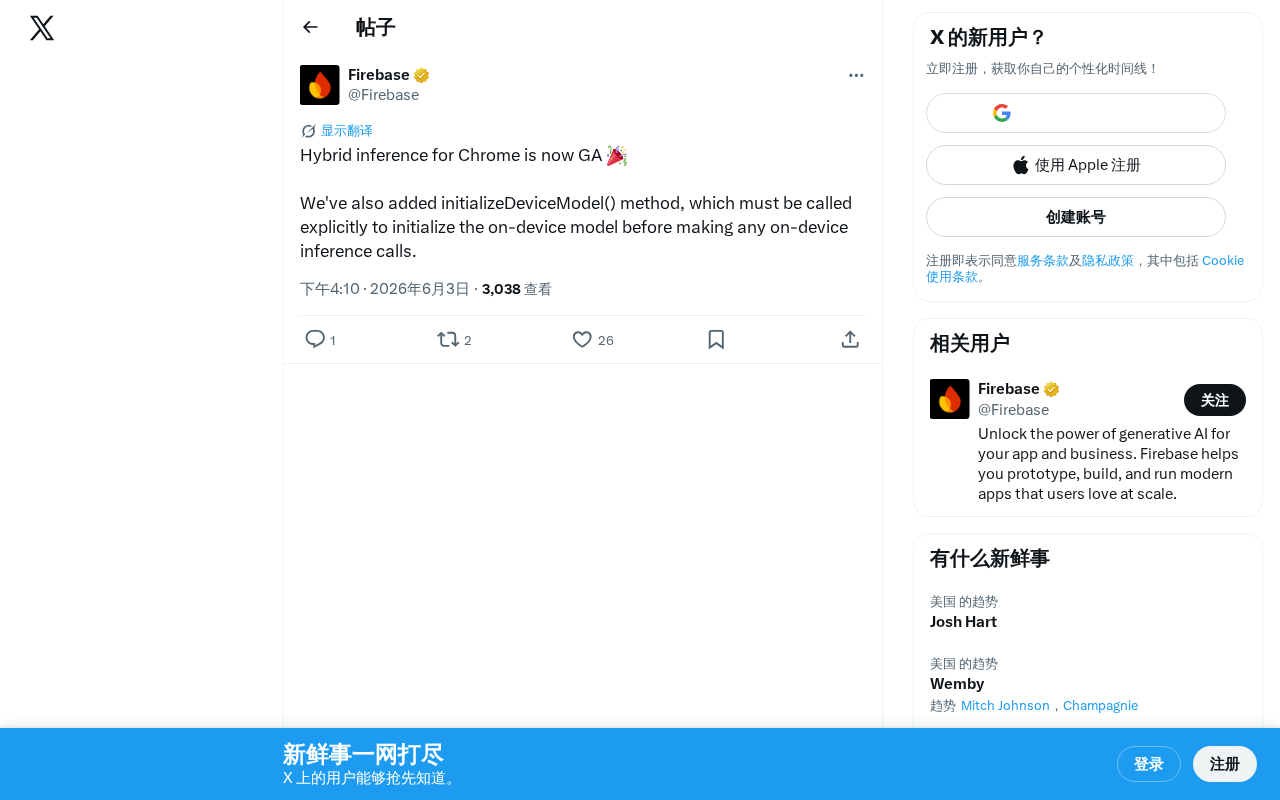
Chrome's Hybrid Inference hits GA, introducing mandatory initializeDeviceModel() for on-device AI.
Google Chrome's Hybrid Inference feature has officially reached General Availability, enabling developers to leverage both cloud and on-device AI models in production. The update introduces a new initializeDeviceModel() method that must be explicitly called before any on-device inference, representing a Breaking Change. This architecture balances performance, privacy, and offline availability while pushing forward web AI standardization.
Chrome Hybrid Inference Enters GA Stage
Google Chrome's Hybrid Inference feature has officially reached GA (General Availability), marking a significant milestone for browser-based AI inference capabilities.
The concept of Hybrid Inference originates from the technical paradigm of edge-cloud computing collaboration. In traditional Web AI applications, developers typically face a binary choice: either send data to the cloud for inference (high latency, greater privacy risks) or rely entirely on on-device models (model capabilities limited by local hardware). Hybrid Inference introduces an intelligent routing layer that dynamically determines where inference is executed based on factors like task complexity, network conditions, and privacy requirements. Chrome's implementation uses lightweight models like Gemini Nano as the on-device engine, while seamlessly switching to cloud-based models like Gemini Pro/Ultra for more demanding tasks, creating a complementary capability stack.
Hybrid Inference is a key component of Chrome's built-in AI capabilities, allowing developers to leverage both cloud and on-device AI models for inference within the browser. This architectural design balances performance, privacy, and offline availability, bringing more flexible AI integration options to web applications.
GA (General Availability) in the software release cycle means the product has passed internal testing (Alpha), public testing (Beta), and stability verification stages, providing reliability guarantees suitable for production deployment. Previously, Chrome's AI features went through an Origin Trial phase, limited to registered developers in controlled environments. Reaching GA means all Chrome users and developers can rely on these APIs in production, with Google committing to backward compatibility and SLA-level stability support.
New initializeDeviceModel() Method
Explicit Initialization Mechanism
In this update, the Chrome team introduced the initializeDeviceModel() method. This is a significant API change — developers must now explicitly call this method to initialize the on-device model before making any on-device inference calls.
The initialization process for on-device AI models involves multiple low-level steps: first checking whether model weight files have been downloaded locally (typically hundreds of MB to several GB), then loading the model into memory or GPU VRAM, followed by model graph compilation and optimization (such as operator fusion and quantized inference path selection). On devices supporting WebGPU, GPU compute pipelines also need to be created. This process can take anywhere from seconds to tens of seconds, so the explicit initialization design allows developers to front-load this overhead into time windows imperceptible to users, such as the idle phase of a Service Worker.
This design change reflects several important considerations:
- Resource management optimization: Loading and initializing on-device models requires local compute resources and memory. Explicit initialization gives developers precise control over when this process occurs
- Controllable user experience: Developers can trigger model initialization at appropriate moments (such as during user idle time or on first need), avoiding impact on page load performance
- Clearer error handling: Explicit calls make initialization failure scenarios easier to catch and handle
Impact on Developers
For developers already using Chrome's Hybrid Inference API, this means adding an initialization step to their code. Before calling any on-device inference interface, initializeDeviceModel() must be successfully called first. This is a Breaking Change, and existing code needs to be updated accordingly.
A Breaking Change is the most critical event for developers to watch during API evolution. On the web platform, the impact of Breaking Changes is particularly significant due to automatic browser updates — developers cannot control users' browser versions. The Chrome team typically provides a migration buffer period through a Deprecation Trial mechanism, during which the old API can still be used by registering a Token. For the introduction of initializeDeviceModel(), developers need to add asynchronous initialization logic and handle fallback strategies for initialization failures (such as falling back to pure cloud-based inference).
Technical Value and Use Cases of Hybrid Inference
The core advantage of the hybrid inference model lies in intelligently distributing inference tasks:
- Privacy-sensitive data can be processed entirely on-device without uploading to the cloud
- Complex tasks can leverage more powerful cloud-based models
- During network instability, automatic degradation to on-device models ensures continued functionality
On-device inference has inherent advantages in data privacy, aligning closely with data minimization principles in regulations like GDPR (General Data Protection Regulation) and CCPA (California Consumer Privacy Act). When sensitive data such as user-input text and images are processed entirely locally, there are no compliance risks associated with data transmission and cloud storage. This is particularly important for application scenarios with strict data sovereignty requirements, such as healthcare, financial services, and enterprise internal tools. Hybrid Inference allows developers to strictly limit PII (Personally Identifiable Information) processing to the device based on data classification policies.
With the GA release, developers can more confidently use this capability in production environments, delivering smarter web experiences to users.
Future Outlook for Native Browser AI Capabilities
The official release of Chrome Hybrid Inference is an important step in the development of native browser AI capabilities. It lowers the barrier for web developers to integrate AI while opening a standardized path for on-device AI applications. As more on-device models are supported and APIs are refined, we can expect more innovative browser AI use cases to emerge.
Notably, Chrome's initiative is also driving the evolution of web standards. The W3C Web Machine Learning Working Group is developing related standard proposals, and other browser vendors (such as Firefox and Safari) may implement similar hybrid inference capabilities in the future, forming a unified cross-browser API standard. This will further solidify the web platform's position as a distribution channel for AI applications, creating competitive dynamics with native apps in terms of AI capabilities.
Key Takeaways
Related articles

Claude Code for Test Development in Practice: An AI Programming Workflow That Doubles Your Efficiency
A practical guide to Claude Code for test development: auto-generating test scripts, Plan Mode workflows, MCP + Playwright integration, and Subagent parallel tasks to build systematic AI-assisted workflows.

Hermes Agent Hands-On Review: An AI Efficiency Revolution for Indie Game Developers
Indie game developer reviews Hermes Agent vs OpenClaude: intelligent context compression, real-time Memory, remote control via Telegram, and practical use cases in game dev, social media, and email.

Vibe Coding Beginner's Guide: Tool Selection Across Three Categories with Practical Examples
A comprehensive guide to Vibe Coding's three tool categories: Agent frameworks, CLI Coding, and IDE tools, with practical examples including Snake game and data analysis workbench.