Claude Code Artifacts Explained: How AI Programming Enables Team Collaboration
Claude Code Artifacts turns AI coding sessions into shareable interactive pages for whole-team collaboration.
Anthropic's new Artifacts feature for Claude Code transforms AI programming outputs into interactive, auto-updating webpages shareable via private links. Covering PR walkthroughs, project dashboards, incident postmortems, and UX prototypes, it bridges the gap between developers and non-technical team members. This signals a paradigm shift in AI programming tools—from individual code generation to team-wide collaboration infrastructure.
Anthropic recently launched a significant new feature for Claude Code—Artifacts. The core value of this feature isn't about making AI write better code, but about solving a long-overlooked problem: How can teams collectively understand what AI has done?
This marks AI programming tools' transition from "individual productivity" to "team collaboration infrastructure."
What Is Claude Code Artifacts?
To understand the significance of this feature, you first need to understand Claude Code itself. Claude Code is a terminal-based AI programming tool from Anthropic that lets developers converse directly with Claude in the command line—having it read codebases, write code, execute commands, and create and manage files. Unlike editor plugin-based AI tools, Claude Code is closer to an "AI programming agent"—it doesn't just complete code snippets but can understand entire project contexts and execute complex multi-step tasks. Anthropic, one of OpenAI's primary competitors, was founded by former OpenAI Research VP Dario Amodei, and its Claude model series has consistently been at the forefront of the industry in code generation and reasoning capabilities.
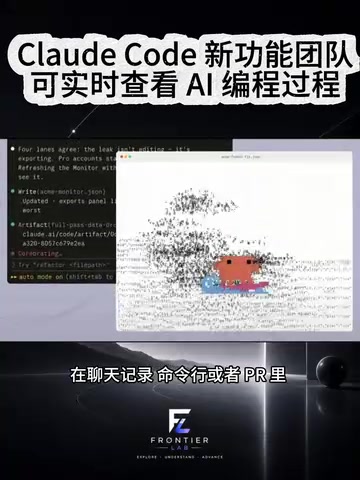
Previously, when AI wrote code, the output mostly remained in chat logs, terminal output, or Pull Requests. This content was reasonably clear for the developers themselves, but for other roles on the team—product managers, designers, project managers—it was essentially an information wall.
Now, Claude Code can generate an interactive webpage from the entire coding process. These pages cover a rich range of content:
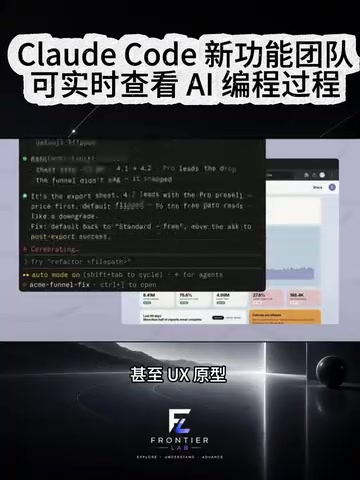
- PR Walkthroughs: Automatically generates visual explanations of code changes. Pull Requests (PRs) are one of the most core collaboration mechanisms in modern software development—after a developer completes a piece of code, they submit a PR requesting team review, which includes all code additions, deletions, and modifications. However, PRs are essentially technical documents aimed at developers, filled with diffs, commit messages, and other technical details that non-technical roles struggle to extract valuable information from. Artifacts' PR walkthrough feature essentially auto-generates a "plain language guide" for each PR, visually showing what the change does, why it was made, and which functional modules are affected.
- Project Dashboards: Real-time display of project progress and key metrics
- Incident Postmortems: Structured presentation of investigation and fix processes
- Version Comparisons: Clear display of differences between versions
- UX Prototypes: Rapid generation of interactive interface prototypes
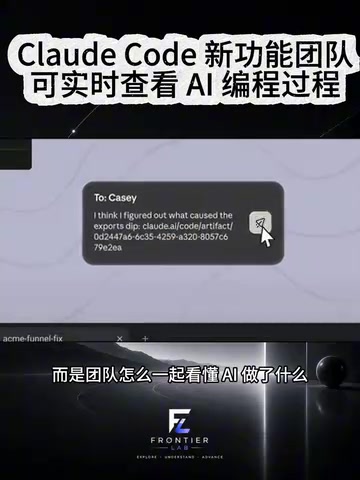
More critically, these pages can be shared directly with team members via a private link, without requiring them to install any tools or have a Claude account. This "zero-barrier sharing" design dramatically reduces collaboration friction—in traditional workflows, non-technical members who want to understand development progress often need to install specialized tools like GitHub or Jira, or wait for developers to manually compile and forward information.
A Real-Time Collaborative Space, Not a Static Report
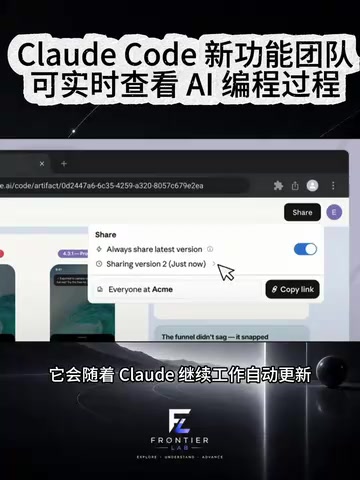
The biggest difference between Artifacts and traditional documents or reports is: It's not one-time static content, but a dynamic page that automatically updates as Claude continues working.
This means that when developers have Claude continuously iterate on code, team members can open the same link to see the latest progress. No need for repeated screenshots, weekly reports, or sync meetings—information flow becomes automated.
This design philosophy aligns with a trend: as AI takes on more and more execution work, humans' core responsibilities are shifting toward review, decision-making, and coordination. And to do these well, the prerequisite is that everyone can efficiently access contextual information. In software engineering, this problem has a dedicated term called "Context Switching Cost"—every time a developer is interrupted to explain progress or organize documentation, they need significant time to re-enter their coding flow state. Research shows it takes an average of 23 minutes to fully regain focus after a single interruption. Artifacts fundamentally reduces these unnecessary interruptions through automated information synchronization.
From Individual Productivity to Team Infrastructure: A Paradigm Shift in AI Programming
Looking back at the evolution of AI programming tools, a clear progression emerges:
Phase 1: Code Completion (e.g., GitHub Copilot)—helping developers type faster. GitHub Copilot launched in 2021, based on OpenAI's Codex model, and is essentially an "intelligent autocomplete" tool. It analyzes the current file's context and comments to predict what code the developer will write next and offers suggestions. AI programming tools at this stage were more like an advanced code snippet library, limited in scope to single files or even single lines of code.
Phase 2: Conversational Programming (e.g., Cursor, Claude Code)—helping developers think faster. Tools at this stage achieved a qualitative leap: AI no longer just completes code but can understand the entire codebase structure, engage in multi-turn conversations with developers, and execute complex cross-file refactoring. Cursor is an AI editor based on VS Code that deeply integrates large language models into the editor; Claude Code takes the terminal Agent route. The common characteristic of these tools is upgrading AI from "input assistance" to "programming partner," though interaction remains one-on-one.
Phase 3: Collaborative AI Programming (e.g., Artifacts)—letting the entire team participate in the process and results of AI programming
Previously, AI programming was more like one person being productive in a terminal—a "private conversation" between developer and AI. But software development has never been a solo endeavor—it involves requirements understanding, architecture design, code implementation, test verification, deployment and operations, and many other phases requiring coordination across multiple roles.
In actual R&D teams, information asymmetry is a long-standing and costly problem. Product managers aren't sure if features are implemented as expected and can only verify after deployment to test environments; designers can't see how their mockups are being translated in a timely manner, stretching feedback cycles to days or even weeks; managers rely on weekly standups or reports for project progress updates, with severely lagging information. According to a 2023 Stripe survey, developers spend less than 30% of their time actually writing code on average, with the rest consumed by communication, meetings, and documentation.
The emergence of Artifacts essentially opens a window facing non-technical roles in the AI programming workflow:
- For developers: It's a context record and work log, convenient for retrospection and handoffs
- For product managers: It's a visual progress report—no more chasing developers asking "how far along are we?"
- For designers: It can directly showcase UX prototypes, shortening the design-to-implementation feedback loop
- For managers: It's a transparent project board, reducing information asymmetry
Implications for the Industry
The launch of this feature sends a clear signal: Competition among AI programming tools is shifting from "whose model is stronger" to "whose collaboration experience is better."
As code generation capabilities gradually converge, true differentiation will manifest in workflow integration and team collaboration. Anthropic's decision to push in this direction shows they've already realized: enterprise customers don't buy AI programming tools just to make individual developers write code faster—they want to elevate the efficiency of their entire R&D organization.
From an enterprise procurement perspective, selecting AI programming tools is becoming increasingly complex. Early on, enterprises only needed to evaluate model code generation quality and response speed; now, selection criteria have expanded to include security compliance (whether code might leak externally), private deployment capabilities, integration depth with existing DevOps toolchains, team management and permission controls, and now the cross-role collaboration capabilities that Artifacts represents. Gartner noted in a 2024 report that by 2028, 75% of enterprise software engineers will use AI programming assistants, and the top three factors enterprises prioritize in selection are: security, team collaboration capabilities, and model performance. Collaboration capability has already surpassed model performance itself as a metric enterprises value more.
It's foreseeable that other AI programming tools will follow with similar collaboration features. And for teams currently evaluating AI programming tools, beyond focusing on model capabilities, whether team-level visibility and collaboration are supported will become an increasingly important selection criterion.
The second half of AI programming isn't just about writing code—it's about redefining how teams collaborate around AI output.
Related articles
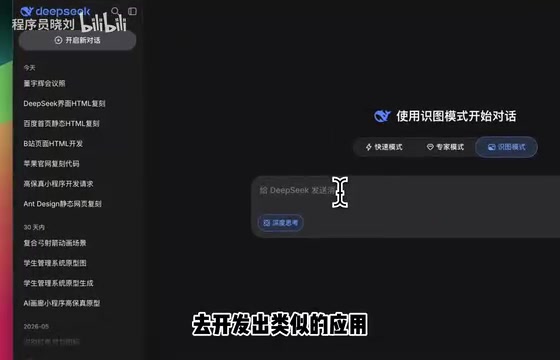
DeepSeek Image Recognition Mode Tested: Screenshot-to-Code Achieves Up to 80% Accuracy
Hands-on testing of DeepSeek's image recognition mode for screenshot-to-code, covering Ant Design, Baidu, Bilibili, and Apple websites with ~80% accuracy.
Elastic Acquires Deductive AI for $85M, Accelerating the AI-Powered Debugging Market
Elastic acquires AI debugging startup Deductive AI for up to $85M, boosting its observability and security platform. Analysis of the deal's strategy, competitive landscape, and industry impact.
Baseten Raises $1.5 Billion: Why AI Inference Infrastructure Has Become a Capital Darling
AI inference startup Baseten is raising $1.5B at a $130B valuation. We analyze why inference infrastructure is booming, the competitive landscape, and what this mega-round signals.