Claude Code Chinese Tutorial: A 100-Page Systematic Learning Guide on Feishu Docs

A 100-page Feishu Docs guide offers Chinese learners a systematic path to mastering Claude Code's AI agent capabilities.
This article examines a 100-page Chinese tutorial on Feishu Docs for learning Claude Code, Anthropic's command-line AI programming agent. It covers the document's core topics including AI autonomous learning, intelligent memory systems, and task decomposition, while providing a rational assessment of its value and limitations alongside practical learning advice.
Common Pain Points When Learning Claude Code
As Claude Code (also known as Hermes) continues to gain massive popularity in the AI programming space, more and more developers and AI enthusiasts in China are eager to deeply learn this powerful autonomous AI agent. However, learners commonly face several core challenges: official documentation is in English, knowledge points are scattered, underlying logic is hard to grasp, and there's a lack of systematic learning paths.
Claude Code is a command-line AI programming agent developed by Anthropic, built on the Claude large language model. It can directly understand codebases, perform file operations, run commands, and carry out multi-step autonomous programming tasks within a terminal environment. Unlike traditional AI code completion tools (such as GitHub Copilot), Claude Code possesses stronger autonomy — it can not only generate code snippets but also understand entire project structures, autonomously plan task steps, execute system commands, and iteratively correct based on execution results. "Hermes" was its internal codename during early development, and some community members still use this name.
Recently, a Bilibili content creator shared a Chinese learning resource hosted on Feishu Docs, claiming to be a 100-page systematic tutorial covering everything from basic concepts to advanced practice. This article analyzes the value of such Chinese learning resources and provides practical advice for readers who want to learn Claude Code.
Core Content Covered in the Chinese Documentation
AI Autonomous Learning and Intelligent Memory Mechanisms
According to the documentation, it focuses on breaking down several core capabilities of Claude Code as an AI agent:
- Self-learning mechanism: How the agent accumulates experience during interactions
- Intelligent memory system: How it maintains context, remembers project structure and user preferences
- Automatic task decomposition: The ability to break complex requirements into executable steps
- Autonomous iterative evolution: Continuously optimizing output quality based on feedback
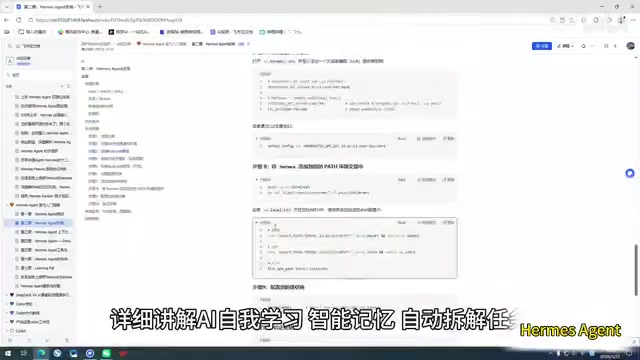
To understand these capabilities, you first need to grasp the core concept of AI Agents. An AI agent refers to an AI system capable of perceiving its environment, making autonomous decisions, and executing actions — going beyond the traditional "input-output" conversational mode. A complete AI agent typically contains four core components: a perception module (understanding user intent and environmental state), a planning module (decomposing goals into subtasks), an execution module (calling tools to complete specific operations), and a memory module (maintaining context and historical information). Claude Code is a textbook implementation of this Agent architecture — it can read file systems, understand code dependencies, invoke terminal commands, and dynamically adjust subsequent strategies based on execution results, forming a complete "perceive-think-act" loop.
Regarding the memory system, Claude Code's implementation involves multiple layers of context management mechanisms. Large language models themselves are limited by context window length, so agents need external memory mechanisms to extend their "memory capacity." Claude Code achieves project-level persistent memory through CLAUDE.md files, where users can record project specifications, coding style preferences, and architectural decisions. Additionally, it uses conversation context to maintain short-term working memory and leverages file system read/write operations to achieve "long-term memory" of project state. This layered memory architecture enables the agent to maintain consistency throughout extended programming sessions.
These capabilities are precisely what distinguish Claude Code from ordinary AI conversation tools. Understanding these underlying principles helps users collaborate more efficiently with Claude Code and write more precise instructions.
A Complete Learning Path from Beginner to Advanced
The documentation adopts a progressive structure:
- Basic cognitive layer: Understanding what Claude Code is, what it can do, and which scenarios it's suited for
- Core feature analysis: Deep understanding of how each feature works
- Advanced thinking layer: Mastering efficient usage mindsets and methodologies
- Practical application layer: Demonstrating actual workflows with specific case studies

This structured learning approach is indeed more effective at building a complete knowledge system compared to watching scattered tutorial videos.
Rational Assessment: Value and Limitations of the Learning Resource
What's Worth Affirming
For learners with limited English reading ability, a well-structured document written in plain Chinese can significantly lower the barrier to entry. Translating complex agent principles into easily understandable explanations is valuable work in itself.

Issues to Be Aware Of
However, learners should maintain rational judgment:
- Timeliness issues: Claude Code updates rapidly, and any static document may quickly become outdated
- Accuracy verification: Community-compiled documents may not be officially reviewed — cross-reference with official English documentation is recommended
- Practice is king: No document can replace hands-on practice — learn by doing
- Access method: This resource is obtained through comment section interaction, a common community distribution model
It's worth noting that the AI programming tool space where Claude Code operates is intensely competitive. Major competitors include: GitHub Copilot (backed by Microsoft/OpenAI, focusing on code completion and Chat mode), Cursor (an AI-first editor based on VS Code), Windsurf (formerly Codeium, emphasizing Agent capabilities), and Devin (claiming to be the first AI software engineer). Claude Code's differentiated advantage lies in its command-line native design philosophy — it doesn't depend on any specific IDE and can run in any terminal environment, making it particularly suitable for DevOps, system administration, and complex project refactoring scenarios. Meanwhile, the Claude model's inherent strengths in code comprehension and long-text processing provide underlying advantages. Understanding this competitive landscape helps learners better judge Claude Code's applicable scenarios and learning priorities.
Practical Advice for Efficiently Learning Claude Code
For readers who want to systematically learn Claude Code, here's the recommended learning path:
Step 1: Build foundational understanding. Whether through Chinese documentation or official English docs, first understand Claude Code's positioning and core concepts.
Step 2: Set up a practice environment. Start hands-on work as early as possible — use Claude Code in real projects, even if you begin with simple code generation.
Step 3: Deeply understand Prompt engineering. Claude Code's effectiveness largely depends on how you communicate with it — learning to write good instructions is key. In agent scenarios like Claude Code, Prompt engineering differs significantly from ordinary conversation scenarios. Traditional Prompt optimization mainly focuses on single-turn output quality, while Prompts in Agent scenarios need to consider multi-step task planning guidance, tool-calling accuracy, and error recovery strategies. Effective Claude Code instructions typically contain three elements: a clear goal description (what to do), constraints (what not to do, what standards to follow), and verification criteria (how to determine task completion). Mastering this structured instruction-writing approach can significantly improve the agent's task completion rate and output quality.
Step 4: Join community discussions. Follow relevant technical communities and forums to exchange experiences and tips with other users.
Conclusion
The Claude Code Chinese learning documentation on Feishu provides domestic learners with a relatively systematic entry point. In today's era of rapidly iterating AI tools, quickly mastering how to use such tools is indeed a skill worth investing in. But remember, any document is just a starting point for learning — true capability improvement comes from continuous practice and reflection.
Key Takeaways
Related articles
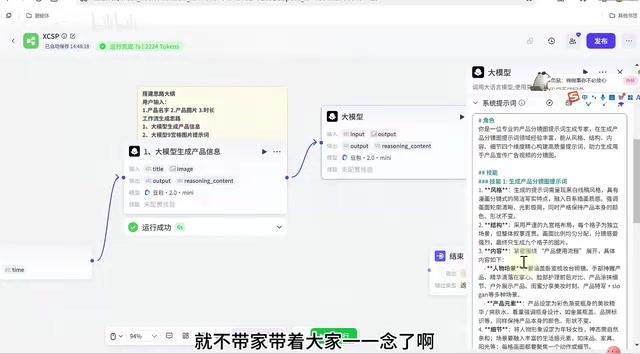
Coze Workflow in Practice: Complete Tutorial for AI One-Click Product Promo Video Generation
Step-by-step guide to building a Coze workflow for AI product promo videos, integrating HappyHours and Jimeng across 12 nodes with nine-grid storyboards and polling loops.
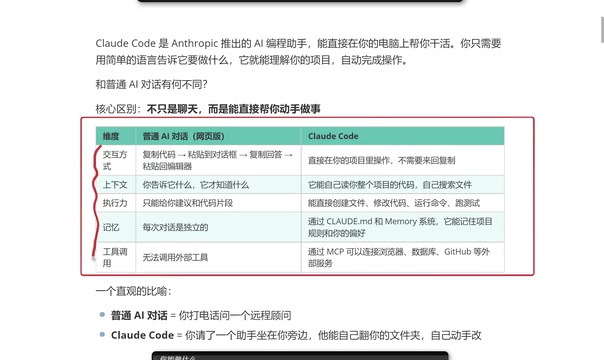
Getting Started with Claude Code: 5 Key Differences from Traditional AI Chatbots
Explore 5 key differences between Claude Code and traditional AI chatbots like ChatGPT, covering interaction, context, execution, memory, and tool integration.

Your Pension Forced to Buy AI Bubble Stocks: The Truth Behind Nasdaq's Rule Changes
Nasdaq's fast-track rule changes may force your 401K and pension funds to buy SpaceX, OpenAI, and Anthropic stock. Analysis of the $4T valuation bubble and what investors can do.