Claude Code Practical Course Breakdown: From AI Programming Methodology to Autonomous Agent Building

A Claude Code course teaching AI programming methodology for building trustworthy autonomous coding agents.
This Claude Code practical course goes beyond tool tutorials to teach AI programming methodology. It covers building autonomous AFK Agents, optimizing codebases for AI, establishing feedback loops as guardrails, and using PRDs with multi-stage Kanban Boards for unsupervised AI work. The course emphasizes that engineering fundamentals—not prompting tricks—are the real bottleneck in AI programming efficiency.
Not Just a Tool Tutorial — It's an AI Programming Methodology
This practical Claude Code course, created by a seasoned developer, makes a crucial distinction right from the start: This is not a Claude Code tool tutorial — it's an AI programming course.
The course author candidly acknowledges that despite the impressive capabilities of AI coding tools, many developers feel confused in actual use — "I can only sit there watching the AI work, and it actually feels less efficient." This pain point reveals the core contradiction in current AI programming: tools are evolving, but the methodology for using them hasn't kept pace.
The ultimate goal of the course is crystal clear — to make Claude Code a trustworthy autonomous Agent that can independently complete high-quality coding work while you're AFK (Away From Keyboard). This Agent differs from inline code completion tools like GitHub Copilot — it's an autonomous system with a complete capability loop encompassing task understanding, code generation, self-verification, and error correction. Claude Code, Anthropic's command-line AI coding tool, can directly read project files, execute terminal commands, run tests, and autonomously fix code based on test results. The key to achieving reliable AFK operation lies in building sufficient "guardrails" for the Agent, ensuring AI maintains output quality even without human supervision.
This means you can truly achieve "parallelized" development — letting AI work continuously in the background while you focus on higher-level architectural decisions and product thinking.
Real Engineering Skills: A Conversion Course for the AI Era
The core philosophy the course emphasizes is: While the tools have changed, the fundamental engineering methodology hasn't. For developers who already possess solid engineering skills, this course serves as a "conversion course" — helping you adapt existing engineering expertise to the AI toolchain.
A Conversion Course is a well-established concept in higher education, first widely adopted in the UK university system. It refers to intensive programs that help professionals with expertise in one domain quickly transition to an adjacent field. In the AI programming context, this concept is cleverly borrowed: senior developers already possess core engineering capabilities like requirements analysis, architecture design, and code review. What they lack isn't learning from scratch, but rather "translating" these abilities into the new paradigm of human-AI collaboration.
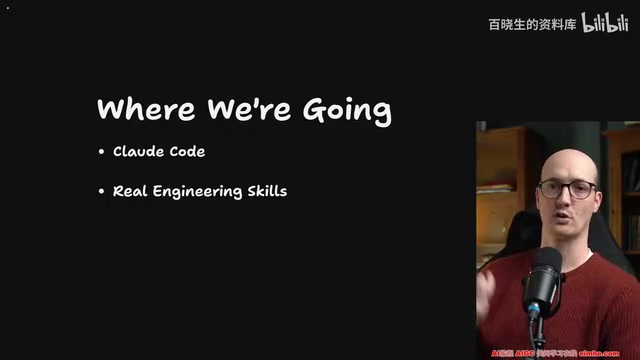
The engineering practices covered in the course include:
- Planning: How to create reasonable work plans for AI programming
- Requirements Gathering: Clear requirements are the prerequisite for efficient AI execution
- Prototyping: The right approach to quickly validating ideas
- Codebase Structure Optimization: Making your codebase AI-friendly to maximize the value of feedback loops
- Multi-stage Kanban Management: Building PRDs and Kanban Boards that allow AI to work unsupervised for hours
Among these, PRD (Product Requirements Document) and Kanban Board take on entirely new significance in the AI programming context. PRDs define detailed requirements, acceptance criteria, and priorities for product features, while Kanban Boards manage development progress through visual task cards and workflow columns (such as To Do, In Progress, Done). In traditional development, they serve as communication vehicles between people; in AI programming, they become the "contract" between humans and AI. Structured PRDs provide AI with clear task boundaries and acceptance criteria, while multi-stage Kanban Boards decompose complex projects into atomic tasks that AI can tackle one by one, enabling AI to autonomously complete multiple tasks in sequence and achieve hours of unsupervised work.
For developers who haven't yet established systematic engineering thinking, this content is equally valuable. AI programming doesn't mean you can skip engineering fundamentals — quite the opposite: the more powerful AI becomes, the higher the demands on engineering standards.
Why Is Your AI Programming Efficiency Low?
The course directly addresses a common phenomenon: many people complain that AI programming makes them less efficient, forcing them to watch AI's output the entire time. The author pinpoints the issue — the problem isn't the AI; it's that your codebase and development environment aren't prepared for AI's autonomous operation.
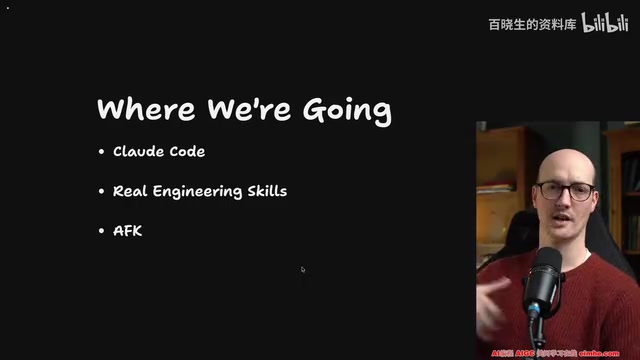
This is a profoundly insightful observation. To ensure Claude Code maintains output quality in AFK mode, you need the following preparations:
- A structured codebase: AI needs clear code organization to understand context
- Robust feedback mechanisms: Tests, type checking, linting, and other automation tools form AI's "guardrails"
- Clear task definitions: Through PRDs and planning documents, let AI know "what to do" and "how to do it"
- Reasonable human-AI division of labor: Knowing when human intervention is needed, such as during prototyping and technical research phases
The feedback mechanism here deserves deeper understanding. A Feedback Loop is a core concept in cybernetics and software engineering, referring to the process where system output is fed back into the system to regulate subsequent behavior. In the AI programming context, TypeScript's static type checking catches type errors at compile time, ESLint and other linting tools detect code style issues and potential bugs, and comprehensive test suites (unit tests, integration tests) provide validation of functional correctness. Together, these tools form AI's "guardrail system" — when AI-generated code fails these checks, it can automatically receive error information and make corrections, forming an autonomous "generate-verify-fix" loop. Without these guardrails, AI is like walking along a cliff edge without a fence — output quality becomes completely unpredictable.
In other words, making your codebase an environment where AI thrives is more about the code itself than about the AI. This perspective overturns many people's assumption that "good prompts are all you need."
Practice-Driven: A 20,000-Line TypeScript Project as Your Playground
The course provides a practical project of approximately 20,000 lines of code as a playground, built with TypeScript + React + Node. However, the author specifically emphasizes that you don't need to be proficient in this tech stack to keep up with the course, since AI handles most of the code writing.
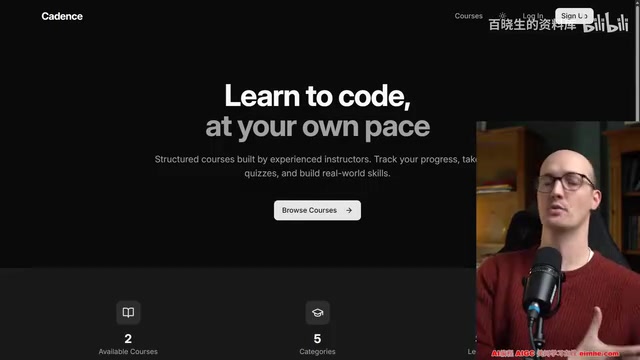
More importantly, all AI programming methodologies learned in the course can be transferred to any language and any project. You can skip the playground entirely and practice these exercises directly on your own codebase. This design reflects the course's essence — it teaches the paradigm of collaborating with AI, not operations specific to a particular tech stack.
The Ultimate Course Outcome: A Trustworthy AFK Agent
Upon completing the course, students will possess the following core capabilities:
- Mastery of all Claude Code features, becoming an expert tool user
- Building autonomously running AI Agents that enable AFK programming in your own codebase
- Achieving parallelized development efficiency, effectively "cloning" yourself through Claude to handle multiple tasks
- Precisely judging when human intervention is needed, leveraging human advantages at critical junctures like prototyping and technical research
- Creating systematic AI work plans, including PRD writing and multi-stage Kanban Board management
Among these, parallelized development is one of the most transformative capabilities that AI programming brings. Borrowing the concept of parallel computing from computer science, it refers to developers simultaneously launching multiple AI Agent instances, each handling different independent tasks. For example, one Agent implements a user authentication module, another simultaneously works on a data visualization component, while the developer focuses on system architecture design or communicating requirements with stakeholders. Claude Code supports running multiple sessions simultaneously in multiple terminal windows, with each session working independently on different Git branches. This model fundamentally changes the developer's role — from "code writer" to "tech lead of an AI team," with core work shifting to task decomposition, priority setting, code review, and architectural decisions. This further confirms why the course places such emphasis on engineering methodology: managing multiple AI Agents requires stronger engineering planning skills than writing code yourself.
Final Thoughts
The value of this course lies not only in teaching you how to use Claude Code, but in proposing a core thesis for the AI programming era: Engineering capability is the real bottleneck in AI programming. While everyone chases the latest models and tools, returning to engineering fundamentals, optimizing codebase structure, and establishing systematic AI collaboration workflows are what truly create the competitive edge.
For developers who want to seriously improve their AI programming capabilities, this "methodology-first" course design philosophy is worth exploring in depth. After all, tools will keep iterating, but good engineering practices never go out of style.
Related articles
Anjney Midha: The Rise from Singapore to Helm of a16z's AI Investment Empire
Deep dive into Anjney Midha, the key figure behind a16z's AMP fund, covering investments in Anthropic, Mistral, and Black Forest Labs, and his Outputmaxxing philosophy.
Pi: A Lightweight AI Coding Agent Framework — Setup & Hands-On Guide
A deep dive into Pi, a minimalist AI coding Agent framework covering multi-model support, extensions, skill loading, and hands-on custom extension building with model mixing strategies.

Why the Mayor of Los Angeles Has No Real Power: A City Designed to Be the Anti-New York
Why does LA's mayor seem powerless during crises like wildfires? It's not about competence — it's a century-old system designed to prevent corruption by radically decentralizing power.