Claude Code Source Code Study Guide: Efficiently Mastering Core AI Agent Development Architecture
Claude Code Source Code Study Guide: E…
A systematic approach to learning AI Agent core design and implementation from Claude Code source code.
This article explains how to efficiently study Claude Code's 510,000 lines of source code, recommending the Node version with source-level documentation. It focuses on mastering Agent Loop and context compression, Hooks/MCP/Skill extension mechanisms, and Orchestrator pattern multi-Agent orchestration. Two learning paths are proposed—documentation-driven and interactive Skill exploration—with the goal of understanding architectural design to quickly build your own Agent system using AI tools.
Introduction: The Real Value of the Claude Code Source Leak
After the Claude Code source code was leaked, the greatest value for developers isn't the code itself—it's that it represents the best AI Agent implementation in the world today, bar none. If you're interested in Agent development, this is the best learning sample and opportunity available.
However, facing 510,000 lines of code, most people feel overwhelmed. This article shares a systematic approach to learning Claude Code, helping you quickly grasp the core design principles and implementation details of AI Agents from the source code.
Version Selection: Why the Node Version with Documentation Is Recommended
Claude Code currently has multiple variant versions: a Python version, a Rust version, and the native Node version. With so many choices, beginners often don't know where to start.
The recommendation is to choose the version with complete source-level documentation. This documentation isn't just simple API descriptions—it's line-by-line code analysis that can answer all your questions about implementation details. For example:
- Agent Loop core cycle: Which line of code starts execution and how the loop works
- Orchestrator pattern: The mechanisms and implementation of multi-Agent orchestration
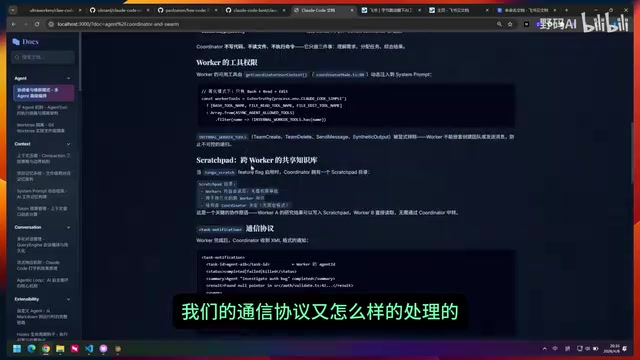
- Communication protocols: How Agents communicate and collaborate
- Multi-Agent call chains: The complete flow from initiation to completion
Core Learning Content: The Technical Essence of Claude Code
Agent Loop and Context Compression Mechanisms
Understanding the Theoretical Foundation of Agent Loop
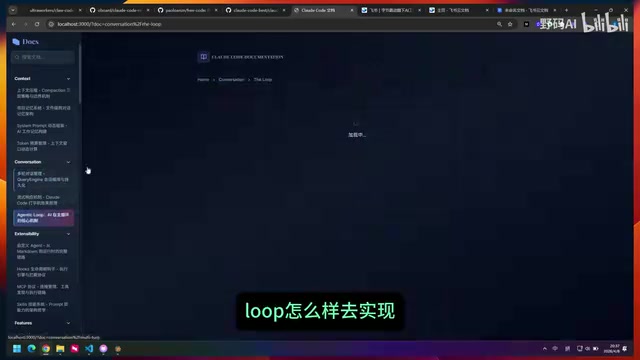
An AI Agent is an AI system capable of autonomously perceiving its environment, formulating plans, and executing actions to accomplish goals. Unlike traditional single-turn Q&A-style LLM calls, Agents have the ability to execute in continuous loops—this is the core of the Agent Loop. Agent Loops typically follow the ReAct (Reasoning + Acting) paradigm of "Perceive → Think → Act → Observe": after receiving input, the model generates reasoning steps, calls tools to execute actions, then incorporates tool results back into the context to continue reasoning until the task is complete. Claude Code's Agent Loop implementation is considered one of the most engineering-mature open-source references available, with its loop control, exception handling, and state management details being extremely valuable for developers.
Why Context Compression Is So Critical
A large language model's Context Window is a finite resource. Taking the Claude 3 series as an example, although it supports 200K Token ultra-long contexts, in actual Agent tasks, as multi-turn tool calls and conversations accumulate, the context rapidly expands, causing inference costs to rise exponentially, response latency to increase, and even triggering the "Lost in the Middle" problem—where the model's attention to information in the middle of the context drops significantly. Context compression techniques use strategies like summarization, selective retention, and hierarchical memory to dramatically reduce Token consumption while preserving key information.
Context compression is one of the areas where Claude Code excels most. The source code demonstrates multiple compression strategies:
- Local compression (micro-compression): Fine-grained compression targeting specific conversation segments—not crude history truncation, but differential compression granularity based on the importance of different conversation segments
- Memory system handling: How to combine long-term memory with current context
- Token management: How to write prompts that are more Token-efficient
- Multi-turn conversation management: How to maintain conversation quality within a limited context window
These all belong to the core content within the "Harness" conceptual framework, and understanding them is crucial for building your own Agent.
Hooks, MCP Protocol, and Skill System
MCP Protocol: An Open Standard for Solving Tool Integration Fragmentation
MCP (Model Context Protocol) is an open standard protocol released by Anthropic in late 2024, designed to solve the fragmentation problem of integrating AI models with external data sources and tools. Before MCP, every AI application needed custom integration code for different tools (databases, APIs, file systems, etc.), making maintenance costs extremely high. MCP draws on the design philosophy of the Language Server Protocol (LSP), defining a standardized client-server communication specification: MCP Servers expose Resources, Tools, and Prompts, while MCP Clients (i.e., AI applications) call these capabilities through a unified interface. As an important reference implementation of MCP, Claude Code's source code demonstrates complete implementation details including protocol handshake, capability negotiation, and streaming responses.
Hooks and Skills: The Foundation of Extensible Agent Architecture
The Hooks system is a classic event-driven extension mechanism in software engineering, widely used in React frameworks, Git workflows, and WordPress plugin systems. In the AI Agent context, Hooks allow developers to inject custom logic at critical points in Agent execution (such as before/after tool calls, at the start/end of conversation turns, when errors occur) without modifying core code. The Skill system is the concrete implementation of Agent capability modularization—each Skill encapsulates domain-specific knowledge, tool-calling logic, and execution strategies that can be loaded and combined on demand, embodying the design principle of "composition over inheritance."
The source code provides detailed demonstrations of Claude Code's extension mechanisms:
- Hooks system: Registration and triggering mechanisms for event hooks
- MCP (Model Context Protocol): Complete implementation of the Model Context Protocol
- Skill system: Loading and execution logic for skill modules
Orchestrator Pattern: The Core Architecture for Multi-Agent Orchestration
The Orchestrator Pattern is one of the core architectural patterns in multi-Agent systems. In this pattern, a master Agent (Orchestrator) is responsible for task decomposition, sub-Agent scheduling, and result aggregation, while multiple specialized sub-Agents (Worker Agents) each handle execution tasks in specific domains. This is similar to the API Gateway pattern in microservice architecture, but the Agent version places more emphasis on dynamic task planning and context sharing.
The corresponding alternative is the "Pipeline" pattern, where Agents process and pass results sequentially. Claude Code uses the Orchestrator pattern to handle complex programming tasks: the main Agent is responsible for understanding requirements and planning steps, while sub-Agents handle specific tasks like code generation, test execution, and file operations respectively. Understanding this pattern is a key prerequisite for building multi-Agent systems capable of handling complex tasks.
Hidden Features: WaterDream and Pet Sprites
The source code also contains some undisclosed internal features that are very inspiring for understanding Agent design philosophy:
- WaterDream automatic memory: The ability to automatically organize and summarize user memories every night
- Pet Sprite system: An interesting interactive Agent subsystem
- Computer Use: Implementation of computer operation capabilities
- Cloud assistant: A cloud-based Agent system that runs continuously in the background
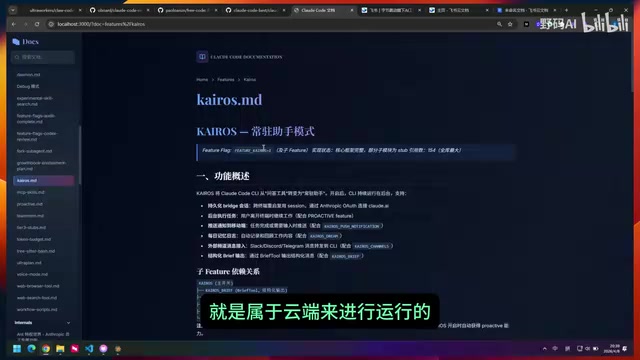
If you only want to build an electronic pet system, you just need to implement an Agent Loop plus the pet system module to create an entirely new Agent application.
Practical Learning Methods: Two Efficient Source Code Study Paths
Method 1: Documentation-Driven Learning
The most direct approach is to understand the overall flow through documentation:
- Start with flowcharts and data flow diagrams to understand the overall architecture
- You don't need to read code line by line—get the concepts clear first
- For unclear details, dive deeper into the code
- Use search functionality to quickly locate modules you want to learn about (such as the memory system)—the documentation annotates specific code line numbers
Method 2: Interactive Exploration with a Universal Skill
This is a more efficient learning approach—using a universal Skill to have a conversation with the codebase. Thanks to Claude Code's Skill system and its modular "composition over inheritance" design, this Skill can:
- Be placed in any codebase for execution
- Be set as a global Skill, usable in any project
- Answer any questions about architectural design and code implementation
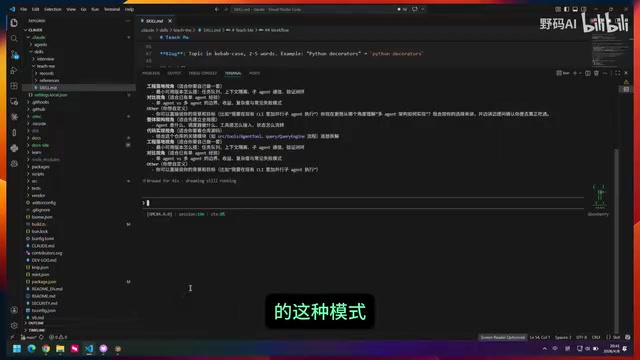
For example, you can ask "What is the overall architecture of this system?" and it will explain from a system architecture perspective what the Agent is, what scheduling is, and how various modules collaborate.
Even more powerful, it supports a beginner mode:
- Tell it you're a beginner
- It will ask questions based on your level
- Based on your answers, it assesses your understanding
- Combined with the codebase content, it provides the most suitable learning path for you
- Finally, it can test your understanding of the project
From Learning to Practice: Building Your Own AI Agent
By combining both approaches above, you can:
- Understand core architecture: Agent Loop, scheduling systems, memory management
- Master design patterns: Orchestrator pattern, multi-Agent orchestration, Tool Use execution—where Tool Use's theoretical foundation comes from the ReAct paradigm, alternating between "chain-of-thought reasoning" and "action instructions" to let the model both reason logically and interact with external environments for real-time information
- Validate learning outcomes: Verify depth of understanding through interactive Q&A
- Quickly reproduce implementations: Re-implement what you've learned in your preferred programming language using AI
Ultimately, you don't need to hand-write all the code—you just need to understand module decomposition, decision patterns, and core logic, and AI can help you build an Agent system tailored to your needs.
Conclusion
The Claude Code source code is currently the best textbook for learning AI Agent development. The key isn't reading 510,000 lines of code line by line, but mastering the right learning methods: documentation-driven understanding of the big picture, Skill-based interaction for diving into details, and ultimately transforming knowledge into your own Agent implementation. This learning path of "understand the design → validate cognition → hands-on practice" is far more efficient than blindly reading source code.
Related articles
 Tutorials
Cursor + Codex Dual-IDE Collaboration: A Practical Methodology for Open-Source Project Customization
A complete methodology for open-source project customization based on real-world experience, detailing the Cursor+Codex dual-IDE workflow, seven-stage process, MVP validation, and AI source code reading techniques.
 Tutorials
Cursor Multi-Agent in Practice: Building a Full-Stack Next.js Blog in 50 Minutes
Build a full-stack blog in 50 minutes using Cursor IDE's multi-Agent mode with Next.js, Clerk auth, and Supabase. Learn the 4-phase AI Agent workflow and key integration pitfalls.
 Tutorials
Building an AI Software Factory from Scratch: A Cursor Engineer's Hands-On Experience with Multi-Agent Collaboration
Cursor engineer Eric shares practical insights on building an AI software factory: automation levels, guardrail design, parallel Agent management, and scaling to 1000+ Agents for 24/7 development.