Claude Cowork Usage Limits Doubled: Anthropic Temporarily Boosts AI Collaboration Capacity

Anthropic doubles Claude Cowork usage limits for one month to boost AI collaboration capacity.
Anthropic has announced that Claude Cowork's usage limits will be doubled for one month, allowing users to delegate larger and more complex tasks to Claude's autonomous Agent mode. This move serves as both a stress test and a growth strategy in the increasingly competitive AI Agent market, where Anthropic differentiates through its safety-first approach to autonomous AI execution.
Claude Cowork Gets a Major Update: Usage Limits Doubled for One Month
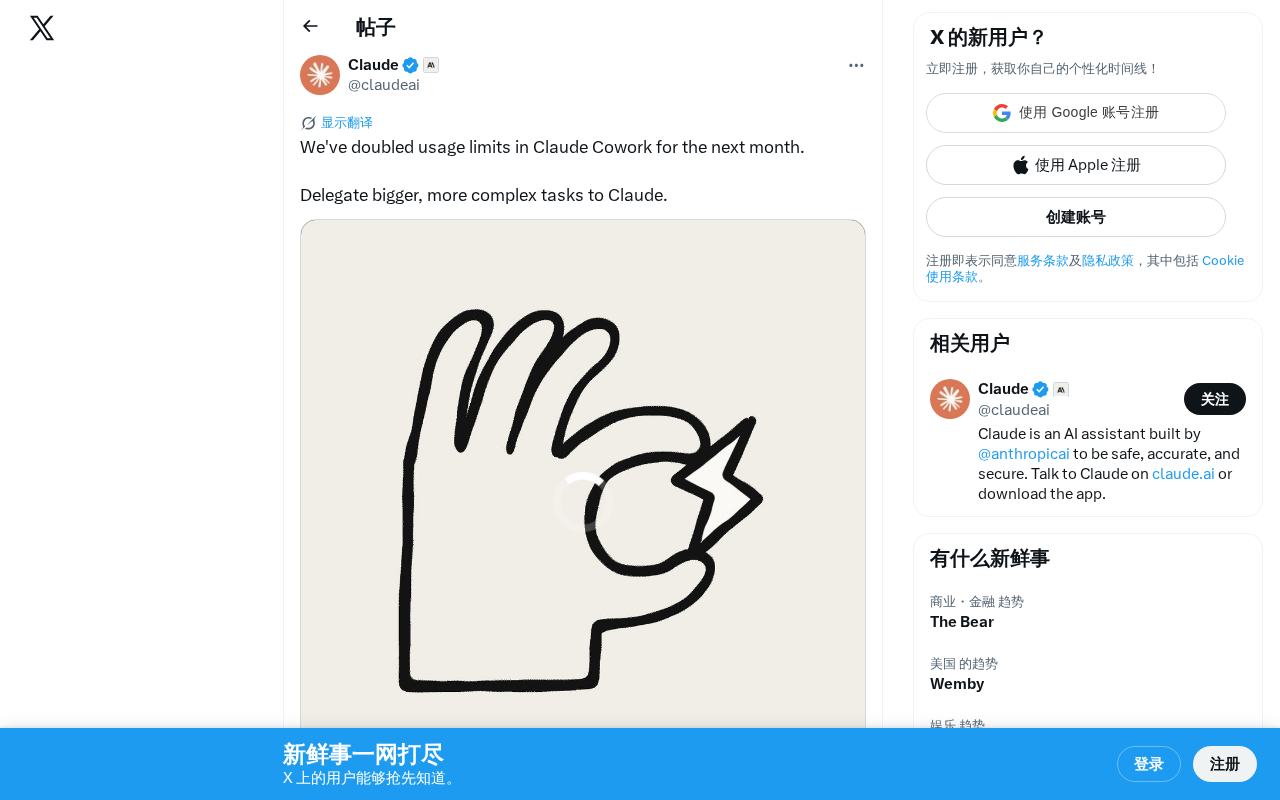
Anthropic recently announced on their official Twitter that Claude Cowork's usage limits will be doubled for the next month. This means users can delegate larger-scale, more complex tasks to Claude for completion.
What Is Claude Cowork?
Claude Cowork is a collaborative work mode launched by Anthropic that allows users to delegate complex tasks directly to Claude for autonomous processing. Unlike traditional conversational interactions, Claude in Cowork mode can independently handle longer, more complex workflows—functioning more like an AI collaboration partner rather than a simple Q&A tool.
From a technical perspective, Claude Cowork essentially falls within the AI Agent product category. Traditional large language model interactions involve single-turn or multi-turn conversations where users need to guide the AI step by step to complete tasks. Agent mode, however, grants AI greater autonomy—it can independently plan task steps, invoke tools, read and write files, execute code, and autonomously adjust strategies when encountering problems. This shift from "conversational assistant" to "autonomous executor" represents a critical step in AI applications evolving from assistive tools to collaborative partners. Anthropic's positioning in this space is closely tied to its Constitutional AI safety philosophy—granting AI greater autonomy while ensuring controllable behavior through built-in safety constraints.
The core value of this feature lies in freeing users from tedious task execution, allowing them to focus their energy on decision-making and creative work while delegating execution-level tasks to AI.
What Does Doubled Usage Mean?
Greater Task Processing Capacity
"Usage limits" in AI products typically involve multiple dimensions: token consumption (input and output text length), API call counts, concurrent task numbers, and computation time caps. For Agent modes like Cowork, usage limits are particularly critical because a single autonomous task may involve dozens or even hundreds of internal reasoning loops, each consuming computational resources. Doubling usage limits means Anthropic needs to prepare accordingly at the infrastructure level, including GPU cluster expansion, inference optimization (such as KV Cache management, speculative decoding, and other techniques), and load balancing strategy adjustments.
Doubled usage limits directly mean users can:
- Process longer document analysis and generation tasks
- Execute more complex multi-step workflows
- Complete more iterations and revisions within a single session
- Delegate large projects that previously needed to be split up to Claude in one go
Strategic Considerations Behind the One-Month Limit
Anthropic's choice of a "one month" time window likely stems from multiple considerations. On one hand, it can serve as a stress test to observe system performance and user usage patterns under higher loads; on the other hand, it may be intended to collect data to evaluate whether higher usage limits should become a permanent adjustment.
From a business strategy perspective, this type of temporary quota increase is known as a "usage expansion trial" in the SaaS industry—a proven growth strategy. The core logic is: once users become accustomed to higher usage quotas and integrate them into their workflows, reverting to original limits creates significant friction, thereby increasing paid upgrade conversion rates. Simultaneously, Anthropic can observe actual consumption patterns under doubled quotas to optimize future pricing tier design, finding the optimal balance between perceived user value and computational costs.
Industry Competition Context
The AI assistant market is becoming increasingly competitive. Products like OpenAI's ChatGPT and Google's Gemini are continuously raising their capability ceilings and usage quotas. Anthropic's move is clearly an investment in user experience, using more generous usage limits to attract and retain high-frequency users—especially developers and knowledge workers who rely on AI for professional work.
Between 2024-2025, the AI Agent space has become a core battleground for major players. OpenAI launched Operator and GPT-4o's autonomous mode, Google DeepMind's Gemini has multimodal Agent capabilities, and Microsoft's Copilot is evolving toward fully autonomous workflows. Additionally, there are vertical-domain players like Devin (software engineering Agent) and Cursor (coding Agent). Anthropic's differentiating advantage lies in its deep investment in AI safety—Claude's ability to "refuse to execute harmful tasks" is particularly important in Agent scenarios, because autonomous execution means higher costs for errors, amplifying the value of safety guardrails.
Practical Advice for Users
If you're an active Claude user, the next month is an excellent opportunity to try delegating more complex tasks to Claude. Consider handing off work that you previously had to complete manually due to usage limits to Cowork mode, fully leveraging this doubled quota to explore the boundaries of AI collaboration.
Specifically, the following task types are particularly worth trying during this period: large codebase refactoring and documentation generation, long-form research report writing with multiple revision rounds, end-to-end execution of complex data analysis workflows, and building automated workflows requiring multiple tool invocations. Users are advised to track which task types benefit most from the doubled quota during use, enabling informed decisions about whether to upgrade subscriptions after the promotional period ends.
Key Takeaways
Related articles

Claude Code for Test Development in Practice: An AI Programming Workflow That Doubles Your Efficiency
A practical guide to Claude Code for test development: auto-generating test scripts, Plan Mode workflows, MCP + Playwright integration, and Subagent parallel tasks to build systematic AI-assisted workflows.

Hermes Agent Hands-On Review: An AI Efficiency Revolution for Indie Game Developers
Indie game developer reviews Hermes Agent vs OpenClaude: intelligent context compression, real-time Memory, remote control via Telegram, and practical use cases in game dev, social media, and email.
Vibe Coding Beginner's Guide: Tool Selection Across Three Categories with Practical Examples
A comprehensive guide to Vibe Coding's three tool categories: Agent frameworks, CLI Coding, and IDE tools, with practical examples including Snake game and data analysis workbench.