Claude Fable 5 Hands-On Review: Double the Price — Is It Worth It?
Real-world tests show Claude Fable 5 excels at technical tasks but costs 2x — use it strategically.
Through two hands-on tests — a landing page redesign and a full WordPress-to-Astro website migration — this article compares Claude Fable 5 against Opus 4.8. Fable 5 showed stronger design intuition and proactive problem-finding, but at double the API cost. The practical takeaway: reserve Fable 5 for complex technical work and stick with Opus 4.8 for everyday tasks. Good prompt engineering matters more than chasing the newest model.
Overview: Anthropic Launches Its New Flagship Model
Claude Fable 5 and Claude Mythos 5 have officially launched — Anthropic's most advanced AI models to date, and arguably the most powerful AI models on the market. But amid all the hype, only two questions truly matter: How much more does it cost? And how much does it actually improve real-world workflows?
Ryan, an AI entrepreneur with a six-figure income, ran a head-to-head comparison between Fable 5 and the previous flagship model, Opus 4.8, using real web design tasks. The results are well worth examining.
Claude Fable 5 Pricing: API Costs Doubled
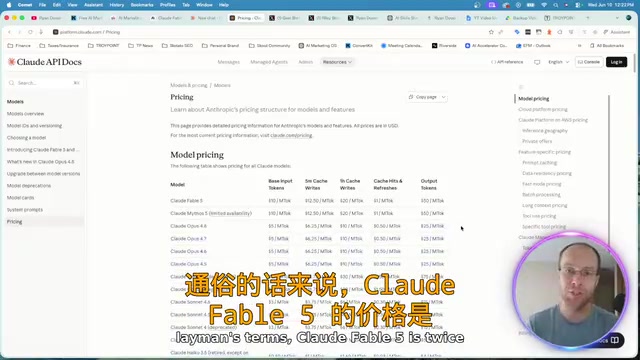
Claude Fable 5's API pricing is aggressive:
- Input tokens: $10/million tokens (vs. $5 for Opus 4.8)
- Output tokens: $50/million tokens (vs. $25 for Opus 4.8)
In short, Fable 5 costs twice as much as Opus 4.8 and burns through your quota at double the rate.
To understand the real-world impact of this pricing, you need to understand tokens. Tokens are the basic unit LLMs use to process text — in English, one token corresponds to roughly 4 characters or 0.75 words; in Chinese, a single character typically consumes 1.5–2 tokens. Using Fable 5's pricing as an example: if you ask the AI to generate a 2,000-word English article (~2,700 output tokens), the output cost alone would be about $0.135. That seems trivial, but for enterprise users or developers making high-frequency API calls — potentially consuming tens of millions of tokens per day in large-scale automated workflows — the cost difference adds up significantly on monthly bills.
Currently, Claude Max plan ($100/month) subscribers can use Fable 5 for free until June 22, after which they may need to switch to a usage-based credits model. Anthropic has also explicitly noted: "Fable is the most powerful model and consumes usage at twice the rate of Claude Code."
Is Fable 5 Overkill?
For most knowledge work scenarios — copywriting, market research, content creation — Fable 5 is likely overkill. As AI creator Gail Breton quipped: "I can't wait to see people use Fable to automate their morning briefings." Using a model that costs twice as much for a morning briefing is, indeed, unnecessary.
But for technical tasks like vibe coding (AI-assisted programming), Fable 5 shows a clear edge. Vibe Coding is a concept coined by OpenAI co-founder Andrej Karpathy in early 2025, describing an entirely new programming paradigm: instead of writing code line by line, developers describe their requirements in natural language and let the AI model generate the complete implementation. The developer's role shifts from "person who writes code" to "person who describes intent and reviews results." This approach is especially suited for rapid prototyping, but its quality depends heavily on the model's code comprehension ability and context window size — precisely the areas where Fable 5 has improved the most over its predecessors.
Another creator, Riley Brown, claimed he replicated the Lovable platform using just two prompts with Fable 5 — and that's exactly where these top-tier models truly shine.
Test 1: Redesigning a Digital Product Landing Page
Test Setup
Ryan used Claude Code (the VS Code extension) to redesign his digital product "Claude Code Skill Stack" landing page, testing both Fable 5 and Opus 4.8. Claude Code is Anthropic's AI coding assistant that runs as a VS Code extension. Unlike simple chat-based AI, Claude Code can directly read project file structures, understand code context, execute terminal commands, and modify files within the editor — it works like a pair-programming partner that can see your entire project.
The page had previously been created by Opus 4.6 and had already generated over $5,000 in revenue.
Both models received the exact same prompt, with thinking mode turned off (disabling the model's chain-of-thought reasoning) and effort set to low (limiting the computational resources and reasoning depth the model invests in each response), ensuring a fair comparison under identical computational constraints.
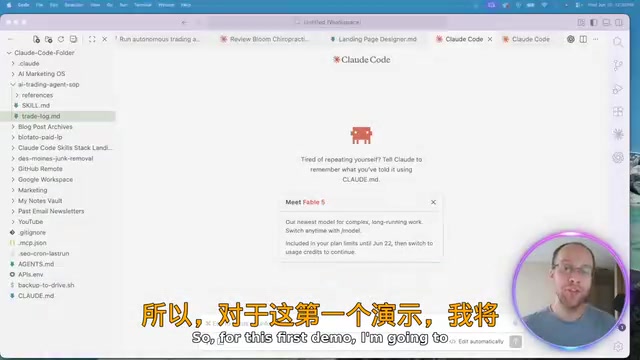
Opus 4.8 vs. Fable 5 Landing Page Results
Opus 4.8's performance:
- Improved the visibility of the top "Get Instant Access" button
- Potentially better optimized for mobile conversions
- Overall changes were minimal, with most updates concentrated in the above-the-fold area
Fable 5's performance:
- Changed the headline from "Ship a week of content in an afternoon" to the more compelling "Turn Claude Code into your marketing team"
- Intelligently highlighted key information in user testimonials — a detail that neither Opus 4.8 nor 4.6 had picked up on
- Added an additional CTA button at the bottom
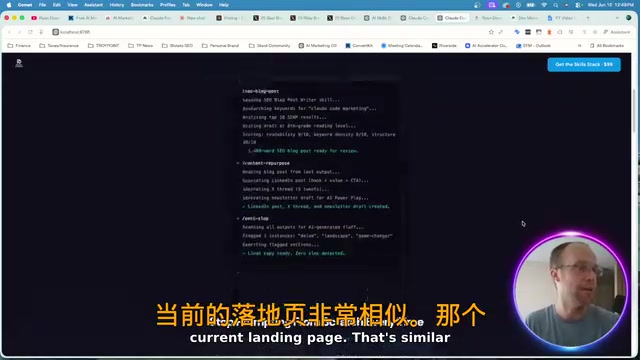
Both models completed the task in roughly the same time, but Fable 5 had a slight edge in attention to detail — especially the testimonial highlighting feature, which demonstrated stronger "marketing intuition." Landing page test: Fable 5 wins by a small margin.
Test 2: Full Website Rebuild (WordPress to Astro Migration)
A More Complex Challenge
The second test involved migrating and rebuilding a complete WordPress + Elementor website (ryandozer.com) to the Astro framework, while optimizing SEO, load speed, and design.
Astro is a modern static site generation framework launched in 2021. Its core philosophy is "Islands Architecture" — pages are rendered as pure static HTML by default, with JavaScript loaded only for interactive components. Compared to WordPress, a traditional dynamic CMS (where every page request requires PHP execution and database queries), Astro-generated sites typically load 3–10x faster and inherently have better SEO performance. Migrating from WordPress to Astro involves content extraction (exporting from a MySQL database), template restructuring (converting PHP templates to Astro components), and route remapping — complex work that normally takes developers days to weeks of manual effort. Having AI automate this process is an excellent test of a model's ability to understand different tech stacks and perform cross-platform translation.
This time, Fable 5 did take longer than Opus 4.8 to complete the task.
Website Rebuild Results
Opus 4.8:
- Cleaner above-the-fold section with a more prominent CTA
- Clean design but slightly "AI-looking"
- Successfully migrated blog content, video embeds, and images
Fable 5:
- Took a bolder design direction, drawing color palette inspiration from a floating component at the bottom of the original site
- Overall looked more professional, more modern, and more credible
- Also successfully migrated blog content and media files
- Additionally discovered and fixed "embarrassing pages" on the original site (broken links and poor copy)
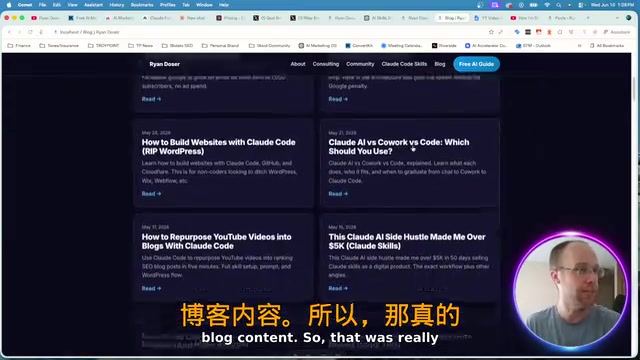
In its change notes, Fable 5 listed three key modifications: the WordPress-to-Astro architecture migration, a clear conversion path design, and proactively discovering and fixing problematic pages on the original site. This ability to "proactively identify issues" is a noteworthy advancement — it means the model isn't just executing instructions but conducting a holistic quality audit of the entire project.
Website rebuild test: Fable 5 wins decisively.
Usage Recommendations: Who Should Use Claude Fable 5?
Based on the test results, Ryan offers a pragmatic usage strategy:
- Fable 5 use cases: Vibe coding, website building, landing page design, and other technical creative tasks
- Opus 4.8 use cases: 90–95% of daily knowledge work, including marketing copy, content creation, and research analysis
A New Model Won't Save Bad Inputs
Good prompt engineering matters far more than chasing the latest model. Prompt engineering is the systematic practice of carefully designing the instructions and context you feed an AI model to optimize output quality. Research shows that the same model can produce outputs that vary by several times in quality depending on the prompt. Effective prompt engineering includes: providing sufficient background context, explicitly specifying output format and style, using few-shot examples, and setting roles and constraints.
If the context and instructions you provide are low quality, even Fable 5 won't produce great results. Too many people get swept up in new-model hype, thinking a model swap will change everything overnight. The reality is that a well-optimized prompt paired with a mid-tier model can often outperform a top-tier model given a lazy prompt. Thorough context and clear instruction design are the key factors that determine AI output quality.
Conclusion: Is Fable 5 Worth Paying Double?
Claude Fable 5 genuinely represents a new tier of model capability — this isn't a minor iteration like Opus 4.7 to 4.8, but a qualitative leap. However, "most powerful" doesn't mean "best fit." For most users, given the doubled cost, the sensible strategy is: reserve Fable 5 for where it counts (complex technical tasks) and continue using the more cost-effective Opus 4.8 for everyday work.
This also reflects a broader trend in the AI industry: the ceiling of model capability keeps rising, but true competitive advantage doesn't come from which model you use — it comes from how precisely you match model capabilities to specific business scenarios, and whether you can fully unlock a model's potential through high-quality inputs.
Key Takeaways
Related articles
PiDeck 0.5.0 Released: Ten Versions in One Week, a Complete Overhaul of the Desktop AI Agent
PiDeck 0.5.0 completes the rebrand from PiDesktop, shipping 10 versions with ~100 changes in one week: design system overhaul, dark mode, LAN sharing, Git integration, and dual-layer proxy config.
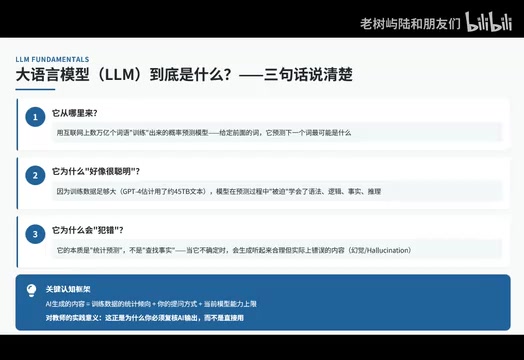
Introduction to AI Literacy: How Teachers Can Build a Systematic Cognitive Framework
A teacher's guide to AI literacy: from AI history and LLM fundamentals to the Agent era, build a systematic cognitive framework and master tool selection strategies.
The 4-Stage Roadmap for AI Application Development: A Career Transition Guide from Beginner to Senior Engineer
A 4-stage roadmap for AI application development: from Python and RAG basics to Agent cluster architecture, covering the core skills needed for career growth.