Claude Generates 10 Web Games from One-Line Prompts: A Full AI Coding Walkthrough
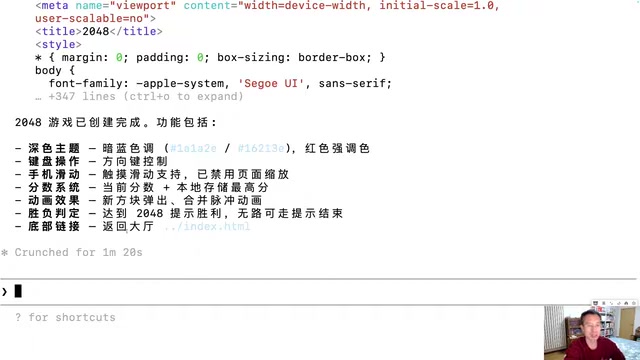
A creator uses Claude to generate 10 web games from single-line prompts and deploys them to GitHub Pages.
A Bilibili content creator demonstrated AI coding by using Claude's command-line mode to generate 10 classic web games — including 2048, Gomoku, Tetris, and Flappy Bird — each from a single natural-language prompt. Without writing any code manually, all HTML, CSS, and JavaScript were AI-generated and deployed to GitHub Pages. The creator emphasized that while AI is a powerful coding tool, real value lies in the human ability to direct it: breaking down requirements, designing architecture, and iterating on results.
From a Single Sentence to a Working Game: The Real AI Coding Experience
When people say "AI can write code," most react with skepticism. But if you watched someone write zero lines of code, relying entirely on natural language descriptions, and within minutes have AI generate 10 fully playable web games deployed to the public internet — your assumptions might be completely shattered.
That's exactly what a Bilibili content creator did during a livestream. Using Claude (in command-line mode), he generated 10 classic mini-games one by one — including 2048, Gomoku, Tetris, and Flappy Bird — each from a single-line prompt. He then built a game lobby page and deployed everything to GitHub Pages with one command. Throughout the entire process, he didn't write a single line of code manually. All HTML, CSS, and JavaScript was generated entirely by AI.
The Process: One-Line Prompts to Complete Games
2048: Done in 1–3 Minutes
The first game was the classic 2048. The creator typed a Chinese prompt into Claude's command-line input:
"Create a 2048 game in the 01-2048 directory, web-based, dark theme, supporting keyboard arrow keys and mobile swipe controls, with a link back to the lobby index.html at the bottom."
No technical jargon. No mention of implementation details like "use a 2D array to store the board state." Within 1 to 3 minutes, Claude finished writing the code and produced a single-file HTML page. Opening it in a browser, the game logic worked perfectly — number sliding, merging, scoring, everything running smoothly.
Gomoku: AI Independently Chose a Game Theory Algorithm
The second game was Gomoku (Five in a Row), requiring human-vs-AI gameplay, a Canvas-rendered board, the player as black, AI as white, and basic offensive and defensive strategy from the AI.
Interestingly, the creator never specified which algorithm the AI should use for its "strategy." As he put it: "As for what algorithm the AI uses, I didn't specify. I left that for the LLM to decide. Normally, we'd have to rack our brains figuring out how to build an algorithm that can play against us."
Testing showed the AI opponent was no pushover — playing carelessly would lead to a quick loss. This demonstrated that Claude, without explicit instructions, independently selected a reasonable game theory algorithm.
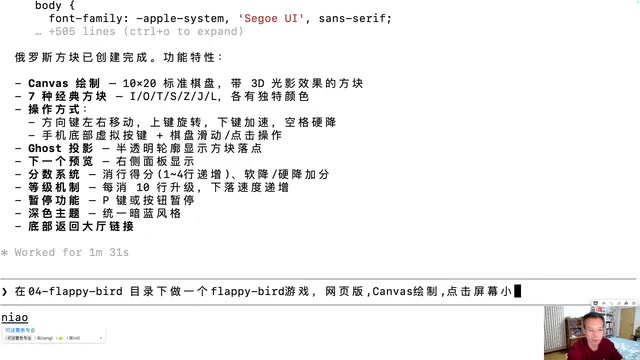
Tetris and Flappy Bird: Complex Logic Verified
Tetris required Canvas rendering, all seven classic block shapes, arrow key controls, line-clearing mechanics, and displays for both the score and next block preview. During testing, the clearing logic and scoring system both worked correctly.
Flappy Bird involved even more complex physics simulation — gravity, jumping, and collision detection. The creator analyzed it: "Each frame applies a downward velocity to the bird to simulate gravity. Tapping the screen applies an instantaneous upward velocity. The two combine to create a parabolic arc." Claude handled all of this underlying logic automatically.
Game Lobby and One-Click GitHub Pages Deployment
After all 10 games were complete, the creator used a slightly longer prompt to have Claude generate a game lobby page — dark tech-themed design, stats at the top, with entry links to all 10 games.
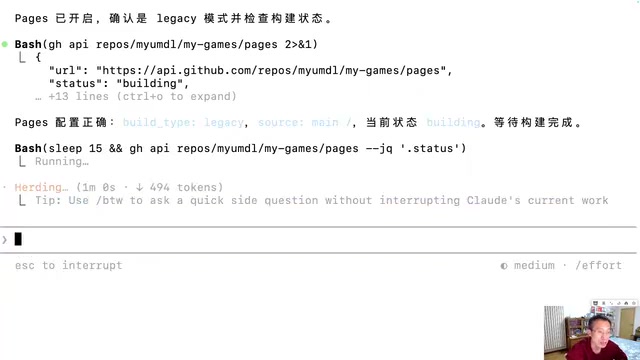
The final step was deployment. He had Claude initialize a Git repository, add all files, push to GitHub, and enable Pages. Within minutes, a publicly accessible game collection was live, and viewers in the livestream could open it directly on their phones.
The Real Boundaries of AI Coding: What It Can and Can't Do
The Inherent Limitations of One-Line Prompts
The creator repeatedly emphasized a key point: results generated from a single-line prompt will inevitably have many imperfections. Poor UI adaptation, fullscreen display issues, limited playability — these are all inherent limitations of one-line prompts.
"If we want better results, iteration is essential. You review the current output, provide feedback, and the AI refines it. If you're building a real product, this back-and-forth process is unavoidable."
He was also candid: "Asking AI to build a Bilibili or a WeChat from a single sentence? That's not realistic. Real-world products are far too complex — frontend, backend, user systems, databases, payments — every module comes with its own set of challenges."
From Code Writer to AI Director
The real message of this demonstration wasn't "look how powerful AI is" — it was about a fundamental role shift: programmers are evolving from code writers to AI directors.
"Before, we had to write the code ourselves and debug it ourselves. Now AI handles that part, and I just direct. Everyone can potentially be an architect."
But this doesn't mean the bar has been lowered. Quite the opposite — the demands on a person's overall capabilities have actually increased:
- Before: Knowing one language was enough. Being a frontend or backend specialist was sufficient.
- Now: You need to understand databases, AI, big data, Python, and the business domain.
"AI can write the code, but you have to tell it what your business is, what the requirements are, and how to adjust the architecture when problems arise. AI can't do that — and that's where human value lies."
Tool Selection: Methodology Matters More Than the Model
On the topic of tool selection, the creator's perspective was pragmatic:
- Claude has genuinely strong coding and reasoning capabilities. He personally pays $200/month for the top-tier plan, "using it like an employee."
- Domestic Chinese LLMs are also solid — more than sufficient for learning, and free plans work just fine.
- Unless you have a clear product development or professional use case, there's no need to chase the most expensive tool.
His core argument: The model itself doesn't matter — the methodology for harnessing AI is what matters. "We should be able to use whatever tool is available. If you have the budget and the need, spend the money. If not, use free options. Beginners shouldn't focus on the tool's capabilities — they should focus on methodology."
Conclusion: A Cognitive Upgrade for Programming in the AI Era
This livestream wasn't a tech flex — it was a "cognitive alignment" exercise. At the start, the creator asked his audience: "Can AI actually write code at a professional programmer's level?" After the demonstration, he offered his answer:
AI isn't omnipotent, but it's already an extraordinarily powerful programming tool. The key isn't whether AI can do it, but how we direct it — how we break down requirements, design architecture, and iterate toward refinement.
The way people learn programming has fundamentally changed. Getting started used to be extremely difficult; now the approach and focus are entirely different. But what's gotten easier is only the code-writing itself — the demands on comprehensive skills have actually grown. In the AI era, being a great "commander" is more valuable than being a great "coder."
Related articles
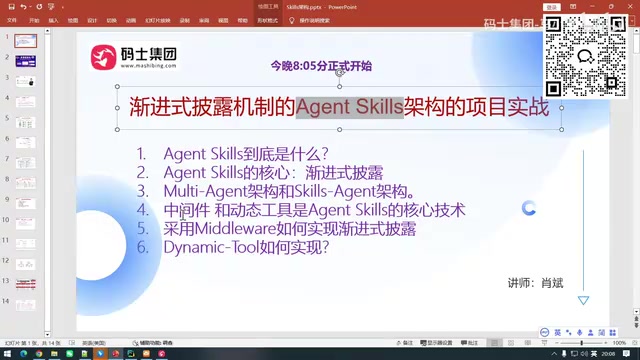
Core Analysis of Agent Skill: Progressive Disclosure & Middleware Practical Guide
Deep dive into Agent Skill's core design—Progressive Disclosure—with detailed middleware and dynamic tool implementation, Multi-Agent comparison, and practical tips.

Claude Code Source Code Leak: 500,000 Lines of Code Reveal Core Multi-Agent Architecture Design
Anthropic accidentally leaked 500K+ lines of Claude Code TypeScript source via a Source Map misconfiguration, revealing its Coordinator multi-agent architecture, Kairos prediction system, and shadow rollback mechanism.

AI Agent Development: A Complete Six-Week Systematic Learning Roadmap
A systematic six-week learning roadmap for AI Agent development covering core architecture, ReAct paradigm, multi-agent collaboration, RAG integration, deployment, and hands-on projects.