Claude Opus vs. Sonnet vs. Haiku: A Practical Comparison and Selection Guide
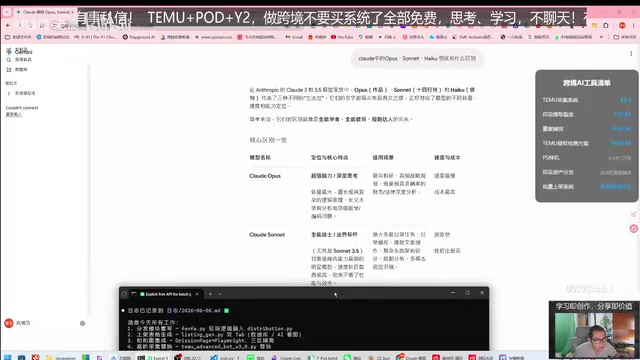
A practical guide to choosing between Claude Opus, Sonnet, and Haiku for different development tasks.
This article provides a hands-on comparison of Claude's three models — Opus, Sonnet, and Haiku — based on real development experience. Haiku excels at automation and lightweight tasks with minimal cost, Sonnet is the balanced all-rounder ideal for daily coding, and Opus tackles the most complex reasoning challenges. A clear selection strategy helps developers match the right model to each scenario and optimize their AI budget.
Introduction: Choose the Right Tool by Understanding Model Differences
Many developers feel overwhelmed when faced with Claude's three models — Opus, Sonnet, and Haiku — for AI-assisted programming. What exactly are the differences? Which model fits which scenario? Picking the wrong one doesn't just waste your budget; it can also slow down your development workflow.
Recently, a content creator on Bilibili shared hands-on insights from using different Claude models in daily development. Combined with a systematic breakdown of each model's capabilities, they offered an extremely practical selection guide. This article builds on that foundation with an in-depth analysis to help you quickly build a mental framework for the Claude model family and make smarter choices.
Claude Model Family Overview: Three Models, Three Strengths
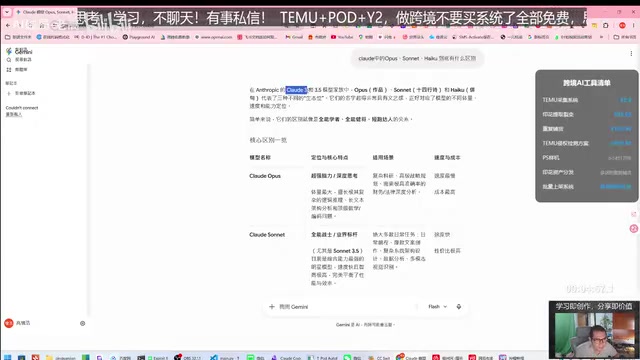
Claude is developed by Anthropic (a company founded by former core members of OpenAI). The current main product line includes the Claude 3 and 3.5 series, featuring three distinctly positioned models: Opus, Sonnet, and Haiku.
In simple terms, think of them this way: Opus is the flagship tier, Sonnet is the workhorse tier, and Haiku is the lightweight tier. Let's break down the core characteristics of each.
Opus: The "Scholar" Flagship for Deep Thinking
Opus is the largest and most capable model in the Claude family — think of it as the "ultimate brain." Its core strengths include:
- Extremely complex logical reasoning: Multi-step, multi-condition reasoning chains are its forte
- Long-text architecture analysis: Capable of processing and understanding the overall structure of large codebases or lengthy documents
- Top-tier math and coding ability: Handles high-difficulty algorithm problems and complex system design with ease
- Best for: Complex research analysis, advanced strategic planning, and high-accuracy financial/legal deep analysis
However, Opus comes with obvious trade-offs — it's slow and expensive. If you're just writing a simple script or having a casual conversation, using Opus is like driving a tank to the grocery store — completely unnecessary.
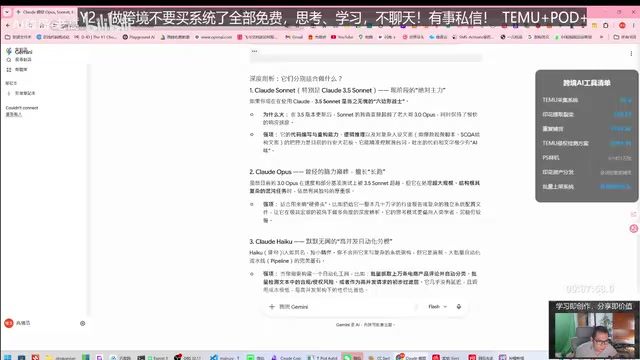
Sonnet: The Industry-Benchmark "All-Rounder"
Sonnet is the most balanced model in the Claude family and currently the most widely used version. The content creator primarily uses Sonnet in actual development, for a simple reason: it offers the best value for money with the broadest capability coverage.
Sonnet strikes an excellent balance between intelligence, response speed, and cost. For the vast majority of development scenarios — whether it's writing code, generating documentation, or analyzing problems — Sonnet delivers satisfying results. It's Anthropic's main model positioned to compete with GPT-4-level offerings and the default choice for most users.
If you're unsure which model to use, going with Sonnet is almost always a safe bet.
Haiku: The Lightning-Fast Lightweight "Efficiency Tool"
Haiku is the lightest of the three models, built for being "small but mighty." While it can't match the other two in complex reasoning, it has irreplaceable advantages of its own:
- Blazing-fast response times: Near-instant returns, ideal for high-frequency call scenarios
- Extremely low cost: The cost advantage becomes very significant during batch processing
- Best for: Daily development assistance, content creation, building automation tools, and batch data processing
Here's a highly practical takeaway: If your goal is to build automation tools, Haiku is more than enough. There's no need to pay premium model fees for simple tasks.
Practical Selection Strategy: Which Model for Which Scenario
Based on real-world development experience, here's a summarized selection strategy:
Scenario 1: Automation Tool Development → Go with Haiku
For developing automation scripts, batch data processing tools, simple web scrapers, or scheduled tasks, Haiku is the best choice. These tasks have relatively straightforward logic and don't require deep reasoning from the model. Haiku's speed and cost advantages shine here. Especially in scenarios requiring high-concurrency API calls, Haiku can save you a significant amount of money.
Scenario 2: Daily Programming and Code Generation → Go with Sonnet
For medium-complexity feature development, code refactoring, and bug troubleshooting, Sonnet is your best daily development companion. It can understand moderately complex business logic, generate consistently high-quality code, and responds fast enough for everyday use.
Scenario 3: Complex System Architecture Design → Consider Opus
For large-scale system design, complex algorithm implementation, and scenarios requiring deep cross-module analysis, Opus is worth considering. But be sure to evaluate whether you truly need this level of capability to avoid unnecessary cost waste.
Quick Selection Reference Table
| Dimension | Opus | Sonnet | Haiku |
|---|---|---|---|
| Reasoning Ability | ⭐⭐⭐⭐⭐ | ⭐⭐⭐⭐ | ⭐⭐⭐ |
| Response Speed | ⭐⭐ | ⭐⭐⭐⭐ | ⭐⭐⭐⭐⭐ |
| Cost | High | Medium | Low |
| Recommended For | Hardcore problems | Daily development | Lightweight tasks |
Real-World Challenges of Using Claude
It's worth noting that the content creator also candidly shared some pain points of using overseas AI tools:
- Network stability: Using Claude from within China can involve unstable connections — an unavoidable reality when using overseas services
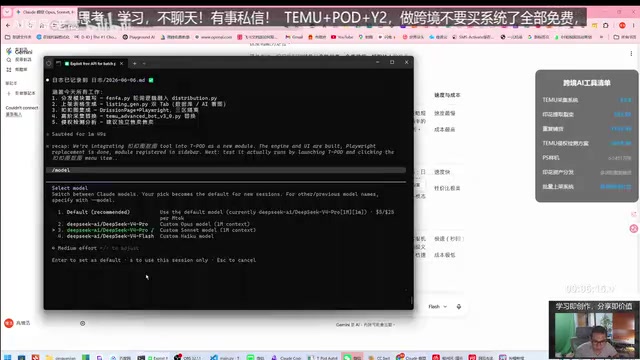
- Trust issues with proxy services: There are many API proxy services on the market, but it's difficult to verify the authenticity of the models they serve, so careful vetting is needed
- Cost considerations: High-end models like Opus are quite expensive to use directly, which is a major reason many developers opt for Sonnet or even Haiku
Conclusion: Choosing the Right Model Matters More Than Choosing the Expensive One
A common misconception when using AI programming tools is that "more expensive means better." In reality, precisely matching the model to your needs is the optimal strategy:
- Use Haiku for simple tasks: Save money and time, maximize efficiency
- Use Sonnet for daily development: Stable, reliable, and the best bang for your buck
- Use Opus for hardcore problems: Deep reasoning that's worth every penny
Understanding each model's capability boundaries and choosing the right one for each specific task — that's the correct approach to using AI programming tools efficiently. Rather than wasting tokens on an expensive model, allocate your budget wisely and make every API call count.
Related articles

AITS Hands-On Review: API + Web + App Automated Testing All in One Platform
In-depth review of AITS: an AI testing platform covering API automation, Web automation, App real-device cloud testing, and performance testing end-to-end.
Codex vs Claude Code vs Cursor: How to Choose the Right AI Coding Tool
In-depth comparison of Codex, Claude Code, and Cursor: pricing, stability, and capabilities. Codex excels at frontend UI, Claude Code at backend logic, Cursor remains a stable veteran. Find your best AI coding tool.

Hermes Jarvis Deep Dive: The Voice-Driven All-in-One AI Assistant
Deep dive into Hermes Jarvis voice AI assistant: its core features, five-layer architecture, multi-model integration, system-level control, and the future of voice-driven AI development.