Claude Proactively Discovers Bugs in an Open-Source Library: AI Evolves from Coding Assistant to Collaborator
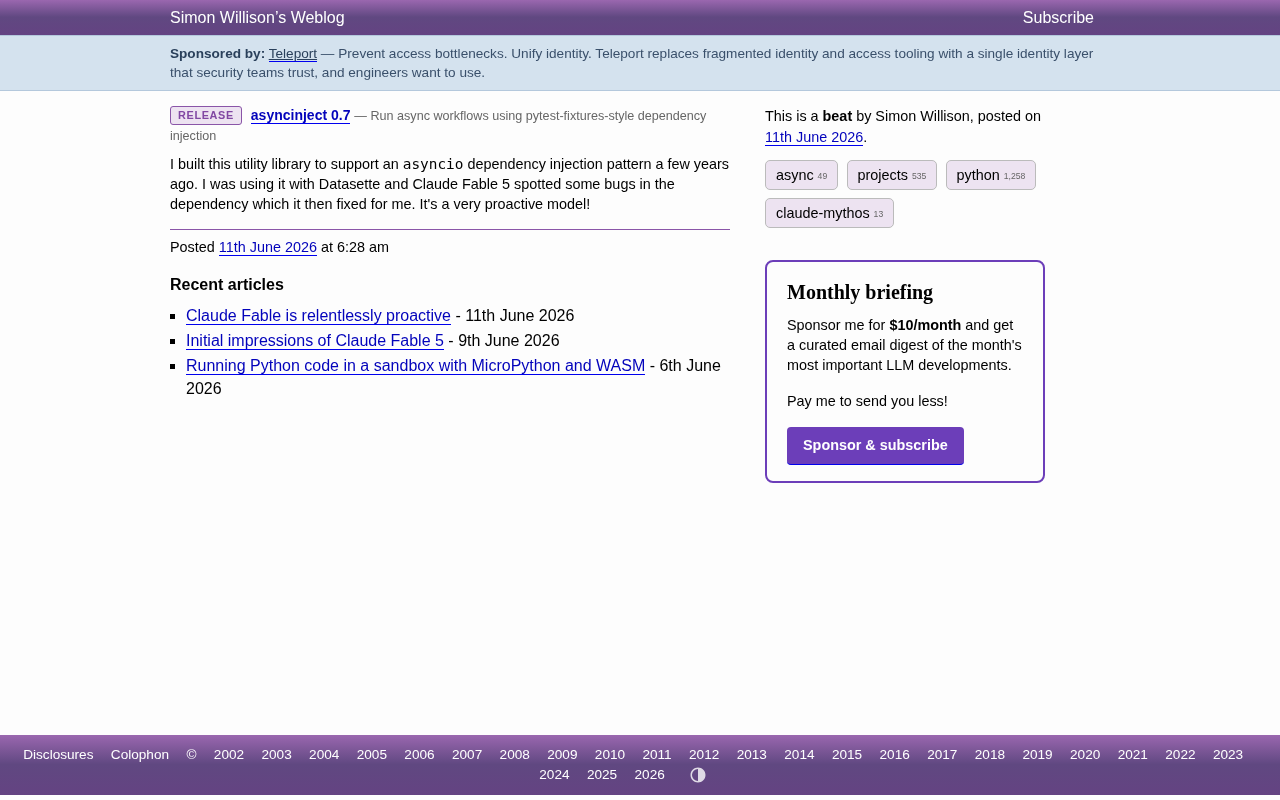
Claude proactively found and fixed bugs in asyncinject, signaling AI's shift from coding tool to collaborator.
Simon Willison released asyncinject 0.7, with bugs discovered and fixed proactively by Claude — not in response to a prompt, but through autonomous code review. This marks a significant shift: AI moving from passive code completion to active bug detection in complex async Python code. The case highlights implications for open-source maintenance and the evolving role of developers as AI becomes a true programming collaborator.
Event Overview
Simon Willison (renowned developer and creator of Datasette) recently released version 0.7 of his open-source utility library asyncinject. The highlight of this update isn't the functionality itself, but rather the "developer" who found and fixed the bugs — Claude proactively identified issues in the code and submitted fixes.
What Is asyncinject: A Lightweight Solution for Async Dependency Injection
asyncinject is a Python utility library that Simon Willison built several years ago, specifically designed to support dependency injection patterns in asyncio environments. It's used in the Datasette project (an open-source tool for exploring and publishing data) to manage dependencies between asynchronous functions.
Dependency Injection (DI) is a classic design pattern in software engineering. Its core idea is to "inject" external resources that a component depends on from the outside, rather than having the component create them internally. This pattern greatly improves code testability and modularity — in unit tests, you can easily replace real dependencies with mock objects without modifying business logic code. The Spring framework popularized this pattern in the Java ecosystem, while in the Python ecosystem, dependency injection practices have been relatively fragmented, lacking a unified lightweight solution — especially for asynchronous programming scenarios.
In Python's async programming landscape, managing the execution order and dependencies of asynchronous functions is often far more complex than with synchronous code. Python's asyncio is the standard library's async I/O framework, built on an event loop and coroutine mechanism. In synchronous code, when function A calls function B, the execution order is linear and deterministic. But in an async environment, multiple coroutines may execute concurrently, and one coroutine's output may serve as another's input, forming a complex dependency graph. The core value of asyncinject lies in this: it automatically builds a dependency graph by analyzing function signatures, then uses mechanisms like asyncio.gather() to execute tasks without mutual dependencies in parallel — maximizing concurrency while ensuring correctness.
As a data exploration tool, Datasette needs to simultaneously execute database queries, permission checks, template rendering, and other async operations when handling HTTP requests, all with complex interdependencies. asyncinject was born from this exact scenario, enabling Datasette to define these dependencies declaratively rather than manually orchestrating async call chains.
What Does AI Proactively Finding Bugs Mean?
From Passive Tool to Active Collaborator
Simon Willison specifically noted in the release notes:
Claude Fable 5 spotted some bugs in the dependency which it then fixed for me. It's a very proactive model!
The mention of Claude Fable 5 deserves special explanation. Claude is a large language model series developed by Anthropic, and "Fable" is likely an internal codename or early testing designation for a specific model version. Anthropic has consistently emphasized its "Constitutional AI" safety alignment approach while continuously improving the model's code comprehension and generation capabilities. From Claude 1.x to the Claude 3.5 series (including Sonnet, Opus, Haiku, and other tiers), its performance on code tasks has steadily improved — particularly in code review, bug detection, and refactoring suggestions, which require deep semantic understanding.
The keyword here is proactive. Traditional AI coding assistants are typically reactive — developers pose questions, and AI provides answers. GitHub Copilot's typical usage involves developers writing code in an editor while AI auto-completes based on context; ChatGPT and Claude's conversational modes follow a user-asks, model-answers pattern. This case demonstrates an entirely new collaboration model: the AI model proactively identified potential issues while reviewing code and directly provided fixes. This "proactiveness" means AI is no longer merely a tool waiting for instructions — it's beginning to exhibit behavior patterns similar to a senior code reviewer, flagging suspicious areas based on its understanding of programming patterns and common pitfalls as it reads through code.
From a technical perspective, AI's ability to proactively discover bugs relies on the convergence of several key capabilities: first, static code analysis ability — finding potential issues through logical reasoning without running the code; second, pattern recognition ability — after training on massive code corpora, large language models can identify common error patterns (such as race conditions, resource leaks, improper boundary condition handling, etc.); and finally, contextual understanding ability — the model needs to understand the architectural intent of the entire codebase to judge whether a piece of code's behavior aligns with design expectations.
Implications for Open-Source Project Maintenance
For open-source project maintainers, this is a signal worth paying attention to. Many open-source libraries (especially small utility libraries maintained by individuals) often accumulate technical debt due to limited maintainer bandwidth. The open-source community has long faced a structural dilemma: millions of software projects worldwide depend on the unpaid labor of a small number of maintainers. According to multiple surveys by Tidelift and GitHub, over 60% of open-source maintainers report experiencing burnout, and many critical infrastructure libraries (such as OpenSSL, core-js, etc.) have been chronically undermaintained. The 2014 Heartbleed vulnerability was a textbook example — a cryptographic library depended on by millions of servers worldwide, with only one or two core maintainers.
If AI can proactively review code, discover bugs, and submit fixes, this would dramatically reduce the maintenance cost of open-source projects. We've already seen some early practices: GitHub's Dependabot can automatically detect security vulnerabilities in dependencies and submit update PRs; Google's OSS-Fuzz project uses fuzz testing to automatically discover vulnerabilities in open-source software. AI proactively finding logic bugs and submitting fixes represents yet another leap in automated maintenance capabilities — evolving from "finding known types of problems" to "understanding code intent and discovering logical deviations."
Technical Ecosystem Context: Claude's Continued Evolution in Code
Simon Willison used the "claude-mythos" tag to mark this release, suggesting he is systematically tracking the performance of Claude-series models on real-world programming tasks. Willison himself is one of the most active practitioners and chroniclers in the AI tools space. His blog has long tracked the actual capability boundaries of various large language models, and his observations often reflect model performance in real engineering scenarios more accurately than benchmarks. His systematic use of specific tags to document AI-assisted programming cases constitutes a valuable longitudinal research dataset in itself.
From simple code completion to proactive bug discovery, the capability boundaries of AI coding assistants are expanding rapidly. Looking back at this evolutionary path: when GitHub Copilot launched in 2021, AI coding assistants primarily offered line-level or function-level code completion; in 2023, ChatGPT and Claude demonstrated the ability to understand and generate complete code modules; in 2024, tools like Devin and Cursor began attempting to have AI take on more complete engineering tasks, including cross-file modifications and project-level refactoring. "Proactive bug discovery" represents a new milestone — AI no longer needs humans to explicitly point out where problems lie; it can autonomously judge code correctness.
One detail worth noting: asyncinject is not a simple project — it involves low-level mechanisms of Python async programming, including event loops, coroutine scheduling, and dependency graph resolution. Specifically, Python's event loop is a single-threaded scheduler that maintains a queue of pending tasks, switching execution between coroutines via the await keyword. Coroutine scheduling involves state management for task suspension, resumption, and cancellation, while dependency graph resolution requires topological sorting to determine the correct execution order — and if cycles exist in the dependency graph, they must be detected and reported as errors. Bugs in this type of code are often non-deterministic, meaning they may only trigger under specific execution orders or concurrency conditions, making it difficult for traditional unit tests to cover all edge cases. The fact that AI can accurately identify bugs in this kind of code demonstrates a remarkably deep understanding of async programming patterns — not just reading the syntactic structure of code, but reasoning about its dynamic runtime behavior.
Conclusion
The release of asyncinject 0.7 is a small event in itself, but the trend it reflects deserves every developer's attention: AI is evolving from a coding assistant into a coding collaborator, shifting from passive response to active participation. When AI can autonomously review codebases and discover bugs that humans have overlooked, software development workflows may be undergoing a quiet revolution.
The far-reaching impact of this transformation may exceed our current imagination. If AI can continuously and cost-effectively review code quality, the software industry's long-standing "technical debt" problem may finally see a systemic solution. At the same time, the developer's role will continue to evolve — from personally writing every line of code to increasingly serving as architects and reviewers, forming a complementary collaborative relationship with AI. asyncinject 0.7 may be just a small footnote in this transformation, but it clearly points toward a future that is already arriving.
Related articles

A Gen-Z Woman Making $1.5M/Month: Deconstructing the Growth Methodology Behind AI Apps
Gen-Z indie dev Nicole built 4 hit AI apps earning $1.5M/mo. Deep dive into her industrialized UGC engine, traffic testing system, and minimalist tech stack.
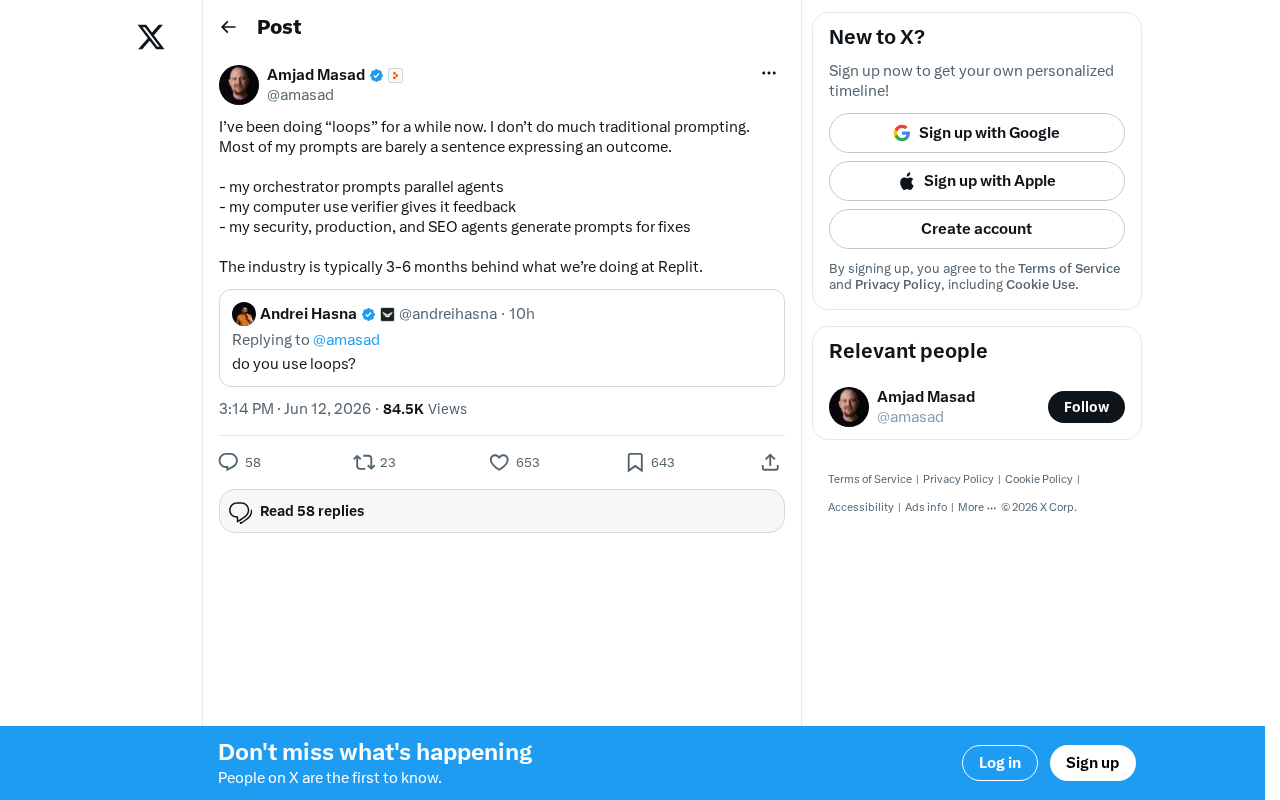
Replit's AI Loops Workflow Explained: Multi-Agent Collaboration Replaces Prompt Engineering
Deep dive into Replit's AI Loops workflow: how orchestrators, parallel agents, and Computer Use Verifiers build automated closed-loop systems through multi-agent collaboration.
Claude Code + Skills: A Practical Guide to AI-Powered Test Case Generation
Learn how to use Claude Code + Skills to auto-generate enterprise-grade test cases. Covers AI Agent vs LLM differences, the four core capabilities, and the complete workflow from requirements to test cases.