Click and Drag to Code: The New Paradigm of AI Visual Programming
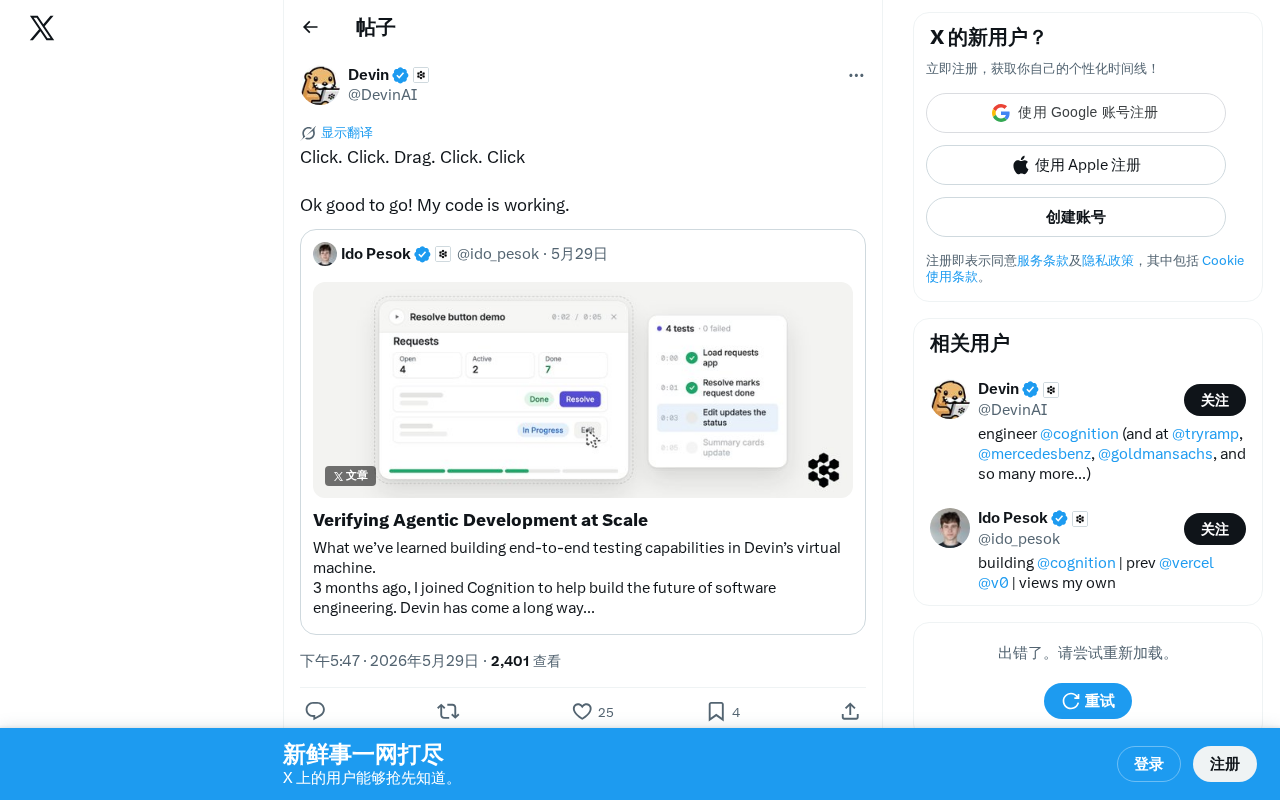
AI visual programming is transforming coding from line-by-line writing to click-and-drag interactions.
AI-powered visual programming tools like Cursor, v0, and Bolt are fundamentally reshaping how software is built — compressing the development process from hours of manual coding to simple click-and-drag operations. This paradigm shift frees professional developers to focus on architecture and business logic while lowering barriers for non-technical citizen developers. However, concerns around debugging ability, understanding depth, and technical debt remain important considerations as the industry navigates this transformation.
From Code to Clicks: Programming Is Being Redefined
"Click. Click. Drag. Click. Click — there, my code is running."
This brief exclamation from Twitter perfectly captures the paradigm shift brought about by today's AI programming tools. Not long ago, getting code to work meant hours of debugging, repeatedly consulting documentation, and searching for answers on Stack Overflow. Now, an increasing number of developers are discovering that the core interaction of programming is shifting from "writing code" to "clicking and dragging."
The Convergence of AI Visual Programming and Traditional Tools
The AI Evolution of Low-Code and No-Code Platforms
Low-code and no-code platforms aren't new concepts, but the addition of AI has brought about a qualitative leap. Low-code platforms allow developers to build applications using minimal hand-written code combined with visual interfaces, while no-code platforms eliminate the need for hand-written code entirely. This space has been booming since the mid-2010s — Gartner predicts that by 2025, 70% of new enterprise applications will be built using low-code or no-code technologies, with the market expected to exceed $30 billion.
Traditional visual programming tools (such as MIT's Scratch and IBM-led Node-RED) offer pre-built blocks that users can only combine within limited parameters. Scratch teaches programming logic through drag-and-drop coding blocks, while Node-RED connects IoT devices and API services through flowcharts — their shared limitation is that expressiveness is constrained by predefined component libraries. The new generation of AI-driven tools is breaking through this ceiling:
- Cursor: An AI-native code editor based on VS Code that uses large language models to understand developer intent, automatically completing entire code logic blocks based on context and even understanding project structure across files
- v0 (by Vercel): Generates React components and complete frontend interfaces directly from natural language descriptions, instantly transforming design intent into deployable code
- Bolt (by StackBlitz): Runs a complete development environment in the browser, where AI can generate an entire application's frontend and backend code at once with instant preview
These tools are blurring the line between "writing code" and "configuring systems." Their underlying technology relies on the code generation capabilities of large language models (LLMs) — models trained on billions of lines of open-source code that understand programming language syntax, design patterns, and best practices, thereby transforming high-level intent into concrete implementations.
A user's operations might simply be:
- Click to select a component
- Drag to adjust layout
- Click to confirm AI-generated code suggestions
- Click again to run
Throughout this process, the actual code logic is handled by AI in the background, and the developer acts more like a "decision-maker" than a "writer." This pattern is known in the industry as "Intent-Driven Development" — developers express goals, and AI handles the implementation path.
The Ultimate Compression of Development Interaction Costs
What makes this tweet interesting is that it describes a complete development workflow in the fewest possible words. Five clicks plus one drag, and the code works. This reflects an important trend: the interaction cost between developers and code is being compressed to the extreme.
"Interaction cost" in the field of Human-Computer Interaction (HCI) refers to the sum of physical operations and cognitive effort a user must expend to achieve a goal. In a software engineering context, this includes keystroke count, context-switching frequency, time spent waiting for compilation, energy spent consulting documentation, and the cognitive burden of maintaining code state in one's mental model. Every technological innovation essentially compresses this cost.
From a historical perspective, programming interaction has gone through several phases:
- The Punch Card Era (1950s-1960s): Programmers needed to punch holes in physical cards to represent binary instructions, with each card typically storing only 80 characters. After submission, programs required hours or even days to produce results, and a single punctuation error meant starting the entire batch over. The design of FORTRAN and COBOL was physically constrained by card column widths.
- The Command Line Era (1970s-1980s): The emergence of Unix terminals and text editors (like vi and Emacs) allowed programmers to input and modify code instantly. Feedback cycles shortened to minutes, but developers needed to memorize vast numbers of commands and shortcuts, creating a steep learning curve.
- The IDE Era (1990s-2010s): Integrated Development Environments like Visual Studio, Eclipse, and IntelliJ IDEA consolidated code editing, compilation, debugging, and version control into a unified interface. Features like syntax highlighting, auto-completion, and real-time error detection compressed feedback cycles to seconds, significantly reducing developers' cognitive burden.
- The AI Era (2020s-): Marked by GitHub Copilot (released in 2021), AI code assistants can predict developer intent based on comments, function names, or even cursor position and generate complete code blocks. Pressing Tab to accept a suggestion provides near-instant feedback. With the current generation of products like Cursor and v0, even the step of "writing prompts" is being further simplified into visual operations.
What Do AI Programming Tools Mean for Developers?
Impact on Professional Developers
For senior engineers, "click to complete" doesn't mean a loss of technical depth. On the contrary, it frees up cognitive resources, allowing developers to focus their attention on higher-level concerns like architecture design, business logic, and system optimization.
This involves an important concept from cognitive psychology — Cognitive Load Theory. Human working memory has limited capacity (typically considered to be 7±2 information chunks). When developers need to simultaneously remember API parameter formats, handle edge cases, and maintain variable states, very little cognitive space remains for creative thinking. AI tools effectively reduce "extraneous cognitive load" by automatically handling low-level implementation details, allowing developers' limited attention to focus on decisions that truly require human judgment.
Repetitive boilerplate code — such as database connection configurations, API route setups, form validation logic, and error handling templates — may account for 30%-50% of code volume in typical projects while containing virtually no business innovation. This highly patterned code is precisely what AI excels at handling. When AI takes over this work, senior engineers' roles evolve from "code implementers" to "system architects" and "AI collaborators" — they review AI-generated code, make technology selection decisions, and design interaction contracts between systems.
Reshaping the Programming Barrier to Entry
The more profound impact lies in lowering the barrier to programming. When "writing code" becomes "clicking and dragging," more people without technical backgrounds can participate in software development. This trend has given rise to the new role of "Citizen Developer" — business professionals who don't program as their primary job but build applications using low-code/AI tools. Gartner estimates that by 2026, citizen developers will outnumber professional developers by four to one.
Specific scenarios include: product managers can directly prototype their ideas without waiting for engineering schedules; designers can convert Figma visual mockups into runnable frontend code through AI tools (such as Vercel's v0 or Anima); entrepreneurs can validate MVPs without hiring engineers.
MVP (Minimum Viable Product) is a core concept in lean startup methodology, referring to a product version built with minimal resources that can validate core hypotheses. Traditionally, even the simplest MVP required weeks of development time and tens of thousands of dollars in cost. With AI programming tools, a web application with basic functionality can go from concept to interactive prototype in hours, dramatically accelerating the "Build-Measure-Learn" iteration cycle. In Y Combinator's Winter 2024 batch, over 25% of startup teams were using AI tools to generate their product's core code.
Potential Concerns and Challenges
Of course, this convenience also raises questions worth considering:
-
Depth of Understanding: When developers no longer write code line by line, will their understanding of underlying system logic deteriorate? In computer science education, this is known as the "Leaky Abstraction" problem — a concept proposed by Joel Spolsky in 2002 pointing out that all non-trivial abstractions are leaky to some degree. When AI hides implementation details, developers may lack the ability to penetrate the abstraction layer for diagnosis when encountering edge cases the abstraction can't cover. Historically, every elevation in abstraction level (from assembly to high-level languages, from manual memory management to garbage collection) has been accompanied by similar concerns, but the industry has ultimately found new equilibrium points.
-
Debugging Ability: When "clicking" can't solve the problem, do developers still possess the ability to investigate deeply? GitHub's internal research shows that developers using Copilot actually spend more time debugging complex bugs that AI can't solve compared to not using AI tools — because they need additional time to understand the logic of AI-generated code, which may follow a thought process inconsistent with their own mental model.
-
Technical Debt: Will AI-generated code create more hidden risks in long-term maintenance? Technical debt is a metaphor proposed by Ward Cunningham in 1992, referring to compromises made in code quality for short-term delivery speed that must be "repaid" in the future through higher maintenance costs. A 2024 research report by GitClear found that AI-assisted code has a "code churn rate" (the proportion of code modified or deleted shortly after being written) 39% higher than human-written code, suggesting that AI-generated code may have quality issues requiring subsequent correction even at first commit. Additionally, AI tends to generate code that "looks correct" but lacks deep understanding of specific business contexts, and this surface-level correctness may mask potential logical flaws.
Conclusion: The Essence of Programming Hasn't Changed
"Click. Click. Drag. Click. Click" may seem understated, but behind it lies decades of evolution in the entire development toolchain. From Grace Hopper inventing the first compiler in the 1950s (automatically converting human-readable code into machine instructions) to today's AI transforming natural language and visual operations into complete programs — each step has shortened the distance between human intent and machine execution. The essence of programming — transforming human intent into machine-executable instructions — hasn't changed; only the efficiency and form of this transformation process have.
Future developers may truly only need to clearly know "what they want," and as for "how to implement it," they can leave that to AI. This is both exciting and worthy of our careful reflection. As computer scientist Edsger Dijkstra's famous quote implies: computer science is to computers as astronomy is to telescopes — tools change, but the thinking ability to understand problems, decompose problems, and solve problems elegantly remains a developer's most core competitive advantage.
Related articles

Claude Code for Test Development in Practice: An AI Programming Workflow That Doubles Your Efficiency
A practical guide to Claude Code for test development: auto-generating test scripts, Plan Mode workflows, MCP + Playwright integration, and Subagent parallel tasks to build systematic AI-assisted workflows.

Hermes Agent Hands-On Review: An AI Efficiency Revolution for Indie Game Developers
Indie game developer reviews Hermes Agent vs OpenClaude: intelligent context compression, real-time Memory, remote control via Telegram, and practical use cases in game dev, social media, and email.
Vibe Coding Beginner's Guide: Tool Selection Across Three Categories with Practical Examples
A comprehensive guide to Vibe Coding's three tool categories: Agent frameworks, CLI Coding, and IDE tools, with practical examples including Snake game and data analysis workbench.