Cloning Successful Apps to $35K/Month: An Indie Developer's Validation-First Methodology

Indie developer earns $35K/month by cloning validated apps with a systematic screening methodology.
Former optometrist Samuel Rondo taught himself to code via YouTube and now runs three apps earning $35K/month. His core strategy: never build unvalidated products. Instead, he finds proven apps on Twitter, screens them through four filters (personal use, working product, organic demand, simplicity), then builds better versions. His growth playbook follows a clear sequence — ads first for quick validation, SEO for compounding traffic, faceless YouTube channels, and affiliate marketing.
A former optometrist with zero programming background taught himself to code through YouTube and now runs three apps generating $35,000 per month. His core strategy isn't inventing entirely new products — it's finding apps already validated by the market and making them slightly better. While the approach sounds simple, it's backed by a rigorous system for screening, validation, and growth.
From Optometrist to Indie Developer: A Pragmatic Path to Self-Taught Programming
Samuel Rondo's story began with a simple need — he wanted to rebuild an Instagram tool he'd been using. With no computer science degree and no programming experience, he found a 15-hour course on YouTube and learned by doing.
The key was his learning method: every time he learned a new concept, he immediately applied it to the project he was building. He believes just watching courses isn't enough — you get lost in language features you may never use and lose sight of why you're learning.
For anyone looking to get started today, Samuel's advice is even more radical: if he were 18 now, he wouldn't learn to code the traditional way. He'd go straight to AI coding tools. He proposes a three-step framework:
- Pick a real project — find a product you like, take screenshots
- Ask ChatGPT what you need to learn — let AI map out your learning path
- Build step by step, asking AI for help at every obstacle — use modern tech stacks like Next.js, Node.js, etc.
Today, AI can help you build 90% of an app. The remaining 10% is what you truly need to understand deeply.
Core Methodology: Never Build Something That Hasn't Been Validated
Samuel has an iron rule: never build something that doesn't already exist, hasn't already succeeded, or at least hasn't already gained traction. This principle reduces the probability of failure while increasing the odds of success.
His primary source for product ideas is Twitter (X), especially communities around indie developers and Build in Public. He then evaluates ideas through four key filters:
- Would I use it myself? — If you don't like it, you won't have the motivation to stick with it long-term
- Is it already working? — You need to see evidence of it actually functioning
- Are they not spending thousands on marketing? — This indicates genuine organic demand
- Is the product simple enough? — Easy for one person to maintain without losing sleep
Only products that pass all four filters give Samuel the confidence to proceed.
The Practical Validation Process: Data-Driven Decision Making
Once he identifies a candidate idea, Samuel conducts a deeper investigation.
Step 1: Look for growth momentum. The most valuable signals on Twitter are founders sharing MRR (Monthly Recurring Revenue) screenshots or Stripe revenue screenshots. This is the ultimate proof that people are willing to pay for the product.
Step 2: Analyze traffic sources. He uses tools like SimilarWeb to examine competitors' traffic composition. If a product is growing through both ads and SEO, that's a very positive signal — it means demand is strong and the success path is easier to replicate. If it relies mainly on SEO, it takes time, but it's still viable with patience.
Step 3: Assess technical feasibility. Confirm whether he can easily build and maintain it. He doesn't want a product requiring complex backends that keep him up at night.
Step 4: Confirm personal interest. Nothing is worse than working on a product you don't care about at all.
Breaking Down Three Apps in Practice
Samuel currently runs three apps with a combined monthly revenue of approximately $35,000:
UseArtemis: The First Lesson
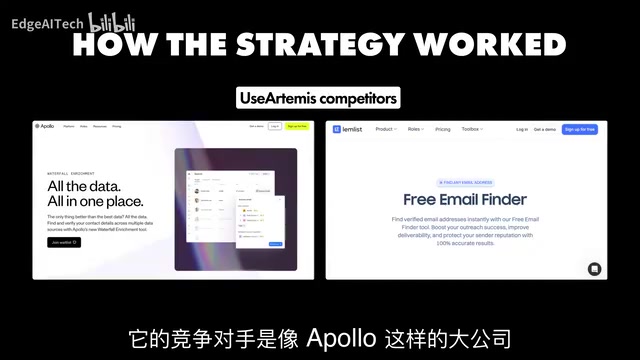
UseArtemis is an AI email finder tool generating about $15,000/month with roughly 10,000 customers. But Samuel admits this was built without using his validation strategy — he ended up competing head-to-head with major companies like Apollo and Lemlist. It's extremely difficult to maintain, with monthly operating costs of around $4,000–$5,000 due to running numerous instances for task automation.
StoryShort: Perfect Execution of the Strategy
StoryShort is an AI video generator for TikTok and YouTube, earning about $20,000/month with around 4,000 customers. This product perfectly embodies his methodology:
- He saw someone on Twitter posting about building a tool for auto-publishing faceless videos, with impressive numbers
- Investigation revealed all traffic came from Facebook ads — meaning the acquisition model could be replicated within a week
- The product itself was simple enough, and he was personally interested in the market
- So he built it quickly, ran ads, and growth took off rapidly
Capacity: The Latest Venture
Capacity.so is a brand-new AI coding tool currently generating $900/month with about 50 users. While still in its early stages, costs may be higher since each website deployment requires running instances.

Growth Strategy: A Four-Step Progressive Acquisition Framework
Samuel's growth strategy follows a clear priority order:
1. Ads First
Always run ads first. Deploy on Google and Meta depending on the product type. This is the fastest way to validate the market and test demand. Some products perform better on Google, others on Meta.
2. Long-Term SEO
Once ads start gaining traction, move into the SEO phase. SEO takes time, but once it kicks in, it delivers nearly free traffic that compounds over time. He uses Ahrefs for SEO analysis and Outrank.so to automate article writing and publishing.
3. Faceless YouTube Channel Network
Leveraging StoryShort's own capabilities, he creates multiple faceless channels on YouTube, TikTok, and Instagram, auto-publishing UGC-style videos about his products daily. This strategy works remarkably well.
4. Affiliate Marketing
Especially important for StoryShort. Affiliate marketing not only brings in customers at a fixed cost but also creates content diversity — many people produce YouTube videos and write articles, generating zero-cost exposure. People are more willing to share your product when they can earn a commission.

Tech Stack and Cost Structure
Samuel's tech stack is quite lean:
- Frontend & Backend: Next.js + Node.js
- Deployment: Vercel
- Payments: Stripe
- SEO Tools: Ahrefs + Outrank.so
- Content Automation: StoryShort
Regarding margins, UseArtemis costs about $4,000–$5,000 per month (due to running numerous instances), while StoryShort costs slightly less. Overall, the profit margins across all three apps remain quite healthy.
Key Advice for Indie Developers
Samuel summarizes several critical pieces of advice:
- Leverage AI coding tools — He believes he never would have learned to code without AI
- Invest time learning ad platforms — Google Ads, Meta Ads, and even X Ads
- Ship as fast as possible — Skip the password reset pages, settings pages, and other boring parts. Launch the most basic product and immediately run ads to test demand
- Focus on SEO once you gain traction — It delivers compounding free traffic and adds tremendous value even if you want to sell the tool later
- Automate everything you can — Content publishing, article creation — if it can be automated, automate it
The essence of this methodology: You don't need to invent a brand-new idea. You need to find demand that's already been validated, then meet it with better execution. Simple, boring tools are often the most profitable ones.
Related articles

Compile First: Using AI to Revive the Dormant Files on Your Hard Drive
Explore how the open-source LLM Wiki project uses a compile-first paradigm to turn dormant local files into a searchable AI knowledge base, compared with traditional RAG approaches.

Replicating Slay the Spire with AI and Zero Code: A Complete Walkthrough from Architecture to Art
A Bilibili creator used Godot and AI tools to replicate Slay the Spire with zero hand-written code. Full walkthrough of architecture-first AI coding and batch art generation.
Claude Generates 10 Web Games from One-Line Prompts: Zero-Code AI Programming in Action
Use Claude Code to generate 10 web games like 2048, Gomoku, and Tetris from one-line prompts — zero manual coding. A full walkthrough of AI programming in practice.